From Film Festivals to Manufactured Normalcy: India’s Long Strategy in Kashmir
 Mushtaq Hussain
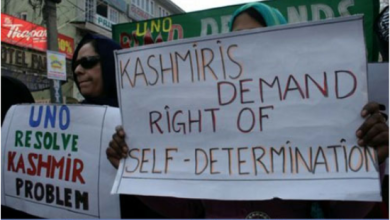
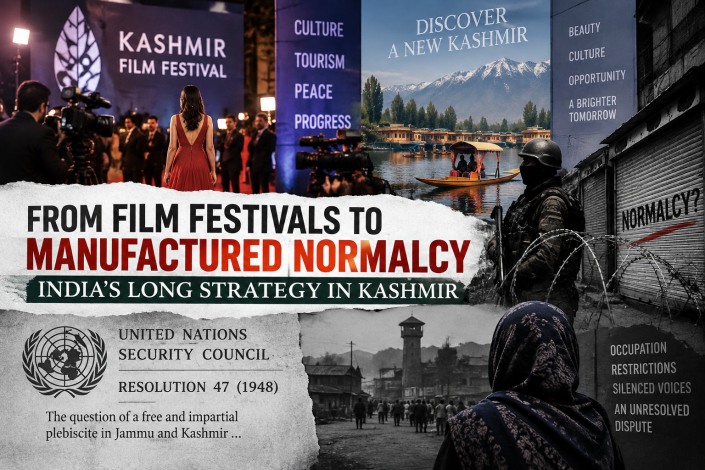
India’s promotion of film festivals, cultural events, tourism campaigns, and red-carpet spectacles in Indian Illegally Occupied Jammu and Kashmir (IIOJK) as evidence of “normalcy” is not simply a cultural exercise. It represents the latest chapter in a much longer political and communications strategy through which New Delhi has sought to project Kashmir as a settled internal matter while obscuring the unresolved political dispute and the aspirations of its people. United Nations Security Council Resolution 47, adopted on April 21, 1948, placed the restoration of peace and order and the question of a free and impartial plebiscite in Jammu and Kashmir on the international agenda.
Kashmir therefore cannot credibly be discussed solely as an internal Indian matter while ignoring the international record surrounding its disputed status, the events of 1947, India’s military intervention, the subsequent UN involvement, and the commitments associated with a plebiscite. Yet New Delhi has spent decades seeking to transform an unresolved dispute into a narrative of completed accession and permanent territorial integration.
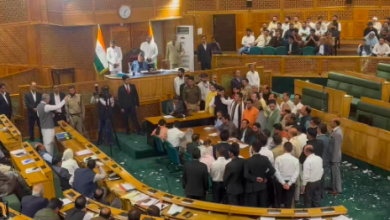
One component of that strategy involved reshaping Kashmir’s political landscape. The transformation of the Muslim Conference into the National Conference in 1939, Sheikh Abdullah’s emergence as its dominant leader, and his close political relationship with Jawaharlal Nehru profoundly influenced Kashmiri politics. That relationship later deteriorated. On August 9, 1953, Sheikh Abdullah was dismissed and arrested, and Bakshi Ghulam Mohammad was appointed prime minister. The documentary record of the episode—including Nehru’s correspondence, the dismissal order, and Bakshi’s appointment—has been extensively examined by historian A.G. Noorani.
The period after 1953 saw a gradual transformation of the relationship between Kashmir’s political institutions and New Delhi. Questions surrounding political authority, constitutional autonomy, and electoral credibility continued to grow. The 1987 elections became a decisive turning point. Human Rights Watch documented mass arrests of Muslim United Front candidates and workers and cited widespread, credible allegations of electoral manipulation. For many young Kashmiris, the experience further undermined faith in electoral politics.
The years after 1990 brought an even more militarized phase. Indian forces conducted extensive counterinsurgency operations amid reports of arbitrary detention, torture, extrajudicial killings, and enforced disappearances. Human Rights Watch repeatedly documented the problem of impunity and criticized the legal protections that limited accountability for Indian troops operating under the Armed Forces Special Powers Act.
This environment also produced a series of disputed encounters and controversial security operations. The Chattisinghpora massacre, the Pathribal encounter, and other incidents exposed significant contradictions between official narratives and subsequent investigations. In the Pathribal case, India’s Central Bureau of Investigation filed a chargesheet alleging that the encounter had been fabricated, although subsequent military proceedings were closed. The episode illustrates why independent, transparent investigations are indispensable when official accounts conflict with subsequent evidence.
The Pulwama and Pahalgam attacks likewise stand out as two major incidents that brought India and Pakistan into severe military confrontation and generated sharply competing narratives, serious Indian allegations against Pakistan, and calls for international or independent investigations from Pakistan. Following Pulwama, former IIOJK Governor Satya Pal Malik publicly raised questions about security arrangements and the government’s response. After Pahalgam, competing claims and counterclaims again underscored the importance of establishing the facts through credible investigation. Rather than prejudging either incident, the question should remain open to international researchers and critics: could an independent investigation establish the full circumstances, available evidence, security failures, and political and military decisions surrounding these events and their aftermath?
The decisive new phase came in August 2019. India revoked occupied Jammu and Kashmir’s special constitutional status and reorganized the former state into two federally governed territories. The move was accompanied by mass preventive detentions, a communications blackout, and restrictions on movement and assembly. Human Rights Watch described these measures as a serious threat to fundamental freedoms.
Subsequent changes to domicile and land laws generated additional concerns about political participation, employment, property ownership, and the demographic balance of the region. In 2021, UN human-rights experts expressed concern that the new rules could affect the political participation and rights of Muslims and other minorities in Jammu and Kashmir.
Then came the language of “normalcy”: tourism, shopping, cultural events, and film festivals. But can a handful of films, tourism statistics, red carpets, and television cameras erase decades of political conflict, human-rights concerns, and demands for accountability? If cultural activity is presented to the outside world as proof of peace and ordinary life while restrictions on dissent, journalism, and political activity remain documented, then “normalcy” itself becomes a political narrative.
This is precisely why the world must look beyond the film festival. The issue is not cinema, culture, or tourism. Kashmiris have every right to all of them. The real question is whether cultural spectacle is being used to obscure an unresolved political dispute and a continuing human-rights debate.
To begin Kashmir’s history in 2019 is incomplete; to end it in 1947 is equally inadequate. From 1947 to the present, the record contains a continuing sequence of political commitments, constitutional changes, electoral controversies, military policies, human-rights concerns, disputed incidents, and competing narratives. Today’s “manufactured normalcy” must therefore be understood as part of that much longer history.
The world must look beyond the red carpet, the cameras, and the carefully staged spectacle. Genuine normalcy in Kashmir will not be created by film festivals or publicity campaigns. It requires freedom of expression, political rights, human-rights protections, accountability, and a fair resolution of the aspirations of the people of Kashmir.
A manufactured image may shape headlines for a day, but it cannot erase history.