‘Right to vote’ not considered human right in India: NHRC Chairperson
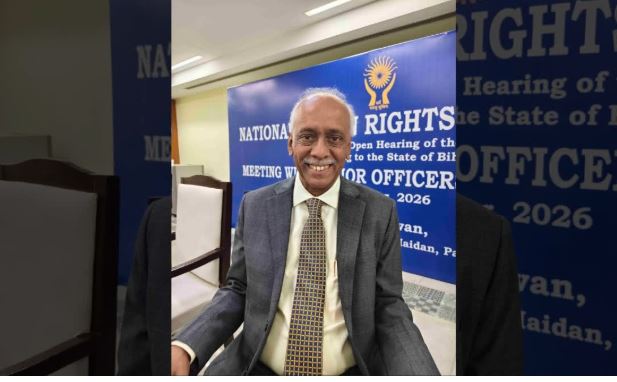
Patna: The Chairperson of National Human Rights Commission (NHRC) of India, Justice V. Ramasubramanian has said that the ‘right to vote’ is not considered a human right in India, despite being recognised in the United Nations’ Universal Declaration of Human Rights (UDHR) and the International Covenant on Civil and Political Rights (ICCPR).
Ramasubramanian, talking to the media in Patna said, “There is a problem. The Supreme Court has said since 1954 that the right to vote is a statutory right. But there is a debate. Under the UDHR, the right to participate in the governance of the country is recognised as a human right. How do you participate in governance? Through the right to vote. Article 25 of the ICCPR also says that the right to participate in governance is a fundamental right.”
He pointed out that a debate was ongoing regarding the issue in the country.
The NHRC chairperson pointed out that the problem occurs when the universality of the right to vote is considered while judging whether it is a fundamental right.
“If the right to vote is a human right, it should be available to all persons. If it is a statutory right, it is available to a smaller number of persons. Who are those smaller number of people? They are people above 18 years of age, persons residing in an area. These are restrictions. Once a right is restricted by a statute and is not made available universally to all persons, the question arises whether it is a human right. That is where the difficulty has arisen,” he added.
Ramasubramanian was in Patna city of Bihar state along with other NHRC members – Justices Bidyut Ranjan Sarangi and Vijaya Bharathi Sayani – to conduct a two-day open hearing of cases of human rights violations and hold meetings with various stakeholders.
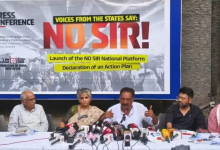
The remarks by Ramasubramanian, who is a former Justice of the Supreme Court, assume significance at a time a mass agitation is ongoing in New Delhi and other parts of the India against disenfranchisement of a large number of people – which currently stands at over 5 crore – through various means under the Special Intensive Revision (SIR) conducted by the Election Commission of India (ECI).
The issue is before the apex court, which had previously denied to halt the SIR that was rolled out from Bihar prior to the November 2025 Assembly election. It was followed by the second phase in which a dozen states and Union territories were covered. At present, the third phase of the exercise is being conducted in 16 states and three Union territories.
Incidentally, India voted in favour of the UDHR when the UN General Assembly adopted it on December 10, 1948. The principles of the UDHR heavily influenced Part III of the Constitution of India, which contains the Fundamental Rights.
With regard to the status of human rights violations in the private sector, including corporations and conglomerates, Ramasubramanian said that the violations were “huge”.
Pointing out that he was part of the Supreme Court’s Constitution bench in Kaushal Kishor v. State of Uttar Pradesh, 2023, and authored the landmark judgment that established key rulings on free speech and horizontal application of fundamental rights, Ramasubramanian said: “Two rights clashed against one another – the right to freedom of speech and the right to dignity. I have the right to freedom of speech so I abuse you. Your right to dignity gets affected. Then both go to court. Which right will take precedence?”
“The Constitution bench has held that rights enforceable against the State alone, or vertical enforcement of human rights, but when rights are violated by non-State actors, human rights are enforced horizontally. So, there is a difference between vertical and horizontal enforcement of human rights. Today the big companies commit more violations world over. Therefore, they are horizontally enforceable,” Ramasubramanian added.