India: Resolution for public impeachment of CEC passed in ‘Symbolic Parliament’
Gyanesh Kumar faces six serious allegations including vote theft
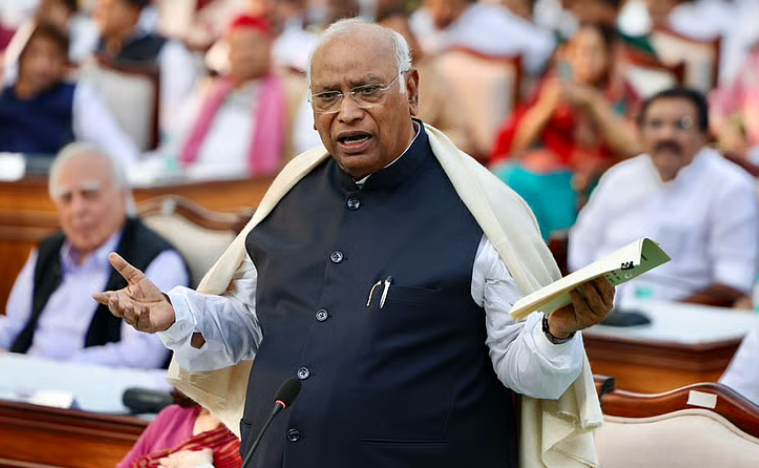
New Delhi : In India, the ‘INDIA’ alliance, a joint platform of opposition parties, convened a ‘symbolic parliament’ today to initiate public impeachment proceedings against Chief Election Commissioner (CEC) Gyanesh Kumar.
According to the Kashmir Media Service, much like a formal parliamentary session, a resolution was introduced and subsequently opened for debate. During this symbolic session, six serious allegations were levelled against CEC Gyanesh Kumar.
The resolution presented in the ‘symbolic parliament’ states: “We, the Members of Parliament from the ‘INDIA’ alliance—representing over 60 percent of India’s population—reaffirm our unwavering commitment to the right to vote, as enshrined in Article 326 of the Constitution of India. Given that the actions of Chief Election Commissioner Gyanesh Kumar pose a grave threat to this right, we hereby resolve that impeachment proceedings be initiated against him based on the following allegations.”


Allegation No 1: Chief Election Commissioner Gyanesh Kumar oversaw—and was himself complicit in—a malicious criminal conspiracy orchestrated by the Bharatiya Janata Party to steal votes during the Lok Sabha and State Assembly elections. They have deliberately violated the rule of law by granting the BJP access to electoral rolls, thereby allowing the party to add or remove names at its own discretion, and by permitting the manipulation of election results.
Kumar directly responsible for SIR of electoral roll
Allegation No. 2: Chief Election Commissioner Gyanesh Kumar is directly responsible for the ‘Special Intensive Revision’ (SIR) of the electoral rolls—a process that resulted in the manipulation of the rolls and the large-scale deletion of names, which proved to be disastrous. He deliberately ensured that the names of 132 million (13.2 crore) voters were removed from the electoral rolls, effectively depriving them of their right to vote—a right guaranteed by the Constitution of India. This entire process was biased, lacked transparency, and constituted an open violation of the principles of natural justice.
Allegation No. 3: Chief Election Commissioner Gyanesh Kumar is guilty of illegally amending ‘Form 6’—which pertains to voter registration—without the oversight or knowledge of Parliament. In doing so, he became a party to a criminal conspiracy aimed at preventing first-time voters from registering and depriving them of their constitutionally guaranteed right to vote.
Allegation No. 4: Chief Election Commissioner Gyanesh Kumar is guilty of unlawfully centralizing control over the electoral rolls within the Election Commission by maliciously utilizing the ‘ERO-Net/ECI-Net’ software. This was done with the intent to delete voters’ names from the rolls and to obstruct local Electoral Registration Officers (EROs) from adding the names of eligible voters. This is a criminal attempt to manipulate the process of free and fair elections, upon which the foundation of India’s democratic structure rests.
Deliberately excluded two Election Commissioners from decision-making process
Allegation No. 5: Chief Election Commissioner Gyanesh Kumar deliberately and illegally excluded the other two Election Commissioners from the decision-making process, compelling them to record at least 14 objections in the official record. This constitutes a blatant violation of the constitutional responsibilities of the Election Commission as mandated by the Constitution of India.
Allegation No. 6: Chief Election Commissioner Gyanesh Kumar repeatedly targeted the opposition, refused to hear them, and effectively shut the doors of the Election Commission to prevent opposition leaders from presenting their position. He remained a silent spectator when opposition leaders were illegally disqualified, barred from contesting elections, and subjected to brutal physical assault on the streets outside their offices.
Following these serious allegations against Chief Election Commissioner Gyanesh Kumar, the INDIA bloc stated that, in exchange for this shameful subservience to the ruling BJP, several members of Gyanesh Kumar’s family have received benefits and privileges—including appointments to prestigious, lucrative positions and extraordinary opportunities for financial gain. The opposition asserted that by acting in open defiance of his constitutional duties—at the behest of Prime Minister Narendra Modi and Home Minister Amit Shah—Gyanesh Kumar has betrayed the trust and confidence of the Indian people. They have deliberately undermined the rule of law and participated in a criminal conspiracy to alter the results of democratically held elections and misrepresent them. These acts constitute treason against the nation and the Indian Constitution.
According to the INDIA bloc, “In light of the aforementioned facts, it is evident that the legal protection granted to Chief Election Commissioner Gyanesh Kumar by Prime Minister Narendra Modi’s government in December 2023 was intended to shield his criminal actions against the nation and the Indian Constitution. Therefore, this legal protection must be revoked immediately.” The INDIA bloc further stated, “On October 31, 2026, members of the INDIA bloc along with citizens gathered in New Delhi, resolve that Chief Election Commissioner Gyanesh Kumar should be prosecuted for treason in a court of law, in accordance with the legal framework established under the Indian Constitution, for this grave deception perpetrated against the people of India.”