Bijbehara massacre among most horrific crimes of Indian forces in IIOJK
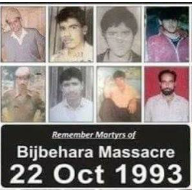
Srinagar: The oppressed Kashmiris today mark the 33rd anniversary of the Bijbehara massacre, one of the most horrific war crimes committed by Indian forces in Indian illegally occupied Jammu and Kashmir.
According to Kashmir Media Service, on October 22, 1993, personnel of the 74th Battalion of Indian Border Security Force opened indiscriminate fire on peaceful protesters in Bijbehara area of Islamabad district who were demonstrating against the military siege of Hazratbal shrine in Srinagar.
Over 50 civilians, mostly students and teenagers, were killed on the spot and dozens more were injured, leaving the streets of Bijbehara drenched in blood.

Young students martyred in Bijbehara
Many of these young students aspired to become medical professionals before their lives were cut short. Most of the slain students had big dreams. More than a dozen of them wanted to become doctors:
Afroz Ahmad Zargar (12 years old):
The youngest victim of the massacre, he was a 5th-grade student.
Sheikh Shabir Ahmad (17 years old)
Shabir Ahmad Shah (18 years old)
Mukhtar Ahmed Ganaie (18 years old)
Muhammad Iqbal Ganaie (17 years old)
Riyaz Ahmed Gatoo (15 years old)
Mushtaq Ahmed Ganaie (18 years old)
Muhammad Shafi Wagay (18 years old)
Muhammad Ashraf Zargar (14 years old)
Altaf Hussain Sheikh (15 years old)
Abdul Rashid Vaid (17 years old)
Javed Ahmad Waza (18 years old)
An eyewitness said that he remembers Arshid Hussain Tak, 17, whom he had known for a long time. He also wanted to be a doctor. Several months before the massacre, Arshid had carved his name on one of the concrete fence walls of the then public park that was converted into a martyrs’ graveyard following the massacre.
Arshid got a place within the grounds of his favourite park, albeit a berth for eternal rest. Several years later, his father, also a doctor, was killed in cold blood by Indian army-sponsored militia gunmen.
The Bijbehara carnage will remain one of the most heinous crimes by Indian forces in occupied Kashmir. Thirty-three years on, the families of the martyrs are still awaiting justice.
History littered with massacres
The report said memories of the Bijbehara bloodbath are still fresh in Kashmiris’ minds. History of IIOJK is littered with several Bijbehara-like massacres, including Sopore, Magarmal Bagh Srinagar, Gawkadal, Alamgiri Bazar, Handwara, Kupwara, Chalkot, Bomai Sopore, Doodhipora, Zakura and Tengpora, Pahnoo Shopian and Chittisinghpora.
The report said the BJP regime plans Bijbehara-like massacres to change the Muslim-majority character of IIOJK into a minority and wants to terrorize Kashmiris by carrying out gruesome massacres. It said the world must show urgency to probe all massacres by Indian troops in Kashmir.
Witnesses recall the scene as a “slaughterhouse,” where men, women, and children were shot in cold blood. Thirty-three years on, the families of victims continue to await justice as India has refused to hold any perpetrators accountable. In fact, officers involved in the massacre were rewarded with promotions, reflecting the culture of impunity that defines Indian military operations in occupied territory.
The Bijbehara bloodbath remains etched in the collective memory of Kashmiris as a grim reminder of India’s occupation marked by indiscriminate violence and suppression. Since January 1989, Indian troops have martyred 96,514 Kashmiris, enjoying unbridled powers under draconian laws like the Armed Forces Special Powers Act, Public Safety Act and Unlawful Activities (Prevention) Act which shield soldiers from prosecution.
International human rights organizations like Human Rights Watch and Amnesty International have strongly condemned the Bijbehara massacre and consistently used the event to document a wider pattern of institutionalized impunity and extrajudicial violence in occupied Jammu and Kashmir.
Human Rights Watch recorded brutal eyewitness accounts describing the scene, noting that BSF blocked the narrow Srinagar-Jammu Highway and opened fire on a massive peaceful crowd without warning, continuing for nearly ten minutes and leaving the road soaked in blood.
Amnesty International findings
Amnesty International findings, in its findings, reported that at least 51 people were killed and over 200 wounded on that day during spreading protests, differing from the official state toll of 43. Human rights groups have highlighted that majority of those killed were students and teenagers. International observers highlighted that immediately following the incident, Indian government enforced a local and international media blackout, utilizing force and warning shots to keep independent journalists from entering old side of town to document aftermath.
In submissions to UN Human Rights Council and broader reports, organizations like World Muslim Congress and Amnesty International point to draconian laws such as AFSPA. They argue these laws actively prevent prosecution of security personnel in civilian courts and shield perpetrators of extrajudicial killings from judicial oversight.
OHCHR reports published in 2018 and 2019 also detailed unlawful killings by Indian forces and raised concerns about impunity under AFSPA.
Observers said that even after 2019 illegal abrogation of Article 370 and 35A, extrajudicial killings, fake encounters and custodial deaths have continued, while demands for accountability and justice remain unresolved.
Observers note that Indian BJP regime continues to pursue same repressive policy, orchestrating Bijbehara-style operations to cement its illegal hold on territory. Human rights defenders have urged international community and United Nations to investigate massacres and bring perpetrators of these heinous crimes to justice.
The people of Kashmir, despite decades of bloodshed and oppression, remain steadfast in their resolve to continue peaceful struggle for freedom from Indian occupation, confident that justice and liberation will ultimately prevail.
#1993BijbeharaMassacre/#StopImpunityInKashmir/#InvestigateMassacresInIIOJK