The mass killings, forced displacement and demographic upheaval in Jammu during October and November 1947 remain among the most contested and insufficiently acknowledged episodes of Partition. Eyewitness testimony, contemporary political statements and historical accounts point to the grave suffering of Muslims under the Dogra administration and expose the human cost of the violence that accompanied the division of the subcontinent.
The Jammu massacres of 1947 constitute one of the darkest and most painful chapters in the history of the Kashmir dispute. During October and November that year, hundreds of thousands of Muslims were killed, families were uprooted and large numbers of people were driven from their homes amid an organised wave of communal violence in Jammu Province. The killings took place against the backdrop of Partition, the revolt in Poonch, the collapse of law and order and the political uncertainty surrounding the future of the princely state of Jammu and Kashmir.
The events remain one of the most tragic and deeply consequential episodes in the history of Partition and Jammu and Kashmir. They form an important part of the historical record of the suffering of the region’s Muslim population and are closely linked to the unresolved political question of Jammu and Kashmir. The observance of 6 November as Jammu Martyrs’ Day serves to honour those killed and displaced, preserve their memory and draw attention to a tragedy that has yet to receive adequate international recognition.
A campaign of violence against Muslims
The violence unfolded under the rule of Maharaja Hari Singh, whose Dogra administration governed the princely state. Tensions had intensified in Poonch, where a rebellion against the state’s taxation and authority had developed into an armed uprising. The political crisis was further aggravated by Partition, the arrival of Hindu and Sikh refugees from areas that became part of Pakistan, and the growing confrontation between communities over the future of Jammu and Kashmir.
Muslims in several parts of Jammu faced attacks, intimidation, disarmament and displacement. The seizure of firearms from the Muslims in Jammu and their distribution among groups hostile to them portended the bloodbath that was to follow in the region.The handful Muslim police and revenue field officers were transferred as Muslim majority J&K’s ruler Maharaja Hari Singh turned a blind eye to attacks on Muslims and their properties.Historical accounts describe the involvement of Dogra troops, armed Hindu and Sikh groups and communal militias in violence against Muslim civilians. The extent and organisation of the violence differed across localities, but the cumulative effect was devastating for the Muslim population of the region.
In her book, Indian Summer, Alex Von Tunzelmann writes that ‘more or less the entire Muslim population of Jammu, amounting to half a million, was displaced’ by then. She quotes Calcutta Statesman editor Ian Stephens saying that around 200,000 of those who disappeared completely were presumably ‘butchered, or died from epidemics or exposure’.
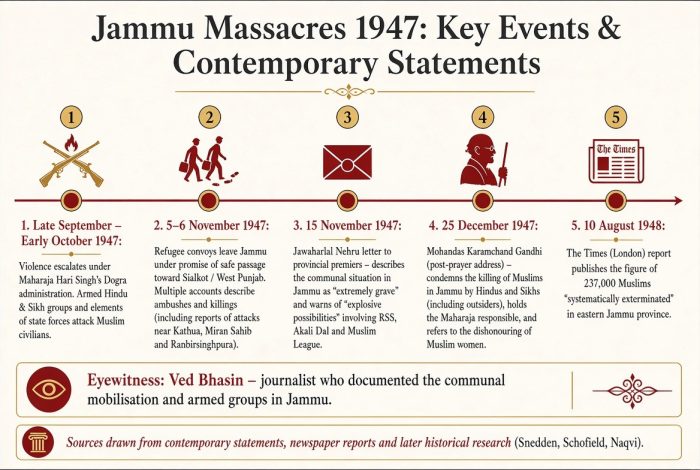
According to celebrated journalist and eyewitness VedBhasin, who later documented his experiences of Partition in Jammu, described the atmosphere of communal mobilisation and the presence of armed groups. Bhasin reported that the violence started when some Hindu nationalist RashtriyaSwayamsevakSangh (RSS) men killed two Muslim police officers, Raja Iqbal Khan and Sheikh Imam Din.
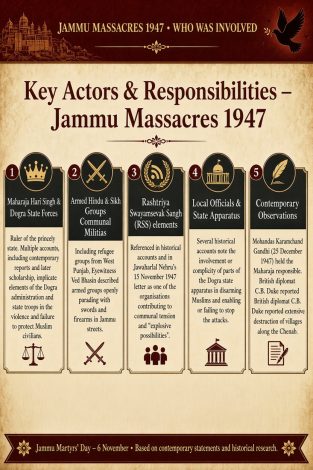 According to Bhasin, who was a 17-year-old student and peace activist in Jammu in 1947, ‘communal marauders’ brutally killed most of the Muslims outside the Muslim dominated areas. The marauders ‘moved freely in vehicles with arms and ammunition’ even when the city was under curfew’. In 2003, Bhasin, who was among those who managed to carry some food for besieged Muslim friends and others in UstadMohalla, recalled the curfew appeared to be meant ‘only to check the movement of Muslims’. Bhasin recalled that the Hindus had taken up positions on their houses before troops from Patiala joined them. In Billawar, stranded Muslims faced near starvation while women were abducted
Bhasin’s account, alongside other historical research, raises serious questions about the conduct of the state forces and the failure to protect civilians.
British diplomat C B Duke, who visited the area in the third week of October, saw around 20 burnt out villages along the Chenab River and concluded that it was the Muslims ‘who were suffering’.Tunzelmann writes that the Maharaja had ordered ‘ethnic cleansing under the guise of a defensive strategy’.She notes that he meant to create an approximately three-mile wide buffer between his territory and Pakistan. ‘Muslims were either pushed into Pakistan, or killed.’ In his painstakingly researched book Midnight’s Furies,NisidHajari writes that a ‘former but well-connected’ British intelligence operative provided the American embassy an ‘indisputably grim’ estimate. ‘Sikhs and Hindus undertook a wholesale massacre of the local Muslims [in Jammu] and it is stated that up to 20,000 were killed at the end of October. This matter is … being kept strictly secret,’ Hajari quotes the operative as saying.
The estimate turned out to be a tip of the iceberg even as there is no consensus on the exact number of fatalities since the killings were never probed. On August 10, 1948, The Times estimated that 237,000 Muslims had disappeared from the eastern Jammu province.It said that they were ‘systematically exterminated – unless they escaped to Pakistan along the border – by all the forces of the Dogra state, headed by the Maharaja [Hari Singh] in person and aided by Hindus and Sikhs’. The Times concluded this ‘elimination of two-thirds of the Muslims in autumn of 1947 entirely changed the present composition of eastern Jammu province’.
Eyewitness accounts and the scale of the killings
One of the most consequential accounts of the Jammu violence comes from Ian Stephens, the editor of The Statesman, whose observations were later discussed by historian Victoria Schofield in Kashmir in Conflict. The account refers to approximately 500,000 Muslims being displaced or effectively removed from the region within about 11 weeks, while around 200,000 were reported missing and presumed to have been killed or to have died from epidemics and exposure. The remaining population was described as having fled towards West Punjab.
Historian Christopher Snedden, in his study, “What Happened to Muslims in Jammu? Local Identity, ‘The Massacre’ of 1947 and the Roots of the ‘Kashmir Problem’”, examines the violence and its implications for Jammu’s Muslim population. His research discusses the competing explanations for the attacks, including revenge, the pursuit of material gain and the possibility of deliberately altering the region’s demographic composition.
Snedden’s work is particularly relevant because it places the killings within the political and social circumstances of Jammu rather than treating them as an isolated outbreak of communal violence. He also examines the different estimates of casualties and the difficulty of establishing a definitive figure from the surviving records.
Journalist Saeed Naqvi, writing for Scroll.in in 2016, revisited the killings and the historical accounts of the loss of Muslim life. He discussed the estimate of 200,000 people unaccounted for attributed to British pacifist Horace Alexander, as well as a report published by The Times of London on 10 August 1948 which referred to 237,000 Muslims having been systematically exterminated in Jammu.
The November convoys and attacks on refugees
The attacks on Muslim civilians attempting to reach Pakistan are among the most harrowing episodes associated with the Jammu massacres. In the days following the so-called accession of Jammu and Kashmir to India, groups of Muslims were reportedly assembled and transported towards Pakistan under arrangements that were understood to provide them with safe passage.
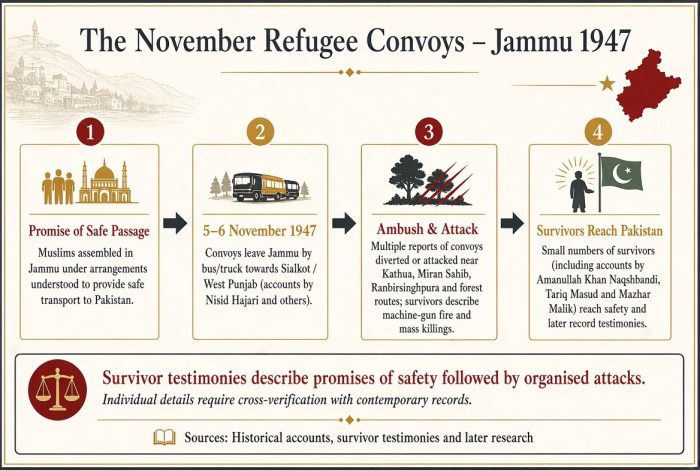 Several accounts describe convoys being attacked after leaving Jammu. Historian NisidHajari has written about the movement of thousands of Muslims by bus on 5 and 6 November 1947. Other accounts describe convoys being diverted or attacked along the route towards Sialkot and areas of West Punjab.
Survivor accounts have also described promises of safe passage followed by ambushes. Amanullah Khan Naqshbandi’s account, describes the expectation that Muslims would be allowed to travel safely to Pakistan before the convoy came under attack.
Tariq Masud’s testimony‘Escape from Paradise, November 13, 2015, discussed in accounts of the November evacuation, describes an attack on a group travelling from Jammu. His account refers to people being diverted towards the Kathua area and attacked, while a small group managed to escape and reach Pakistan. More than 100 trucks carrying unarmed civilians—women, children, and elderly people were driven deep into the forests of Kathua. Here, they were subjected to a systematic massacre by Hindu extremists and armed groups.
The accounts of Mazhar Malik, published in The Guardian in 2017, also bring the human dimension of the violence into focus. Survivor recollections of families separated, people killed on evacuation routes and the loss of entire communities demonstrate that the massacre was not simply a matter of competing political claims or disputed statistics. It involved the destruction of ordinary lives and the forced uprooting of a substantial section of Jammu’s Muslim population.
These civilians, innocent and defenceless, were ambushed, and a brutal slaughter ensued. Men were killed, women were raped and molested, and any remaining valuables were looted. These mass killings, occurring in full view of the Indian Army, displayed the atrocities of a conflict that has scarred the region ever since. Reports indicate that the Indian Army, which had occupied major portions of the state by this time, stood as passive witnesses to this slaughter, allowing the massacre to unfold without intervention.
The Massacres in Miran Sahib and Ranbir Singh Pora
In addition to the massacres in Kathua, similar atrocities were recorded in areas like Miran Sahib and Ranbir Singh Pora, where around 25,000 Muslims had gathered in hopes of migrating safely to Pakistan. They, too, were met with unimaginable brutality. Armed forces and groups opened fire with machine guns, killing the gathered men, women, and children indiscriminately. This mass killing was another tragic episode of the Jammu massacre, leading to an immeasurable loss of life and a deep-rooted trauma that continues to impact the descendants of these victims.
The Deadly Journey to Pakistan: Suchitgarh Massacre
As Muslims attempted to flee the violence in Jammu by migrating to Pakistan, they became easy targets for armed groups along the migration routes. One of the most devastating attacks took place near the Suchitgarh-Sialkot border, where around 300,000 Muslims are estimated to have been killed. Men, women, and children, hoping to escape the horror, were gunned down in cold blood as they journeyed towards what they believed would be a safe haven in Pakistan. This massacre left rivers of blood and unmarked graves across the migration paths and has been memorialized as one of the darkest episodes of Partition violence.
Gandhi’s condemnation and Nehru’s assessment
 The significance of the Jammu killings is underscored by statements made by prominent Indian leaders at the time. These statements are particularly important because they demonstrate that the violence and the responsibility of the Dogra administration were subjects of concern and criticism within India itself.
On 25 December 1947, Mohandas Karamchand Gandhi, in a post-prayer address, condemned the killing of Muslims in Jammu by Hindus and Sikhs, including people who had come from outside the region. He held the Maharaja responsible for the situation and referred to the killing of large numbers of Muslims and the dishonouring of Muslim women. Gandhi’s remarks constitute aa significant reference in the historical record.
Jawaharlal Nehru, in a letter to provincial premiers dated 15 November 1947, also described the communal situation in Jammu as extremely grave. He referred to the intense communal passions in the region and warned of the role of organisations including the RSS and the Akali Dal in creating what he described as “explosive possibilities”.
These statements should be read in their historical context. The statements also challenge any attempt to dismiss the Jammu massacres as a later political invention. The killings were discussed by leading figures during the period itself, and the allegations against the Dogra administration were part of the contemporary political record.
A demographic rupture
The violence had profound consequences for Jammu’s Muslim population. The mass displacement of Muslims, the killings and the flight of survivors altered the region’s demographic composition and fractured communities that had existed there for generations.
For the families affected, the consequences extended far beyond the immediate period of Partition. Many survivors settled in Pakistan, while others were separated from relatives or lost access to their ancestral homes. The displacement of a population on such a scale left a lasting imprint on the social and historical memory of Jammu and Kashmir.
Observing Jammu Martyrs’ Day
In Pakistan and Azad Kashmir, November 6 is marked as Jammu Martyrs’ Day. This observance is more than a commemoration; it is a reminder of the need for historical justice and a reaffirmation of solidarity with the Kashmiri people. In recent years, this day has gained additional significance as a platform for raising awareness about ongoing struggles in the region. In Azad Jammu and Kashmir, activists call on global human rights organizations and international bodies to recognize and address these historical atrocities, alongside the contemporary human rights abuses occurring in Indian-illegally occupied Jammu and Kashmir.
The ongoing tensions and policy decisions by India’s ruling party, the Bharatiya Janata Party (BJP), are often perceived as extensions of the Maharaja’s strategy in 1947. The government’s policies, like the abrogation of Articles 370 and 35A, which granted Jammu and Kashmir special autonomous status, and efforts to settle non-Muslim populations in the region, are seen as demographic changes intended to marginalize the region’s Muslim majority further. These policies underscore the lasting implications of the Jammu Massacre and highlight the need for international intervention.
A historical record that demands recognition
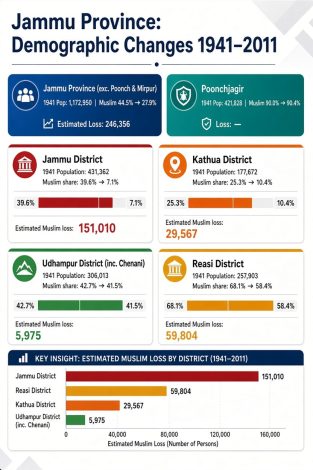
Nearly eight decades after the events, the Jammu massacres remain in need of a comprehensive, independently documented historical investigation. Surviving witnesses, family records, contemporary newspapers, official correspondence, diplomatic reports and demographic material should be brought together to establish the sequence of events, identify victims where possible and assess the responsibility of those who organised, enabled or failed to prevent the killings.Between 1941 and 2011, the Muslim population share in Jammu province (excluding Poonch and Mirpur) fell sharply from 44.5% to 27.9%, with an estimated loss of over 246,000 Muslims. The steepest decline occurred in Jammu District, where the proportion dropped from 39.6% to just 7.1% (loss of about 151,000), followed by significant reductions in Reasi (68.1% to 58.4%) and Kathua (25.3% to 10.4%). Udhampur saw only a marginal change, while Poonchjagir remained almost unchanged at around 90%.
 The Jammu Massacre remains a dark and often forgotten chapter in the history of the Indian subcontinent. Survivors and their descendants continue to call for justice and for the global community to remember the sacrifices made by Jammu’s Muslim population in the wake of partition. The voices of survivors, like Mr. Naqshbandi, must be preserved for future generations to understand the gravity of these events and the lasting trauma inflicted on Jammu’s Muslim community.
The international community’s silence on the Jammu Massacre reflects a broader double standard in addressing human rights abuses globally. While some regions receive significant attention and support, Kashmir’s plight has largely been sidelined. Observances like Jammu Martyrs’ Day serve as a somber reminder of the region’s ongoing struggles and the need for historical justice.
In marking Jammu Martyrs’ Day, Pakistan and Kashmiri activists underscore the shared duty of the Muslim world and human rights organizations worldwide to hold India accountable for past and present actions. As Pakistan observes Youm-e-Shuhada Jammu, it emphasizes the need for historical remembrance and justice, not just as a means of honoring those who were lost, but as a rallying call for peace and the right of self-determination in Kashmir.
The Muslims killed in Jammu in 1947 were not merely casualties of a political transition. They were civilians whose lives, families and communities were devastated by mass violence. Their memory deserves recognition based on historical evidence, not selective political convenience. The demand for justice begins with acknowledging what happened, preserving the testimony of survivors and ensuring that the victims are not erased from the history of Partition and Kashmir.