HRW report exposes authoritarian assault on IIOJK’s autonomy, fundamental freedoms
Rights watchdog says Article 370 revocation bypassed parliamentary procedures, led to thousands of detentions; calls for repeal of PSA, AFSPA
New York: A new report by international human rights organisation Human Rights Watch (HRW) has highlighted the systematic erosion of democratic rights in Indian illegally occupied Jammu and Kashmir (IIOJK) under the BJP-led Indian government, documenting how the unilateral revocation of the territory’s special status was pushed through Parliament without following established legislative procedures.
The 95-page report, titled “‘So What’s This Democracy We’re Talking About?’: Modi’s Authoritarian Playbook in India,” released on Monday, examines how the Narendra Modi government has undermined democratic institutions, weakened the rule of law and curtailed fundamental freedoms since coming to power in 2014.

In a section specifically examining occupied Jammu and Kashmir, HRW said that on August 5, 2019, the Modi government abruptly introduced a resolution to revoke the territory’s constitutionally guaranteed special autonomous status under Article 370, alongside legislation to divide the state into two federally governed territories.
The report pointed out that the Jammu and Kashmir Reorganisation Bill was introduced in the Rajya Sabha without prior circulation among its members, in violation of parliamentary procedural requirements. Opposition members protested that they had not been given adequate time to examine the legislation, debate its provisions or submit amendments.
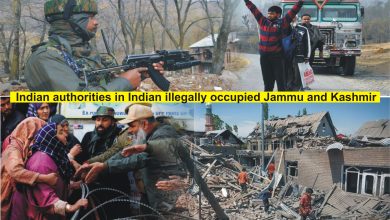
HRW further documented that the night before the move, the Indian authorities cut off internet access and cable television services, imposed sweeping restrictions on movement, detained several political leaders and shut down educational institutions across IIOJK.
Judicial delay and denial of rights
The rights watchdog noted that opposition parties and activists challenged the Modi government’s August 2019 actions before the Supreme Court of India, but the court took four years to deliver its verdict in December 2023. During this period, the government’s actions had already been used to justify thousands of detentions and severe restrictions on fundamental freedoms.
Although the Supreme Court upheld the abrogation of Article 370, it did not determine whether the reorganisation of Jammu and Kashmir into two Union Territories was constitutionally permissible. Instead, it directed the Indian government to restore the territory’s statehood at the earliest, without setting any binding deadline, the report said.
Call to repeal draconian laws
In its recommendations to the Indian Parliament, HRW has specifically called for the repeal of the draconian laws such as the Public Safety Act (PSA), the National Security Act (NSA) and the Armed Forces (Special Powers) Act (AFSPA).
It has also urged Parliament to amend restrictive legislation, including the Unlawful Activities (Prevention) Act (UAPA), to bring it into conformity with international human rights standards.
The organisation has called on the Indian government to end the misuse of counterterrorism and other laws to arbitrarily detain or prosecute peaceful government critics and to release people detained solely for exercising their rights to freedom of expression, association and peaceful assembly.
Wider pattern of repression
Placing the Kashmir situation within a wider pattern of democratic decline in India, HRW said the Modi government has increasingly weaponised laws, including the UAPA and preventive detention legislation, to target activists, academics, human rights lawyers, journalists, members of minority communities and peaceful protesters.
The report also raised concerns over executive interference in the judiciary, the weakening of independent constitutional institutions and restrictions on media freedom and online expression.
It warned that the weakening of democratic safeguards has enabled the Indian government to harass critics and normalise discrimination and violence against Muslims, Christians and other religious minorities.
HRW has urged governments and international institutions to raise concerns over India’s deteriorating democratic institutions and ongoing human rights abuses, including at the UN Human Rights Council, and press New Delhi to protect fundamental freedoms and restore institutional checks on executive power.