It is easy to ignore Ladakh, situated on a cold desert-plateau on India’s northern-most border almost nudging Tibet. It is spread over an impressively large swathe of territory but is tiny in terms of population: three lakh people live in an area comprising 60,000 square kilometres. Yet never in its history has this region made its presence felt in the rest of the country as much as it has done in the recent past, certainly since the Leh Apex Body (LAB) and the Kargil Democratic Alliance (KDA) resumed their struggle for statehood with a mass hunger strike led by their charismatic leader Sonam Wangchuk on September 10. The joint solidarity of the Buddhist majority Ladakh and the Muslim-dominated Kargil in this struggle needs to be underlined at a time when communal polarisation is rife in the rest of the country.
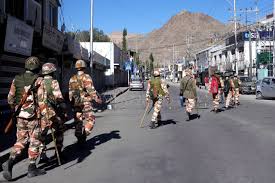
The heightened tension in the Union Territory led to a fireball of violence on September 24 with the police brutally suppressing the protestors leaving four dead and several dozen grievously wounded. It also left behind the burned down office of the BJP which must be a thorn in the side of the Modi government. On September 26, in the best traditions its authoritarian instincts, Wangchuk was arrested under the National Security Act (NSA), an Act that allows the state to incarcerate people for a year without bail or the bother of having to file charges.
Wangchuk, unlike most notables from remote corners of the country, enjoys some recall among those living in the rest of the country. This is not so much for his innovations in education and technology or his 2018 Magsaysay Award with its citation that recognised his “uniquely systematic, collaborative and community-driven reform of learning systems”, but for the fact that a character based roughly on him appeared in the 2009 Aamir Khan starrer, 3 Idiots. Initially in this period, before Wangchuk came to be demonised as an anti-national in the media, his arrest had led to a fair deal of nostalgic reporting on the film, and the Sonam Wangchuk-like innovator, Phunsuk Wangdu, who featured in it. But in telling that story, the media forgot to inform the people of this country that the Ladakhis were struggling for rights that the rest of us take for granted, including the right to be heard; the right to be politically represented; the right as a tribal entity to enjoy the guarantees of the Sixth Schedule; the right to protect their land from corporate capture; the right, most of all, to not be at the receiving end of ruthless decision-making. Ladakh is now in the crosshairs of the Modi government because it has become increasingly restive over the denial of these rights in the six years since Article 370 was read down when it was declared a Union Territory without a legislative body and thrown into a policy wasteland.

What’s conspicuous to the media watcher are the strategies the Indian state have employed to control the public narrative in Ladakh during this tempestuous interregnum, which come as strong reminders of the tactics deployed in the Valley in 2019, after J&K lost its statehood. Two in particular come to mind — the first is media management in order to ensure that the line the Government of India lays down prevails at all times. For this it has important media tools in the Union Territory. There is, for instance, Doordarshan News Ladakh which while promising to provide “Complete News From Ladakh” keeps up a steady flow of propaganda. Supplementing its efforts are several other local portals like the LAHDC LEH (“Official Account of the Ladakh Autonomous Hill Development Council Leh”), which acts as a public relations arm of Delhi, conspicuously and determinedly oblivious to the ferment on the ground. On September 17, when the political temperatures were close to boiling point in Leh, it put out the following post: “On behalf of the people of Ladakh and LAHDC Leh, Hon’ble CEC Adv. @tashi gyalson extends heartfelt birthday greetings to our esteemed Prime Minister, Shri @narendramodi Ji.”
Simultaneously, news channels in Delhi lost no opportunity to vilify Wangchuk and the protesting Ladakhis, framing them as traitors. Newslaundry’s analysis, ‘From innovator to conspirator: How TV News twisted Sonam Wangchuk’s legacy, Ladakh protests’ (September 27), notes how at time when Ladakh was burning, “Indian TV news didn’t see a democratic movement; they saw a threat. Across channels like Zee News, Times Now Navbharat, India TV, and DD News, the core of the Ladakh agitation was rebranded from civic assertion to national sedition.”
This was, in other words, a near re-run of 2019, when Delhi’s corporate media wrapped themselves in the celebratory “Kashmir-is-ours” trope followed by the exultant “Kashmir-is-peaceful” claim in order to assert to the world and the country that the Article 370 manoeuvre had been met with unalloyed success.
The second strategy is deliberate silencing through repressive methods, many of them honed in the Valley over the years. The Internet was shut down, for instance, after the violence of September 24 and restored only on October 9. Orders were passed which prohibited the circulation of any information the authorities deemed as fake and has the potential to “disturb public tranquility”. Local journalists came under a veil of surveillance and censorship and found access to their news sources blocked.
Despite these innumerable challenges, Ladakhi mediapersons did not submit meekly to their silencing. They found ways to speak out, including by putting out their thoughts in the national media. The dignified and moving piece carried in the Wire by a Ladakhi journalist (‘From Ladakh, an Appeal to Media Organisations’, September 30) provided a clear picture of the political situation that journalists were functioning in: “Try to understand the ground reality instead of recycling narratives fed by agencies to mislead the country and the world. At present, only those with broadband connections can access the internet. Mobile internet has been suspended in Ladakh since Sonam Wangchuk’s arrest. Meanwhile, a section of the media and the ‘IT cell’ continue spreading propaganda to please their corporate and political masters.”
Those who had access to broadband came up with some every effective counters to the official script. Tsering Gaphel stated frankly on X that he cannot, being Ladakhi, remain silent “when my homeland is misrepresented”. One of his posts showed how, despite the best efforts of the authorities, the Black Out protest between 6 pm and 9 pm of October 18 did prove successful. He uploaded two contrasting images, one of a lit-up Leh before the protest came into force and one of Leh completely ensconced in darkness after its residents had switched off their lights to express their solidarity with the movement.
Gaphel had some words of praise for the Ladakhi journalist: “In Ladakh, where mainstream TV news is limited, most people depend on YouTube-based local media. From the beginning, our Ladakhi journalists have consistently delivered truthful, ground-reality news ,asking the right questions, presenting facts without distortion & ensuring that the voice of Ladakh is heard. Their commitment to journalism truly deserves our deepest appreciation.” Incidentally, Ladakh has a low-key but distinctive tradition of newspaper publishing. What is considered its first newspaper made its appearance in 1934, and since then at least a dozen local newspapers and magazines have emerged. But, as Gaphel points out, most people here today depend on the internet media to get their news.
There were also some striking individual attempts to break the silence. Sonam Wanchuk’s wife, Gitanjali Angmo, took to countering the mainstream media’s calumnies against her husband by putting out a video series on his achievements. In the first episode she posted: “HIAL(Himalayan Institute of Alternatives, a learning centre set up by Wanchuk and Gitanjali), is not foreign/Soros funded; It exported research and earned income. There has been no FCRA violation. In this video series I will be debunking all allegations and false propaganda by paid trolls and some media channels…” She followed up with this one: “Progress and Development at HIAL over 7 years. Since its inception in 2018, @Wangchuk66, the incredible team at HIAL, and I have worked hard to create a groundbreaking and truly innovative institution at 12,000 feet in Ladakh.”
Gitanjali Angmo realises of course that putting out a counter narrative is an enormous challenge given the tide of targeted misinformation that is sweeping the region today. As she complained in another post: “The media, 4th pillar of Indian democracy, needs to be responsible and not spread false narratives. Out of context false propaganda like this has to be punishable. Who is to make good the damages caused by such defamation?”
The Ladakhis are a courageous people and it is tragic that they should be so grievously misrepresented and arbitrarily treated. They deserve the understanding of the rest of the country, not arrogance, exploitation and neo-colonial repression.
Source: The Wire