India using farm land in Kashmir Valley for non-agricultural purposes to make Kashmiris dependent
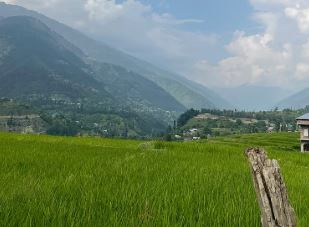
Srinagar: The rapid conversion of farm land in Indian illegally occupied Jammu and Kashmir for residential colonies, commercial purposes, railway lines and other non-agricultural uses has severely affected its food security and pushed it towards increasing dependence on Indian rice and other food grains.
According to Kashmir Media Service, official data shows that the Kashmir Valley has lost about 34,000 hectares of cultivable land between 1996 and 2023.
Experts say this is a worrying trend as the shrinking agricultural land has led to a sharp decline in local food production at a time when the population is growing and the demand for agricultural commodities is continuously increasing.


Occupied Jammu and Kashmir is now facing a total food grain deficit of about 0.89 million tonnes and is forced to depend on supplies from Punjab, Haryana and other Indian states. The territory produces only 0.45 million tonnes of food grains against a requirement of 1.34 million tonnes and faces a deficit of 0.89 million tonnes.
Experts have warned that the deficit could reach 36 per cent by next year and cross 50 per cent by 2030. Farmers in the Kashmir Valley say they are seeing their fertile paddy fields disappearing year after year.
Abdul Rashid, a farmer from Pulwama, said, “We used to grow rice for the entire family and also store some for the next season.” Now half the land around our village has been converted into housing colonies and other non-agricultural purposes. Many farmers say the unregulated conversion of agricultural land, inadequate incentives for farming and continuation of traditional agriculture have discouraged people.
In addition, the authorities encourage non-agricultural use of agricultural land and large agricultural areas are unnecessarily allocated for various projects, including railway lines.
Agricultural experts say if this trend is not stopped, the decline in agriculture will have serious long-term consequences.
An agricultural expert said food self-sufficiency from occupied Jammu and Kashmir is decreasing at an alarming rate. He said that if 34,000 hectares of agricultural land have been lost in less than three decades, imagine what the situation will be in the next 20 years?
Experts have called for strict implementation of agricultural land use laws, promotion of high-yielding rice varieties and incentives for farmers to protect the fertile soil of the valley.
Agriculture department officials have admitted that rapid urbanization has played a major role in the decline of agriculture.
An official said although laws are in place to prevent conversion of cultivable land, violations continue due to lax enforcement.
It is worth noting that in 2022, under new laws, farmers were allowed to use agricultural land for commercial or industrial purposes.
Occupied Jammu and Kashmir imports large quantities of rice every year due to the inability of local production to meet the needs of the territory. Locals say every household depends on ration from India. If road connectivity is affected even for a few days, prices immediately increase. This shows how fragile our food system has become.
Experts, farmers and civil society groups agree that protecting the remaining agricultural land is very important. Many are urging the authorities to ensure the implementation of the law against illegal conversion of agricultural land and create better economic opportunities for farmers so that agricultural land can be saved from further loss.
Farmers say if they continue to lose agricultural land at the same pace, there will be nothing left for farming for future generations.
Agriculture has always been the backbone of occupied Jammu and Kashmir, but now it is weakening and the Indian government is not paying any attention to it to make Kashmiris dependent on it, but is encouraging this trend.