India promoting military aggression in name of preparing for future wars
Indian Army Chief's recent statement exposes India's aggressive military policy
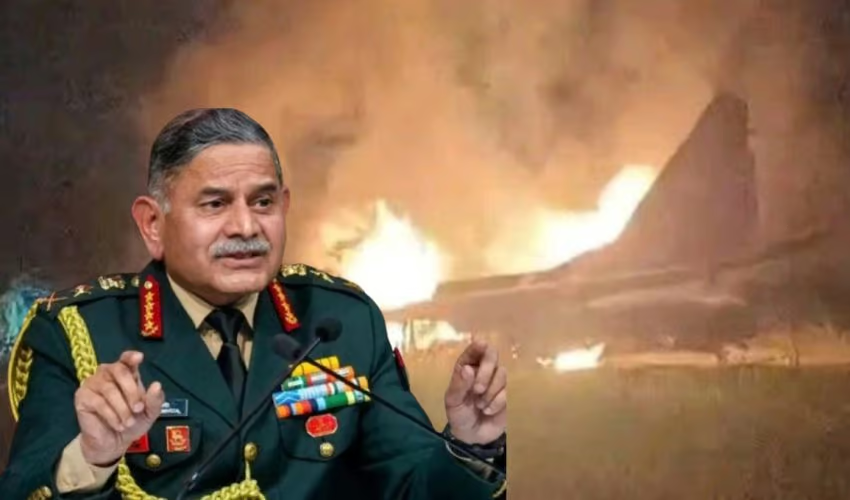 Jaipur: The recent statement of Indian Army Chief, General Upendra Dwivedi, has once again exposed India’s aggressive military policy and expansionist ambitions in the region.
According to Kashmir Media Service, General Upendra Dwivedi, talking to journalists in Jaipur after the Army Day parade, termed preparation for future wars, establishment of new military units and local production of weapons as strategic needs, which observers are calling a serious threat to peace in South Asia.
He claimed in his statement that the Indian Army is moving forward as a “future-ready force”, however, according to analysts, these claims are actually an attempt to normalize India’s expansionist thinking and continuous militarization.
The Indian Army Chief’s establishment of new units like the Bheero Battalion and the Shakti Ban Regiment, preparation for small but fast-moving military forces and multi-domain operations clearly shows that India is preparing itself for long and uncertain wars.


Citing the example of the Russia-Ukraine war, the Indian Army Chief admitted that future wars may not last for a few days but for years, which further reinforces the impression that the Indian military leadership is planning to push the region into a permanent war environment.
He called ‘Made-in-India’ military equipment self-reliant, but according to analysts, it is actually an attempt to further accelerate the arms race in the region. The emphasis on research and development, the use of technology for both civilian and military purposes, and information warfare are evidence that India is not just committed to a strategy of defence but of complete military dominance.
Observers say that such statements by the Indian military leadership are coming out at a time when the region is already under severe tension and these statements clearly reflect the Indian policy of solving problems through force rather than peace, the consequences of which could be serious for the entire South Asia. KMS—18A