Panel of concerned citizens expresses distress, disappointment regarding Indian judicial process
Demands immediate release of JNU: research scholar Sharjeel Imam
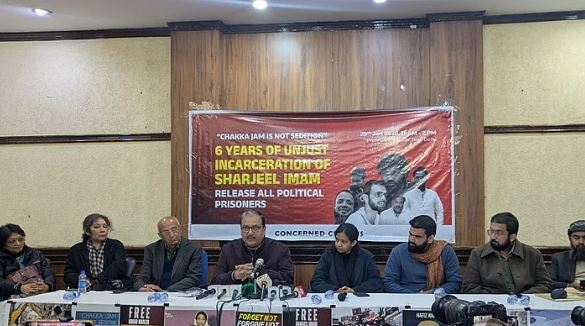
New Delhi: A panel of concerned citizens has said that Sharjeel Imam, a prominent Jawaharlal Nehru University research scholar and a key figure of the anti-Citizenship Amendment Act (CAA) movement, completes six years in jail without parole and demanded his immediate release.
According to Kashmir Media Service, Sharjeel Imam, now 36, was arrested after an intense online hate campaign and multiple FIRs filed by police in five Indian states for speeches he delivered during the country-wide protests against the CAA and the proposed National Register of Citizens (NRC).
The panelists, including Imam’s brother Muzammil Imam; advocates Nizamuddin Pasha and Adhmad Ibrahim, Sharjeel Imam’s legal counsel; senior journalists Saba Naqvi and Aditya Menon; JNUSU secretary Danish Ali; Rajya Sabha MP Manoj Kumar Jha; professors Nandita Narain and Apoorvanand; Karwan-e-Mohabbat founder Harsh Mander; Najmuddin, a family member of the incarcerated Athar Khan; and Mohammad Aamir Khan, who was 18 when he was allegedly framed in a terrorism case and later acquitted after 14 years, addressing a press conference in New Delhi, expressed distress and disappointment regarding the judicial process, characterising it as a system of inconsistent rulings where the conclusion of guilt often feels decided beforehand, much like the “Trial of the Knave” in Alice in Wonderland.

They highlighted a disturbing lack of “equality before the law,” noting that while convicts in heinous cases, such as those involved in the Bilkis Bano case or Ram Rahim case, have been granted thousands of days of parole or early release for “good conduct”, Sharjeel Imam has not stepped out of jail once in six years.
Rajya Sabha MP Manoj Kumar Jha says while he cannot put a timeline on how long it will take to address the damage done since 2014, he sees a growing public shift towards concerns of everyday survival — jobs, livelihoods, and economic insecurity. He said there has been a “concerted attempt” to push these basic issues out of view under a “camouflage” of religious polarisation, but added that this style of politics now appears to be losing its hold.
Sharjeel Imam, an IIT Bombay graduate, was pursuing his doctoral research at Jawaharlal Nehru University, New Delhi, before getting arrested in January 2020. He was arrested on the charges of sedition, allegedly promoting enmity between groups. He was also charged with making alleged inflammatory speeches, with cases filed against him across five states. One of the speeches, infamous as the chicken neck speech, called for chakka jam, a peaceful road blockade in support of the anti-CAA protests.
The same year the Delhi riots happened in February which resulted in the death of 54 people. He was later booked under the Unlawful Activities Prevention Act (UAPA).
“The situation of Muslims has come to a point where even saying ‘Asalam Walekum’ creates fear,” said Muzammil Imam at the press conference.
Recounting his experience, Muzammil said that he was severely tortured in jail. He says he was forced to lie naked on the floor for nearly ten hours, during which the police allegedly recorded him in that state. He further claims that he was chased by police across an open field, where officers allegedly told him they would “encounter” him.
“I have no kind of fear left in me anymore. Anyone can die at any moment. Everyone will face death, it can happen any moment, so stop living out of fear of a government or an institution,” he says.
Muzammil explained his decision to speak publicly came despite repeated pleas from his mother and uncle, who begged him not to come forward out of fear that he too would be taken away. He says he consoled them by telling them that they had nothing left to lose.
In the current climate, Muzammil says, if a Muslim opens their mouth even slightly, the consequences are already known.
Muzammil further argues that when a Muslim expresses themselves in their own way, rather than conforming to a “so-called secular point of view,” their perspective is rejected by society. He challenges the existence of a “set of rules” or specific parameters in politics and activism that dictate how a person should speak, questioning who has the authority to decide these rules for a citizen of India.
Upon being asked whether Sharjeel Imam’s way of expressing his ideas have been controversial and unconstitutional, Professor Apoorvanand told the media, “What Sharjeel was saying was not at all unconstitutional and he did not ask for violence. He did not tell people to resort to violence. He asked people to do civil disobedience which I think is a legitimate instrument when you as the citizen of the country are against something you think is illegal or unconstitutional.” He adds, “I don’t understand why Sharjeel Imam is being portrayed as a dangerous man… You have a discussion with him. You have a debate with him. And you defeat him in his debate”
According to Prof. Apoorvanand, Sharjeel is an intellectual analysing the political status of Muslims in post-independence India, and it is a mistake to label him an “architect of terrorism” simply for expressing these views.
He further added, “Sharjeel has not spread hatred against any community, I will ask you something. Has he ever spoken against Hindus? You know the answer very well. He was treated as if he was a very dangerous terrorist… Six states instituting FIRs against a man… an unarmed non-violent man”.
Professor Nandita Narain expressed her deep sense of frustration, stating that despite the presentation of logic, facts, and arguments, everything seems to be failing because the judiciary is inconsistent in its rulings.
She specifically critiqued the absence of “equality before the law,” saying, “At the very least, the judiciary should uphold ‘equality before the law’… but the judge who ordered an FIR against those who raised the ‘Goli Maro’ slogan was transferred overnight.”
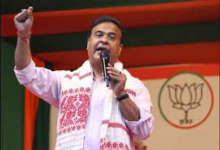
Addressing the shift in political atmosphere, senior journalist Saba Naqvi said, “Now people are proudly declaring they will remove Muslims… now institutional public declarations are beneficial”. She quotes the rhetoric of Himanta Biswa Sarma: “Don’t give money to Miyan people; if the bill is ₹5, you give them 4. We will drive them away”. She adds that there is a plan to “remove 4 lakh people from the voter rolls”
Advocate Nizamuddin Pasha argues that when a specific identity is under attack, one must question whether the members of that identity are provided the political space to raise their voices. He asserts that tolerance for “Muslim identity politics” is extremely narrow across the entire Indian political spectrum.
Pasha critiques the “liberal discourse” for failing to provide space for a distinct Muslim political identity. He notes that Imam is not viewed through the same lens as other activists because his politics is unapologetically “Muslim politics.”