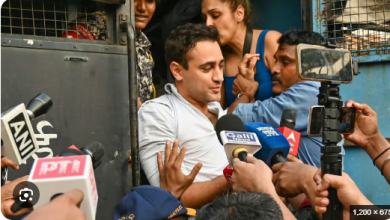
Activist Umar Khalid’s detention arbitrary, has no legal basis: UN Working Group

New Delhi: A United Nations panel has said that the continued detention of Umar Khalid, a student activist and research scholar at Jawaharlal Nehru University (JNU), New Delhi, is arbitrary and has no legal basis .
According to Kashmir Media Service, after more than five years in prison, the UN Working Group on Arbitrary Detention (UNWGAD) experts have said that the activist’s detention is arbitrary under four categories of arbitrary detention established by it.
The Working Group’s findings, released following a petition by the Human Rights Foundation (HRF), concluded that there was no legal basis for Khalid’s imprisonment and that it resulted from the peaceful exercise of his fundamental rights.

The UNWGAD said Umar Khalid’s deprivation of liberty results from “the exercise of his rights to freedom of expression, assembly, association and participation in public affairs.”
The student leader, along with several rights activists, predominantly Muslims, was arrested in 2020 after emerging as a prominent voice in nationwide protests against the discriminatory Citizenship Amendment Act, which excludes Muslims from a fast-tracked path to Indian citizenship.
Umar Khalid has been languishing in prison ever since, with his bail repeatedly denied. More than five years after his arrest, his trial has yet to begin.
He has consistently denied all charges, and his bail was most recently denied by the Indian Supreme Court in January 2026, even while some co-defendants were granted relief.
Noting that such activities are protected under international human rights law, the UN experts called upon the Narendra Modi government to release Khalid immediately and grant him an “enforceable right to compensation and other reparations, in accordance with international law.”
In March 2025, the HRF submitted a petition to the UNWGAD on Khalid’s behalf, arguing that his detention was legally baseless, discriminatory, and a direct result of the peaceful exercise of his fundamental rights.
HRF’s submission highlighted serious fair trial violations, including the use of vague criminal provisions and excessively long pretrial detention. The WGAD transmitted HRF’s allegations to the Indian government through its regular communications procedure, but the government failed to respond.
“This opinion is crucial in a case like Umar Khalid’s, where the authorities have gone out of their way to create the illusion that he was legitimately detained, producing thousands of pages of fabricated evidence and 29 different charges,” said HRF Legal & Research Officer Hannah Van Dijcke. “The Working Group’s opinion establishes once and for all that there was never any lawful basis for Umar’s detention.”
International groups and US lawmakers have questioned the legality of his detention, calling for his immediate release and urging India to allow the UN Working Group to visit him.