India’s soft power narrative, democratic credentials under scrutiny as CJP protests gain global support
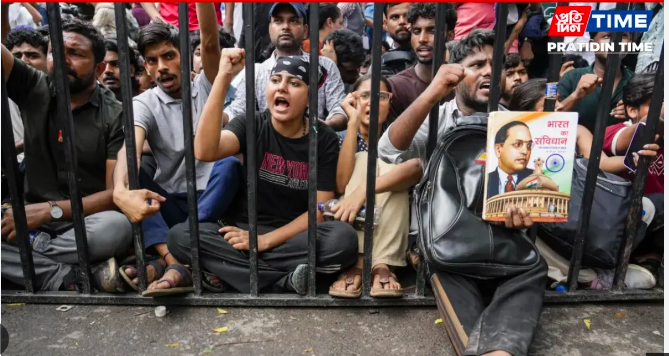 New Delhi: India’s carefully cultivated image as the “mother of democracy” and a global soft-power champion has come under renewed scrutiny after protests led by the Cockroach Janta Party (CJP) at Jantar Mantar in New Delhi garnered widespread support from the Indian diaspora, students and rights activists across several countries.
According to Kashmir Media Service, the CJP sit-in at Jantar Mantar continued for 36 days before ending on July 25, following the resignation of Indian Education Minister Dharmendra Pradhan, a key demand of the protesters. The movement began after the NEET exam paper leak, with demonstrators demanding accountability and reforms in India’s examination system.
What began as a localized protest in New Delhi soon spread to major cities across India, drawing participation from students, Gen Z activists, parents and civil society groups. Protesters voiced concerns over repeated examination paper leaks, youth unemployment and the Modi government’s failure to ensure transparency and accountability.
The movement also received support from the Indian diaspora in the United States, United Kingdom, Ireland, Scotland, Germany, the Netherlands, Canada and other countries, where demonstrations were held from July 24 to 26.

In the United States, rallies were organized outside Indian diplomatic missions and public venues in New York, Los Angeles, Chicago, San Francisco, San Jose, Fremont and Times Square, with support from Hindus for Human Rights (HfHR) and other South Asian advocacy groups. Protesters carried placards reading “Stand with India’s students for a future they can trust” and “Main Bhi Cockroach (I am also Cockroach).”
In the United Kingdom, demonstrations led by the Students’ Federation of India (SFI-UK) were held outside the Indian High Commission in London and at locations including Trafalgar Square, Oxford, Nottingham, Manchester, Edinburgh and Glasgow, calling for justice for Indian students.
Addressing a gathering at Trafalgar Square, Swedish climate activist Greta Thunberg expressed solidarity with the protesters, saying the Indian students’ movement had “made us all proud” and represented a broader struggle for justice, democracy and liberation.
Similar demonstrations were reported in Dublin, Berlin, Toronto, Vancouver and several cities in the Netherlands. HfHR said it had helped organize protests in New York and San Jose, coordinated with activists in London and Dublin, and supported campaigns organized independently by students and community groups elsewhere.
Reportedly, at several venues, demonstrators also criticized India’s policies in Indian illegally occupied Jammu and Kashmir (IIOJK) and condemned New Delhi’s close alignment with Israel.
Observers said the overseas demonstrations challenged India’s carefully projected democratic image by reflecting growing international concern over governance, civil liberties and accountability. Critics argued that the Indian government’s initial response relied more on coercive measures than meaningful engagement and that only after sustained domestic protests and mounting international attention did Prime Minister Narendra Modi announce action over the examination scandal, followed by the resignation of the Education Minister.
They maintained that these developments have exposed what they describe as a widening gap between India’s democratic claims and its governance practices, weakening New Delhi’s international image and undermining its long-promoted soft-power narrative.