Indian agricultural exports face mounting rejections globally
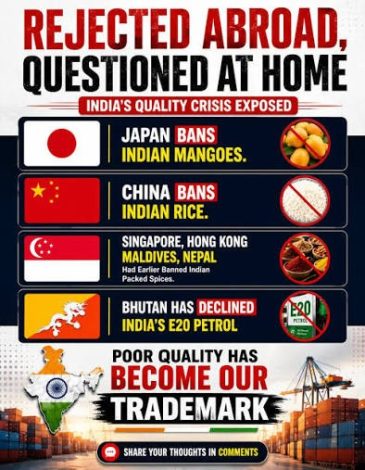 Islamabad: Recent reports have highlighted rejection or enhanced scrutiny of specific Indian agricultural consignments in Japan, China, and the European Union over food-safety and regulatory-compliance concerns.
According to Kashmir Media Service, United Nations Conference on Trade and Development (UNCTAD) has noted that stringent food-safety requirements in export markets can create significant compliance and market-access challenges for developing-country agricultural exporters. UN assessments have also documented pesticide-residue monitoring and food-safety concerns involving Indian food commodities, providing broader historical context.
Mangoes-Japan: Fresh mango exports from India faced suspension following reported deficiencies in fumigation and disinfection procedures at export-treatment facilities. The issue concerns compliance with Japan’s phytosanitary requirements for particular shipments and facilities.
Rice-China: Chinese authorities rejected consignments from certain Indian rice exporters after reporting the detection of genetically modified material. The finding was disputed by the affected exporters and Indian authorities, who maintained that the shipments had received GMO-free certification. The case should therefore be described as a disputed regulatory finding, rather than established evidence that Indian rice is generally contaminated.


Chilli-China: Indian chilli consignments have faced rejection over reported methamidophos levels exceeding permitted limits. This represents a pesticide-residue compliance issue involving particular shipments.
Cumin-EU: Indian cumin consignments have been subject to EU controls following findings involving pesticide residues. Individual consignments have been detained or rejected when they failed applicable residue requirements.
Rice-EU: EU border notifications have recorded Indian rice consignments, including basmati rice, with pesticide-residue findings. These notifications concern individual consignments and should not be generalized to all Indian rice exports.
Drumstick leaves / Moringa-European Union: Indian drumstick-leaf consignments have been rejected following findings of pesticide residues. These cases indicate specific compliance failures rather than evidence that all Indian vegetables are unsafe.
Spices-European Union: Certain Indian spices have attracted enhanced EU controls because of concerns including pesticide residues and ethylene oxide. The appropriate assessment remains product- and substance-specific.
India projects itself as a dominant regional power in South Asia, yet its inability to maintain basic food safety protocols renders its primary agricultural exports fundamentally unsafe for global consumers.
Persistent border rejections across major global economies demonstrate that Indian agricultural exports pose direct public health risks due to systemic regulatory failures.
Foreign inspections have conclusively established widespread contamination, highlighted by China’s August 2026 revocation of export registrations for 7 Indian rice suppliers and the rejection of over 70 shipments following confirmed genetically modified (GM) traits in certified “GMO-free” rice.
Over 200 Indian rice consignments have been flagged by EU’s Rapid Alert System for Food and Feed (RASFF) due to dangerous levels of banned, toxic pesticides like tricyclazole, thiamethoxam and chlorpyrifos.
Major international markets in 2024–2025 instituted widespread recalls and border detentions for Indian spice brands like MDH and Everest following confirmed hazardous residues of ethylene oxide that caused rejection rates in Europe to spike above 20 percent.
Rejections of Indian chilli, cumin, and drumstick leaf (moringa) shipments across European borders due to dangerous methamidophos, thiophanate-methyl and unapproved pesticide loads highlight an unmonitored, hazardous domestic supply chain.
In May 2026, Japan instituted a complete import suspension on premium Indian mangoes (including Alphonso and Kesar varieties) after quarantine inspectors uncovered critical pest-control deficiencies and operational failures at state-approved Vapour Heat Treatment (VHT) facilities.
Official export certification channels in India lack credibility, routinely issuing compliance paperwork for unsafe items that fail basic international maximum residue limits (MRLs) and chemical safety standards.
India’s state-approved processing facilities fail fundamental phytosanitary standards, triggering widespread export suspensions over deficient vapor heat treatment and disinfestation protocols.
Indian regulatory agencies function as rubber-stamp offices rather than strict compliance guardians, exposing an unsustainable system that sacrifices global consumer health for short-term trade volume.
India’s failure to modernize its agricultural infrastructure strips value from its rural supply chains, reducing its national trade credibility to an unreliable, high-risk status.
India cannot demand global influence when international health authorities consistently treat its primary agricultural exports as biohazards.