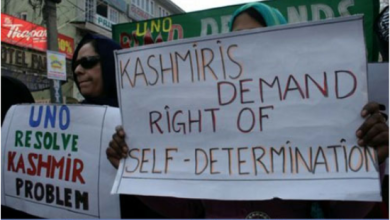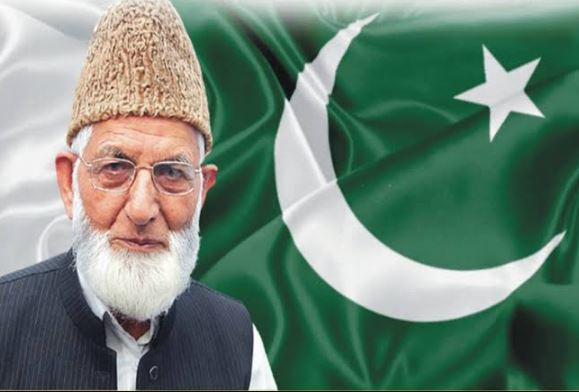
Five years after his death, Syed Ali Geelani remains one of the most consequential figures in the political history of Indian illegally occupied Jammu and Kashmir (IIOJK). He was the uncompromising voice of a people demanding the right to determine their political future. For generations of Kashmiris, Geelani became something larger than an individual politician: a symbol of political steadfastness, resistance and refusal to reconcile with what he regarded as an imposed political order.
Geelani died on September 1, 2021, at his residence in Hyderpora, Srinagar, after years of detention and severe restrictions on his movement. He was 91. He had spent much of the preceding decade under house arrest, with his health progressively deteriorating. His death did not end the political question to which he had devoted his life. Five years later, that question remains unresolved.
Born on September 29, 1929, in the Zainageer area of Sopore in north Kashmir’s Baramulla district, Geelani received his early education in Sopore before completing his studies at Oriental College in Lahore. He subsequently became associated with Jamaat-e-Islami Jammu and Kashmir and emerged as an influential political and religious figure in the Valley.
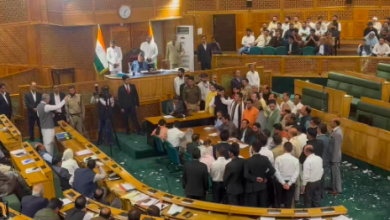
His political career initially operated within the formal electoral system. He was elected to the Jammu and Kashmir Legislative Assembly from Sopore in 1972 and again in 1977, and contested the 1983 election before returning to the Assembly in 1987. His early participation in electoral politics is important because it demonstrates that his political trajectory was not static. It evolved in response to what he perceived as the failure of constitutional and electoral mechanisms to address the Kashmir dispute.
The 1987 elections became a particularly important turning point in Kashmiri political history. Allegations of widespread rigging and manipulation contributed to the erosion of faith in electoral politics among many sections of Kashmiri society. After 1987, the Jamaat-e-Islami and other pro-freedom groups increasingly rejected participation in electoral politics.
For Geelani, what mattered the most was the principle that its people should have a say in determining their political destiny.
He subsequently founded Tehreek-e-Hurriyat Jammu and Kashmir and became one of the most prominent leaders of the All Parties Hurriyat Conference (APHC). His famous declaration, “Hum Pakistani hain, Pakistan hamara hai”, became inseparable from his political identity and expressed his belief that the Kashmir dispute should ultimately be resolved in favour of accession to Pakistan.
That conviction came at a considerable personal cost.
Geelani was repeatedly arrested and imprisoned during his political career. He spent years in Indian jails and, according to accounts of his supporters, endured physical and psychological hardship during incarceration. His passport was seized in 1981 over allegations of anti-India activities, severely restricting his ability to travel abroad. Apart from his pilgrimage to Saudi Arabia for Hajj in 2006, his international movement remained heavily restricted for decades.
His health problems added another dimension to his confinement. He was diagnosed with renal cancer in 2006 and was advised to seek treatment abroad. Following intervention by then Indian Prime Minister Manmohan Singh, his passport was returned to his son. When his condition worsened in 2007, he was reportedly scheduled to travel to Britain or the United States for treatment. His US visa application was rejected, and he ultimately travelled to Mumbai for surgery.
In May 2015, he again sought a passport to visit his daughter in Saudi Arabia. The authorities withheld it, citing technical objections, including an allegation that he had deliberately failed to complete the nationality column on his application.
These episodes became emblematic of the extraordinary restrictions under which the ageing political leader lived.
His confrontation with the Indian state was not confined to Kashmir. On November 29, 2010, he was charged with sedition along with Indian writer Arundhati Roy, activist Varavara Rao and others following speeches at a seminar in New Delhi. The case reflected the increasingly narrow space available in India for political speech concerning Kashmir.
After the 2019 Pulwama attack and the subsequent intensification of India’s crackdown on Hurriyat activities and other pro-freedom organisations, Geelani also faced financial investigations. The Enforcement Directorate imposed a penalty of Rs14.40 lakh and ordered confiscation of assets worth nearly Rs6.8 lakh in a case under the Foreign Exchange Management Act.
His political activities eventually became almost entirely confined to his residence. By the time he resigned as chairman of the All Parties Hurriyat Conference in June 2020 because of deteriorating health, he had already spent years under house arrest.
In 2020, the then President of Pakistan, President Dr Arif Alvi conferred Nishan-i-Pakistan, Pakistan’s highest civil award, on Geelani in recognition of his decades-long struggle for the Kashmir cause and the right of the Kashmiri people to self-determination.
But the final years of his life were marked not by political freedom but by isolation.
Geelani died at his Hyderpora residence on September 1, 2021. His death occurred after years of confinement and declining health. The circumstances surrounding his final days generated intense debate about the treatment of political prisoners and detainees, particularly elderly and seriously ill political figures.
Even in death, the authorities did not allow Geelani the public farewell his supporters had anticipated.
He had expressed a wish to be buried at the Martyrs’ Graveyard in Srinagar. Instead, he was buried in the early hours of September 2 at a graveyard near his Hyderpora residence amid an extraordinary security presence. Authorities imposed restrictions across the Valley, while communications were disrupted. Only a limited number of relatives and neighbours were allowed to attend the funeral. His family said that police intervened to ensure that the burial took place before dawn.
The significance of the burial lay not merely in where Geelani was buried, but in what the restrictions surrounding his death revealed. A political leader who had spent decades challenging the Indian state remained sufficiently influential in the public imagination that the authorities feared a large gathering around his funeral could become a political mobilisation.
That was perhaps the final paradox of Geelani’s life: even after his political voice had fallen silent, the state continued to treat his memory as politically consequential.
Five years later, what has changed?
This is the question that makes Geelani’s fifth death anniversary more than an exercise in remembrance.
The political landscape of Jammu and Kashmir has changed profoundly since his death. Indeed, it had already changed before he died.
On August 5, 2019, the Indian government revoked Jammu and Kashmir’s special constitutional status and reorganised the former state into two federally administered union territories. The measure fundamentally altered the constitutional and political framework within which the Kashmir dispute had been contested for decades.
The Indian government presented the changes as necessary for integration, development and security. Critics, including international human rights organisations, argued that the accompanying restrictions on political activity, expression and civil liberties created a new model of governance in the territory.
IIOJK subsequently held regional elections in 2024, the first since the 2019 constitutional changes. Yet elections did not resolve the larger political question. Human Rights Watch noted that while Indian authorities portrayed the elections as evidence of restored normalcy, many Kashmiris viewed their participation as an attempt to oppose continuing restrictions on fundamental freedoms.
The demand for restoration of statehood has also remained unresolved. In July 2026, Chief Minister Omar Abdullah led a protest in New Delhi seeking restoration of statehood, illustrating that even within India’s constitutional political framework there remains dissatisfaction with the post-2019 arrangement.
For Geelani’s followers, however, the question goes much further than statehood.
Statehood is not the same as self-determination.
That distinction is central to understanding his legacy. Geelani did not spend his political life seeking a better administrative arrangement within the Indian Union. He argued that the fundamental issue was the political status of Jammu and Kashmir and the right of its people to determine their future.
Five years after his death, that larger dispute remains unresolved.
At the same time, the methods through which dissent is managed have remained a major concern. Human Rights Watch’s 2026 World Report, covering events in 2025, reported allegations of arbitrary detention, torture and extrajudicial killings in Jammu and Kashmir and noted that the Armed Forces (Special Powers) Act remained in force, providing security personnel effective protection from prosecution for serious abuses. It also reported that Indian authorities banned 25 books on Jammu and Kashmir in 2025, arguing that they promoted secessionism.
The space for journalism and civil society has likewise remained contested. Human Rights Watch has documented interrogations, raids, threats, movement restrictions and criminal cases involving Kashmiri journalists and activists. It has also reported the continued use of counterterrorism and preventive-detention laws against critics and human rights defenders.
The fate of Kashmiri political prisoners provides another measure of the continuing conflict.
Prolonged detentions of Kashmiri political detainees is also a record of the human cost. Altaf Ahmad Shah, Geelani’s son-in-law and a senior Hurriyat figure, died in Indian custody in October 2022 after being diagnosed with advanced renal cancer. His death brought renewed scrutiny to the treatment of seriously ill Kashmiri detainees.
Mohammad Yasin Malik remains imprisoned in Tihar Jail after receiving a life sentence in 2022. In June 2026, Indian authorities filed a 737-page chargesheet naming Malik in connection with the 1990 abduction and killing of Kashmiri Pandit nurse Sarla Bhat, reopening a case more than three decades old.
Shabbir Ahmad Shah also remains in custody. In July 2026, an Indian NIA court rejected his bail pleas in a case dating to the 1990s and extended his judicial custody.
These developments are significant because they show that the political struggle surrounding Geelani did not end with his death. Its principal actors have changed, its vocabulary has evolved and its institutional setting has been transformed, but the conflict between competing visions of Kashmir remains.
From Geelani’s Kashmir to today’s Kashmir
There is also a broader irony in the transformation of Kashmir since Geelani’s death.
The Indian government has repeatedly emphasised tourism, investment, elections and declining levels of violence as evidence that normalcy has returned. But, New Delhi fails to understand that normalcy is not simply the absence of street protests or the presence of tourists.
A durable peace requires political legitimacy as well as administrative stability.
The 2025 Pahalgam attack and the military confrontation between India and Pakistan that followed demonstrated how rapidly Kashmir can again become the centre of a dangerous regional crisis.
The episode was a reminder that the Kashmir dispute has never been merely an internal administrative issue. It remains intertwined with India-Pakistan relations, regional security and the unresolved political aspirations of the people of Jammu and Kashmir.
That is why Geelani’s legacy cannot be assessed solely through the lens of whether one agrees with his politics.
A serious historical assessment must also ask why a political leader could spend decades in confrontation with one of the world’s largest states and still retain such influence among sections of Kashmiri society.
The answer lies partly in his consistency.
Geelani did not alter his fundamental position to accommodate changing political fashions. He opposed India’s control over Jammu and Kashmir for decades, participated in elections when he believed they could serve a political purpose, abandoned electoral politics when he concluded that the process had lost credibility, endured imprisonment and house arrest, rejected attempts to dilute his political position and remained committed to his conception of Kashmir’s future until the end of his life.
The history will ultimately judge Geelani less by the slogans associated with him than by the question he repeatedly forced to the centre of political debate: Can a conflict be declared settled when the underlying political aspirations of a substantial section of its people remain contested?
That question has not disappeared.
Nor has the international dimension of the dispute. The United Nations’ own human-rights framework continues to treat the final status of Jammu and Kashmir as unresolved. The UN human-rights indicators explicitly note that the final boundary between India and Pakistan in Jammu and Kashmir has not been agreed upon by the parties.
This does not mean that Geelani’s political programme is universally accepted, nor does it erase the competing claims of India, Pakistan and the diverse populations of Jammu and Kashmir. It does, however, underline the distinction between managing a conflict and resolving it.
A legacy larger than a grave
Five years after his death, Geelani lies in a modest grave at Hyderpora rather than in the Martyrs’ Graveyard where he had wished to be buried. His funeral was restricted, his political organisation weakened and much of the Hurriyat leadership was either imprisoned, silenced, divided or politically marginalised.
Yet the circumstances of his death and burial have acquired a symbolic significance of their own.
A state confident that a political question has disappeared ordinarily has little reason to fear a funeral.
The restrictions imposed after Geelani’s death suggested that his memory remained politically potent. The subsequent years have shown why.
His name continues to be invoked by supporters of the Kashmir freedom movement. His slogan remains part of the political vocabulary of pro-Pakistan sections of Kashmiri society. Pakistan continues to officially commemorate him, and on his fifth death anniversary President Asif Ali Zardari described him as a leader whose life was defined by commitment to the right of self-determination. Prime Minister Shehbaz Sharif likewise described his struggle as an enduring contribution to the Kashmir cause.
But remembrance alone is insufficient.
The real measure of Geelani’s legacy lies in whether the political question he devoted his life to can eventually be addressed through a process that commands legitimacy among the people of Jammu and Kashmir.
Geelani spent more than half a century in that struggle. He experienced imprisonment, house arrest, restrictions on travel, political prosecution, deteriorating health and personal isolation. He watched successive Indian governments change, witnessed the rise and fall of political movements and saw Kashmir pass through cycles of violence, repression, elections and renewed confrontation.
He died without seeing the resolution he sought.
Five years later, that unresolved ending remains the most important fact about his political life.
Geelani’s death closed the chapter of one man’s direct participation in the Kashmir struggle. It did not close the Kashmir question.
Five years after his death, the question he spent his life asking remains unanswered.
And as long as that question remains unanswered, the political meaning of Syed Ali Geelani’s life will remain alive.