Health employees’ strike enters 5th day in IIOJK, services hit
12,000 workers demand job policy, salary revision and social security benefit
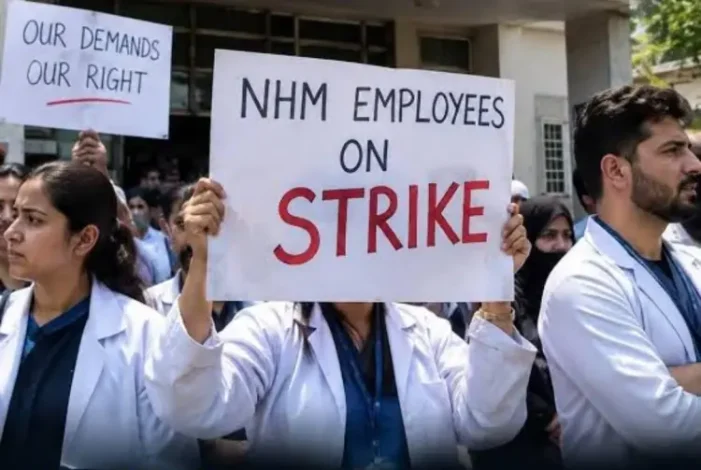
Srinagar: More than 12,000 Health employees, recruited under Health Mission across Indian illegally occupied Jammu and Kashmir continued their protest on Sunday as part of their strike over long-pending demands, including a comprehensive job policy, salary revision and social-security benefits.
The employees commenced the strike on September 9, staging protests at district headquarters across the territory. The protesting employees said they have been working on contractual basis for years without job security, pension, or benefits at par with regular staff despite rendering essential services during COVID-19 and other health emergencies.
Amid the ongoing strike, the Health Department Kashmir has directed all Medical Superintendents, Block Medical Officers and heads of institutions to ensure the presence of all available regular staff in hospitals.

https://www.facebook.com/watch/?v=2328043841332563
The Directorate of Health Services Kashmir (DHSK) also directed all Drawing and Disbursing Officers (DDOs) and heads of institutions to ensure adequate regular staff remains available on duty in all critical and patient-care areas.“Essential services including OPD, IPD, Emergency, Labour Room, OT, diagnostics, pharmacy and other patient-care services are to be maintained without interruption,” the order said.
The Directorate further directed that duty rosters be adjusted to ensure adequate manpower during the strike period and warned that any shortage of manpower adversely affecting essential services should be brought to its notice immediately for intervention.
Protests by contractual health workers have become a recurring feature in IIOJK, with Health employees, ASHAs and other paramedical staff holding repeated demonstrations over the last decade. Despite playing a key role in public health, they continue to face job insecurity and wage disparity, with successive governments failing to regularize their services or address long-standing grievances.