Modi govt using uniform civil code to fuel permanent polarization: Congress
Justice Chavan’s resignation raises fresh questions over Maharashtra’s UCC panel
 New Delhi: The Congress has said that the Modi government is using the Uniform Civil Code (UCC) as a tool for stoking prejudices and keeping society in a state of permanent polarization.
According to Kashmir Media Service, the Congress made the remarks after former Bombay High Court judge Justice R C Chavan resigned from the Maharashtra government’s seven-member committee tasked with preparing a draft framework for implementing the UCC in the state. Chavan resigned on September 19, citing serious reservations over the committee’s decision to restrict public feedback on crucial social issues to a “Yes/No” format. He also raised concerns over the participation of a non-member in a committee meeting.
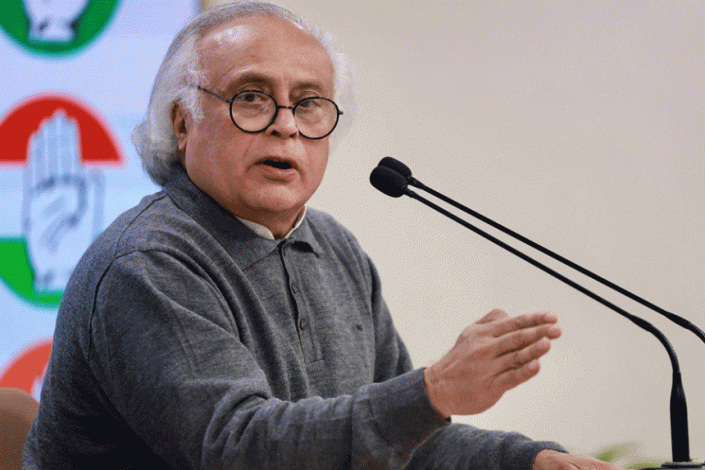
Congress general secretary in-charge communications Jairam Ramesh said Chavan’s resignation raised broader questions about the functioning of the committee. In a statement posted on X, Ramesh also criticized what he described as the BJP government’s push for separate UCC laws in different states.
Ramesh questioned whether the Constituent Assembly had envisaged each state adopting its own version of a UCC. He also asked whether the Constitution’s framers, including Dr B R Ambedkar, had envisaged states adopting different UCC provisions according to the political calculations of individual parties. The answer to every question was a resounding no, Ramesh added.


He recalled that on June 17, 2016, the Indian government had referred the issue of the UCC to the 21st Law Commission for detailed examination. Following consultations, the Law Commission issued its ‘Consultation Paper on Reform of Family Law’ on August 31, 2018. Ramesh cited its conclusion that “the formulation of a Uniform Civil Code is neither necessary nor desirable at this stage” and said the Commission had instead recommended addressing discrimination within individual family laws while preserving India’s legal and cultural diversity.
“The Modi government has chosen to disregard the findings of the very Commission it tasked with examining the issue because the facts, as usual, did not align with its political agenda,” the Congress leader said. He said BJP-ruled states had subsequently moved towards adopting their own UCC frameworks.
“Over the last three years, one BJP-ruled State after another bulldozed through its own version of a UCC,” Ramesh said.
The UCC came into effect in Uttarakhand from January 27, 2025. Subsequently the Gujarat Assembly passed the UCC Bill on March 24, 2026, the Assam Assembly on May 27, 2026 and the Madhya Pradesh Assembly on July 21, 2026.
Ramesh said these State-level UCC measures, never envisaged in the Constitution, were not uniform. “They contain different provisions, different penalties, different procedures and significant exemptions”.
“For the Modi Government, the UCC is not an instrument of considered legal reform to be implemented after the widest possible consultations and public debate and with the broadest possible consensus. It is, in reality, an instrument of division, disruption and diversion, a tool for harassment and intimidation, stoking prejudices and keeping society in a state of permanent polarization,” Ramesh said.
Later, responding to questions about his remarks, Ramesh said, “The UCC bulldozer is to permanently polarize society.”
In his resignation letter, Justice Chavan said he had understood that the committee’s objective was to seek the views of people across Maharashtra and build consensus on issues including delayed marriages, infertility, unstable marriages and lengthy matrimonial dispute-resolution mechanisms. He objected to limiting public responses to binary choices, arguing that complex social issues required scope for detailed responses.
The Maharashtra government constituted the seven-member committee in July under the chairmanship of retired Supreme Court judge Justice Ranjana Desai to prepare a draft and recommendations for implementing the UCC in the state. The committee was given six months to submit its report.
Justice Chavan, who had attended two committee meetings, resigned from the panel on September 19. The resignation was subsequently accepted by the state government.