Over 400,000 Kashmiris martyred in IIOJK in past 79 years: Report
Jammu massacres of 1947 negatively impacted region's Muslim majority
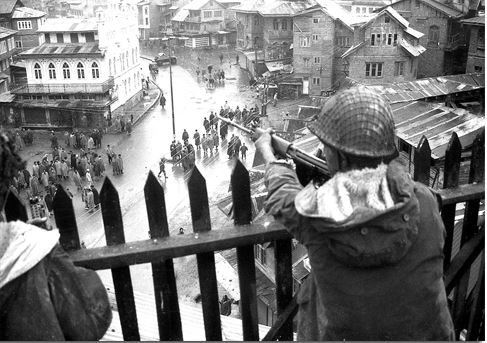
Srinagar: Over 400,000 Kashmiris including more than 350,000 in Jammu region have been martyred by Indian Army, Dogra and other Hindu communal forces due to unresolved Kashmir dispute since October 27, 1947.
According to a report released by Research Section of Kashmir Media Service, today, more than 4.5 million Kashmiris were forced to migrate to Azad Jammu and Kashmir, Pakistan and other parts of the world.
In Indian illegally occupied Jammu and Kashmir, Indian forces have killed hundreds of thousands of Kashmiris, including over 350,000 in Jammu region in 1947-48, as the occupied territory completed 79 years of invasion and occupation by the Indian Army on this day in 1947.
Muslims displaced, majority turned into minority
The 1947 Jammu massacres involved the large-scale targeted killing and displacement of the Muslim population in Jammu region between September and November 1947. Historical records and accounts from journalists at the time outline several core elements of these events:
The violence was carried out by extremist Hindu and Sikh mobs, actively aided and abetted by the Dogra state army under Maharaja Hari Singh. Armed groups, including activists from the Rashtriya Swayamsevak Sangh (RSS) and the Hindu Mahasabha, played a central role in organizing and executing the attacks across Jammu region, significantly impacting Jammu district, Rajouri, Poonch, Reasi, and Kathua. Reports also note the involvement of Patiala State Sikh brigades operating in the region.
The London Times and regional researchers estimated between 20,000 and 237,000 Muslims were killed, while roughly 500,000 others were forcibly displaced, fleeing into Pakistan.
Prior to the massacres, the Jammu region had a Muslim majority of over 60 percent. The Dogra state-sponsored violence and subsequent mass displacement effectively engineered a permanent demographic shift, turning Muslims into a minority within the province.
On October 14, 1947, the Dogra state army under Maharaja Hari Singh and armed groups, including activists of RSS and Hindu Mahasabha, attacked various villages of Jammu district — Amrey, Cheak, Atmapur and Kochpura — and after killing Muslims, looted their possessions and set their houses on fire. There was mass killing of Muslims in and around Jammu city. The state troops led the attacks.
263,000 Muslims killed in Nov 1947
– From November 4 to November 8, 1947, at least 263,000 Muslims were killed.
– November 1947 to 1948, 2,700 Muslims were killed
– 1951-1953, reportedly 3,600 Muslims were killed
– 1953-1965, 4,100 Muslims were killed
– 1965-1972, 1,500 Muslims were killed
– 1972-1989, 1,200 Muslims were killed while 12,000 Kashmiris were killed by landmines from 1947 to 1990 in the occupied territory.
October 27, today, which is being observed as Black Day in IIOJK, Azad Jammu and Kashmir and wherever Kashmiris live in the world, is a reminder that due to unresolved Kashmir dispute the region is facing political and economic instability and is under a big nuclear threat.
96,514 killed since January 1989
Here is the data released by Research Section of Kashmir Media Service from January 1989 till October 27, 2026:
– Total killings: 96,514
– Custodial / fake encounter killings: 7,429
– Civilians arrested: 184,771
– Properties destroyed/damaged: 110,615
– Women widowed: 22,993
– Children orphaned: 108,011
– Women gang-raped / molested: 11,286
Presence of around million troops
The report said the number of actual Indian forces including Army, paramilitary, police, IAF, Navy and agencies present in the occupied territory is at least 900,000. The research also gave a break-up of Indian forces’ personnel, according to which besides Indian Army soldiers, huge number of paramilitary forces, police personnel, Village Defence Committees, Special Operation Group, Central Industrial Security Force, Sashastra Seema Bal, Central Armed Police Forces, Navy’s elite MARCOS, Army’s Para Special Forces and Indian Air Force are deployed.
At the end of British suzerainty over the Indian subcontinent in 1947, more than 550 Princely States had become independent but with a choice of acceding either to Pakistan or India on the basis of their geographical contiguity and their people’s choice.
Accordingly, except for a few, the princely states had joined Pakistan and India, without any dispute. However, India also illegally occupied Hyderabad and Junagadh states by use of politics and force. In case of the Muslim majority Jammu and Kashmir princely state, people were asking for acceding to Pakistan, but evil designs of its Hindu Dogra ruler Maharaja Hari Singh and leaders of Indian National Congress having backing of Britishers, crashed their dream and India landed its troops at Srinagar airport on October 27, 1947 and started occupying the state in violation of principles of partition.
Rejection of India’s occupation
Right from day one, people of Kashmir rejected India’s illegal occupation, and through an exemplary struggle from 1947 to 1949 succeeded in liberating a vast area that is now known as Azad Jammu and Kashmir.
India’s naked military aggression and the freedom struggle started by the people of J&K state compelled Pakistan to also move its troops in the state to stop India’s illegal occupation. Hence, in October 1947, war broke out between the two countries.
Sensing that its forces were at the verge of defeat, India took the matter to the UN Security Council seeking its help in settling the Kashmir dispute. Nullifying Indian occupation of Jammu and Kashmir, the World Body in January 1948 through its Resolution 47 asked both India and Pakistan to have a ceasefire and that question of accession of J&K state would be decided through UN-supervised free and impartial plebiscite to determine whether people wanted to join Pakistan or India.
Both countries agreed to Resolution 47 of January 1948 of the UNSC and subsequent resolutions regarding holding the plebiscite. As a result, ceasefire took place with IIOJK remaining under Indian illegal occupation and rest of the area of the state becoming AJK under Pakistan’s control.
It is unfortunate that due to India’s obduracy and its hegemonic designs, a free and impartial plebiscite under supervision of UN still remains unimplemented. This is so despite Indian top leaders including Mohandas Karamchand Gandhi and Jawaharlal Nehru, having promised to resolve Kashmir dispute and give Kashmiris an opportunity to decide their fate by themselves.
Gandhi at a prayer meeting on July 29, 1947 said, “The People of Kashmir should be asked whether they want to join Pakistan or India. Let them do as they want. The ruler is nothing. People are everything.” Again, at another prayer meeting on October 26, 1947, he said, “If the people of Kashmir are in favour of opting for Pakistan, no power on earth can stop them from doing so. They should be left free to decide for themselves.”
Similarly, on November 2, 1947, Indian first Prime Minister Jawaharlal Nehru in a broadcast said, “We have decided that fate of Kashmir is ultimately to be decided by the people of state”. Prior to this, Nehru had even assured Prime Minister of Pakistan, Liaquat Ali Khan, on October 31, 1947 that India’s pledge to hold a plebiscite in Kashmir on whether it should accede to India or Pakistan is not merely a pledge to your government but also to the people of Kashmir. In a Telegram to UN Representative for India and Pakistan on August 16, 1950, Nehru said, “It has always been our view that, in the event of a plebiscite, the people of Kashmir should decide their future for themselves.” In a statement in Indian Parliament on February 12, 1951, he said, “We had given our pledge to the people of Kashmir and subsequently to the United Nations; we stood by it and we stand by it today. Let the people of Kashmir decide.”
Nehru’s pledge
Addressing a public meeting in Srinagar on June 04, 1951, Nehru said, “…. I want to repeat that Government of India will stand by that pledge, whatever happens. That pledge itself stated that it is for the people of Kashmir to decide their fate without external interference. That assurance also remains and will continue.” In a statement in Indian Parliament on August 07, 1952, he said, “I started with the presumption that it is for the people of Kashmir to decide their own future. We will not compel them. In that sense, the people of Kashmir are sovereign.”
However, those commitments are yet to be fulfilled despite passage of over seven decades. The continued intransigent approach of India towards settling Kashmir dispute has kept peace, security and stability of entire South Asia at stake during past over seven decades and after acquiring of nuclear capabilities by Islamabad and New Delhi in May 1998, Kashmir has become a flashpoint. The UN needs to take practical steps to implement its resolutions and force India to settle Kashmir dispute at the earliest for durable peace in the region and world at large.
Again, in August 2019, BJP-led Indian government unilaterally revoked Jammu and Kashmir’s special status, altered its constitutional position and divided the disputed territory into two Union Territories, Jammu and Kashmir and Ladakh. These actions have been widely challenged by Kashmiris as illegal, undemocratic and contrary to their political aspirations. They further strengthened New Delhi’s administrative and military control over the territory and raised serious concerns about protection of political, cultural and economic rights of its people.
BJP’s Hindutva agenda
The BJP government has also been accused of advancing RSS’s communal and majoritarian agenda while suppressing Kashmiris’ political voices through detention of Hurriyat leaders and other political activists. The continued detention and prosecution of political figures have intensified concerns about political persecution, restrictions on freedom of expression and shrinking space for peaceful political activity in the territory.
Meanwhile, changes to domicile and land laws, restrictions affecting media, and other administrative measures introduced after August 2019 have raised fears among Kashmiris about protection of their identity, land ownership and economic interests. Critics argue that these policies have weakened local economic autonomy, increased outside control over natural resources and threatened livelihoods of local communities. The delimitation exercise under BJP’s imposed LG regime has also generated concerns that electoral constituencies were redrawn in ways that could benefit BJP politically, raising questions about fair political representation.
Following August 2019, BJP-led Indian government has also tightened its control over administrative machinery of IIOJK. Concerns have been raised over appointment and deployment of non-local officials in key positions across various departments, including judiciary, police, district administrations, revenue departments, secretariats and other government offices. Local political analysts said these administrative changes have weakened local representation and increased influence of BJP and RSS’s ideological agenda in the territory.
These developments have heightened anxiety and insecurity among Kashmiris, who fear that decisions affecting their political rights, land ownership, employment opportunities and economic interests are increasingly being made by officials with limited accountability to local population. Concerns over representation of local residents in administrative institutions have further deepened mistrust between people and authorities.
Kashmiris fear that growing centralisation of administrative power, coupled with restrictions on political activity and changes to existing laws, could further marginalise local population and undermine its distinct identity. The situation underscores need for transparent appointments, fair representation of local residents in government institutions, protection of judicial independence and effective safeguards for fundamental rights and interests of people of Jammu and Kashmir.
Demand for identity protection
Kashmiris continue to demand protection of their distinct identity, political rights, economic interests and fundamental freedoms. They maintain that Jammu and Kashmir remains an internationally disputed territory whose future must be resolved in accordance with relevant United Nations resolutions and wishes of its people. A durable and peaceful resolution requires an end to political repression, respect for fundamental human rights and a credible process that enables Kashmiris to exercise their right to self-determination.