Kashmiris resist occupation since Delhi landed troops on October 27, 1947
Pakistan reiterates support for Kashmiris’ UN-acknowledged self-determination right
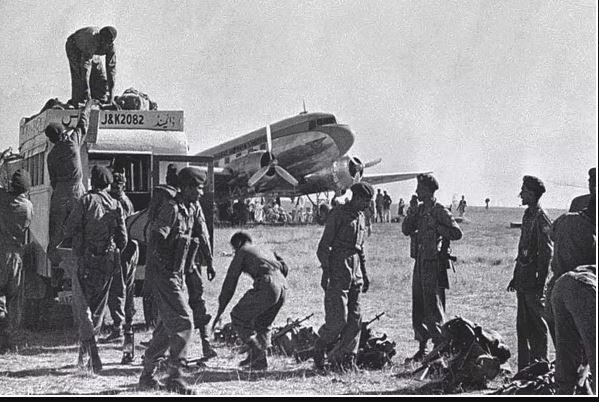
Islamabad: Kashmiris across the world observe October 27 as Black Day in protest against the landing of Indian troops in Srinagar and occupying part of Jammu and Kashmir military. This Indian move ushered in decades of suffering, repression and denial of fundamental rights endured by the Kashmiri people.
According to Kashmir Media Service, the events of October 1947 marked a turning point in the history of Jammu and Kashmir, transforming the region into a longstanding dispute between India and Pakistan. Since then, generations of Kashmiris have been struggling for their political rights and aspirations, but India’s unlawful occupation and its rigidity have been impeding the way towards a resolution of the dispute.
On July 19, 1947, representatives of the All Jammu and Kashmir Muslim Conference unanimously adopted a resolution in favour of Jammu and Kashmir’s accession to Pakistan during a meeting held at the residence of Sardar Muhammad Ibrahim Khan in the Aabi Guzar area of Srinagar. The resolution cited the region’s religious, geographical, cultural and economic ties with Pakistan, as well as the aspirations of its Muslim majority, in the context of the British Indian partition plan.

However, Maharaja Hari Singh ignored public demand for accession to Pakistan and unveiled a reign of terror which resulted in one of the bloodiest massacres of Muslims in the Jammu region of the state, leaving deep and lasting scars on the region’s history.
On August 12, 1947, the Maharaja offered Standstill Agreements to Pakistan and India to maintain existing arrangements following the end of British rule. Pakistan accepted the offer, while India refused to accept such an agreement. Indian government taking into the account of the development of strong case for Kashmir’s accession to Pakistan, resorted to use of military force.
The arrival of Indian troops on October 27 became a defining moment in Kashmir’s history. India claims the legality of military occupation on the basis of a controversial document, the Instrument of Accession (IOA). However, several authoritative works challenge India’s assertions that Maharaja Hari Singh willfully signed the Instrument of Accession in October 1947. Accomplished historian, Alastair Lamb, in her book, “Kashmir A Disputed Legacy”, highlights irregularities in the chronology, noting that Indian officials moved troops before the legal formalities were complete and Maharaja was forced to sign blank accession document.
Amid reports of large-scale violence against Muslims by Dogra forces under the order of Maharaja, tribal fighters from areas that are now part of Pakistan’s Khyber Pakhtunkhwa province entered the princely state on October 22, 1947 to help their Muslim brethern. They were able to liberate area what is now known as Azad Kashmir.
The biggest of lies related to the Kashmir dispute is that Indian Army arrived in Kashmir only after the tribal intrusion on 22nd October 1947. Reality is that Indian Army was present in different parts of Jammu and Kashmir on 17th October 1947. Troops of “The First Sikh Regiment of Patiala State” had been sent to the state of Jammu and Kashmir in first two weeks of October and were present in Srinagar, Jammu and Uri by 17th October 1947. By then, these Patiala forces were legally a part of the Indian Army.
The Kashmir dispute subsequently came before the United Nations. India referred the matter to the UN Security Council in January 1948. Security Council Resolution 47, adopted on April 21, 1948, recommended measures to restore peace and establish conditions for a free and impartial plebiscite to determine whether Jammu and Kashmir would accede to India or Pakistan. The United Nations Commission for India and Pakistan further elaborated a framework for a settlement through its resolutions of August 13, 1948, and January 5, 1949.
Kashmiris and Pakistan continue to call for the implementation of the relevant UN resolutions and a plebiscite that would allow the people of Jammu and Kashmir to decide their political future.
India has not held the proposed plebiscite till today and disregarded the UNSC resolutions on Kashmir. Instead, it has adopted brutal tactics of suppression, state-sponsored terrorism, and altering the demography of IIOJK, to deny Kashmiris their right to self-determination. Kashmiris and their genuine political representatives have continued to demand the exercise of their right to self-determination.
Tired of transgressions, injustices and public humiliations, a indigenous freedom struggle started in 1989 to liberate Indian illegally occupied Jammu an Kashmir from illegal Indian rule. The ensuing decades have witnessed extensive militarisation, arrests, restrictions and serious human rights violations by Indian forces. Rights advocates have repeatedly called for accountability and protection for the civilian population.
Currently, about one million Indian troops are deployed in Kashmir, making it the most militarized zone in the world. Kashmiris and human rights advocates say the huge deployment has contributed to an atmosphere of fear and repression, while abuses and impunity continue to raise concerns.
Another major turning point came on August 5, 2019, when the BJP-led Indian government revoked the territory’s special constitutional status by abrogating Articles 370 and 35A. The move was widely opposed by Kashmiris, who see it as the worst attack on their unique identity, culture and natural resources.
The subsequent reorganisation of occupied Jammu and Kashmir and changes to land, domicile and administrative policies have fuelled concerns among Kashmiris about demographic change and the marginalisation of the local population. Critics argue that these measures could weaken the region’s Muslim identity and diminish local control over land, employment and political representation.
The 2024 Jammu and Kashmir Legislative Assembly elections also took place against the backdrop of the territory’s downgraded status and direct administration from New Delhi. The results were widely interpreted by political observers as reflecting public opposition to the loss of autonomy, although the election itself did not constitute a referendum on the constitutional changes. Concerns have also been expressed over the dismissal of government employees, appointment of non-local Hindutva-aligned officers on heigher posts and the extension of voting rights to non-state subjects.
Against this backdrop, critics warn that Kashmiris face existential threat as their lives, honour and identity are at stake. They argue that India’s expansionist designs, jingoism and Hindu supremacist policy have further complicated efforts to build peace in South Asid. They maintain that a durable settlement requires meaningful dialogue and a resolution of the Kashmir dispute in accordance with the aspirations of its people.
The unresolved Kashmir dispute has repeatedly strained relations between India and Pakistan and contributed to regional instability. The military confrontations between the two nuclear-armed neighbours, including the 1947–48, 1965, 1971 wars and the 1999 Kargil conflict, underscore the risks associated with the dispute. The May 2025 military confrontation, which started with India’s unprovoked aggression agains Pakistan under the cover of Pahalgam false flag operation, further highlighted the dangers of escalation in the region. Although Pakistan’s swift and crushing response to Indian jingoism has dashed all its hopes to the ground, yet India has not learned any lesson from it and is still busy in destabilizing the region. It has again proved that Kashmir is a nuclear flash point and clouds of war will remain hovering on the horizon of the region as long as the Kashmir dispute is not resolved in the light of UN resolutions and in accordance with the wishes of Kashmiri people.
Kashmiris maintain that their struggle for self-determination cannot be suppressed through force and continue to seek international support for their rights. They urge the United Nations and the wider international community to renew efforts towards a peaceful settlement of the dispute.
Pakistan has consistently expressed solidarity with the Kashmiri people and advocated a settlement in accordance with relevant UN Security Council resolutions and their aspirations. Islamabad maintains that a free and impartial, UN-supervised plebiscite remains the appropriate means of allowing Kashmiris to determine their future.
As Kashmiris observe October 27 as Black Day, they call on the international community to take meaningful action towards a peaceful and just settlement of the dispute. They maintain that lasting peace and stability in South Asia will remain elusive until the Kashmir dispute is resolved in accordance with the relevant UN resolutions and the wishes of the Kashmiri people.