Freedom of Religion Bill restricts rights, say speakers at Mumbai seminar
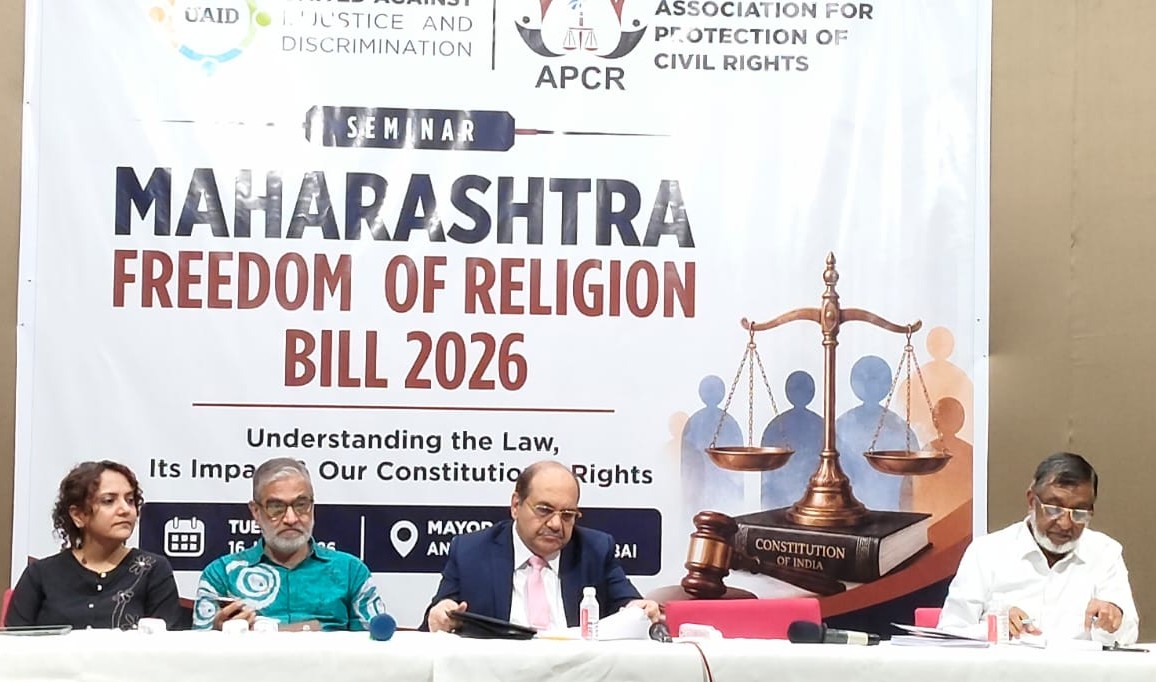
Mumbai : Speakers at a seminar in Mumbai, expressing concern over the proposed Maharashtra Freedom of Religion Bill 2026, observed that it is being presented as a measure to safeguard religious freedom, several of its provisions appear restrictive in nature and could adversely affect constitutionally protected rights.
According to Kashmir Media Service, the seminar organised under the aegis of the Association for Protection of Civil Rights (APCR) and the United Against Injustice and Discrimination (UAID), drew more than 250 legal professionals, academics, civil society members, and concerned citizens from diverse backgrounds.
Former Bombay High Court judge Justice Abhay Thipsay, who presided over the programme, underscored that the Constitution guarantees every citizen the right to freely profess, practice, and propagate religion.

Expressing concern over the proposed legislation, he cautioned that laws drafted with vague and ambiguous language often create uncertainty and fear rather than protection. Such ambiguity, he noted, has the potential to weaken social cohesion and undermine the spirit of mutual respect and pluralism that forms the foundation of Indian democracy.
Advocate Lara Jesani highlighted concerns regarding the broad interpretation of terms such as “allurement.” She warned that educational, charitable, social welfare, and community service activities, particularly those undertaken by minority institutions, could become vulnerable to misuse under the proposed framework.
She further pointed out that the legislation proposes severe penalties, including imprisonment of up to ten years and fines of up to ₹5 lakh in cases involving alleged conversion through marriage or inducement.
She also expressed concern over provisions that permit third parties or police authorities to initiate complaints and place the burden of proving innocence upon the accused, raising significant questions about due process and fundamental legal safeguards.
Dolphy D’Souza of Police Reforms Watch criticised the manner in which the draft Bill was prepared, alleging that it was formulated without meaningful public consultation. He called upon citizens across communities to engage with the proposed legislation and defend constitutional values.
Dr Saleem Khan, Member of the Central Advisory Council of Jamaat-e-Islami Hind, stated that matters of faith and belief are deeply personal and cannot be effectively regulated through coercive legal measures. He stressed the importance of protecting democratic rights and freedoms guaranteed under the Constitution.
Earlier, Shakir Shaikh, General Secretary of APCR Maharashtra, welcomed the participants and highlighted the growing need for public engagement on issues affecting civil rights and constitutional protections.