Manipur on the brink: Ethnic siege, state apathy and a failed internal security system
Modi govt turns a blind eye to bloodshed and suffering in strife-torn state
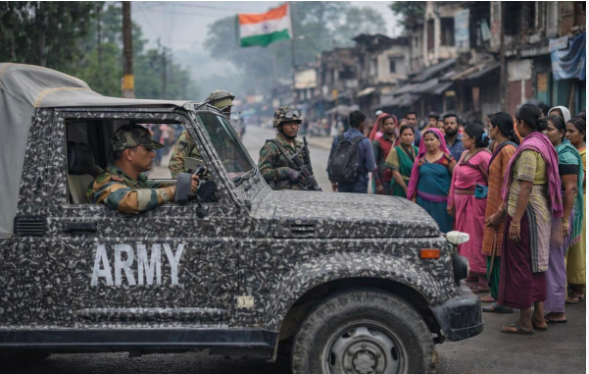 New Delhi: Political analysts have said that India’s conflict-ridden state of Manipur continues to burn in the flames of ethnic violence while Prime Minister Narendra Modi keeps projecting the narrative of a “Developed India” and claiming to have brought lasting peace to the country’s northeastern region.
According to Kashmir Media Service, analysts said that more than 58,000 people in Manipur remain displaced and are still living in dilapidated relief camps under extremely uncertain conditions. Thousands of homes have been destroyed, while the rehabilitation of affected families remains confined to official promises.
They said justice has become a mockery, as despite the registration of more than 3,000 cases relating to the ethnic violence that erupted in 2023, only a small number of charge sheets have been filed in courts. They maintained that both the Indian and state governments have treated accountability as an unnecessary burden, forcing even the Supreme Court of India to direct the establishment of special courts and expedite investigations.
The analysts said the latest bloodshed between Naga and Kuki communities has once again exposed the government’s criminal negligence, political indifference and administrative failure.

They said the killing of three Kuki-Zo church leaders in May 2026, followed by the abduction, killing and mutilation of six Naga civilians, triggered a severe economic blockade imposed by Naga groups. The blockade virtually cut off the supply of food, fuel and other essential commodities to Kuki-majority areas, causing a sharp rise in the prices of rice, LPG and other daily necessities, while the government remained a silent spectator instead of taking effective measures.
In response, Kuki-Zo groups launched a counter-blockade on the national highway during the last week of July. On August 2, a Kuki civil society organization in Ukhrul issued a 48-hour ultimatum demanding an end to the discriminatory restrictions on supplies, warning that a complete shutdown would begin from August 5 if the situation remained unresolved.
The analysts observed that the Modi government’s response has largely been limited to reviewing standard operating procedures and considering the redeployment of police commandos. They said the crisis, which has persisted since 2023, has been marked by routine meetings, paperwork and hollow official statements without any meaningful action on the ground.
They added that Indian forces and security agencies have attempted to portray the arrest of a few militants and an arms dealer, along with the surrender of several militants in July, as major achievements. However, these symbolic actions cannot conceal nearly three years of policy failures. Repeated attacks on Assam Rifles, injuries to Central Reserve Police Force (CRPF) personnel and the killing of a local volunteer demonstrate that violence continues unabated.
The analysts further noted that the recent visit of the Indian Army Chief to Manipur, where he reviewed the security situation and urged greater vigilance, proved to be yet another high-level symbolic exercise that failed to bring any tangible improvement to the ground situation.
They pointed out that India Post was forced to suspend several postal routes due to security concerns, describing it as further evidence of the collapse of governance in the state.
Meanwhile, flash floods in Churachandpur have further aggravated the humanitarian crisis facing already displaced and vulnerable communities. The analysts said the new Chief Minister continues to make official visits, hold meetings, launch anti-drug campaigns and repeat promises of peace, while cabinet expansion remains stalled and key roads connecting different communities remain blocked.
They maintained that the situation reflects not merely administrative incompetence but deliberate political priorities that place power and political interests above the protection of human lives.
The analysts said that although President’s Rule was imposed and later lifted, and the Bharatiya Janata Party (BJP) government has since been re-established, there has been no meaningful improvement in the lives of the people. Ethnic divisions, insecurity and humanitarian suffering continue unabated.
They said communities remain isolated from one another, highways are increasingly being used as instruments of economic warfare and pressure, and thousands of displaced civilians have been left at the mercy of official indifference.
The analysts concluded that while the Modi government projects India internationally as a model democracy committed to peace and good governance, it has abandoned one of its own states to ethnic blockades, displacement, economic sieges and persistent bloodshed. They said Manipur is no longer merely a law-and-order issue but a moral indictment of a governance system that continues to ignore the suffering, displacement and insecurity of the people of the India’s northeastern state.