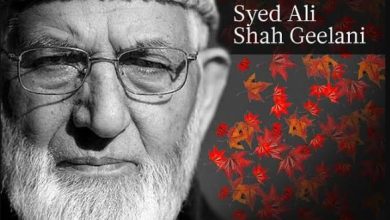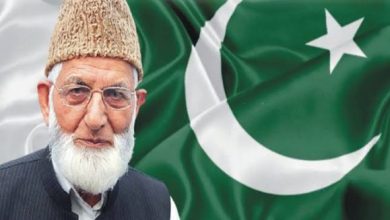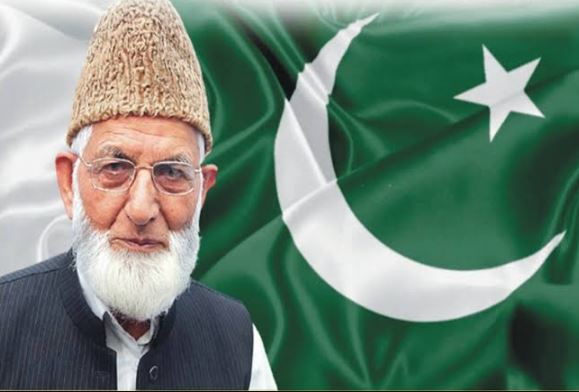
 A revolutionary leader is not made in peaceful times. Peaceful politics has its own tests—elections, parliamentary debates, public meetings, administrative performance and the ability to negotiate. But revolutionary leadership is tested when the political ground beneath one’s feet begins to shake, when Indian democratic institutions lost credibility, when Indian pressure becomes unbearable and, above all, when everything is offered in exchange for compromise. This was the real test faced by Syed Ali Shah Geelani. Geelani’s political Life-It cannot be judged simply by what Indian propagated against him the gathering heleaded or the speeches he delivered. His real political test came when Kashmir entered some of its most turbulent and difficult phases in 1989. At a time when political accommodation could offer personal comfort, influence and recognition, he chose to remain attached to his political conviction. That is what distinguishes revolutionary leadership from conventional politics. He was having strong political tested constituency to bank upon.
A conventional politician often measures success through power: how many votes were secured, what office was obtained, what influence was acquired and how long that influence could be maintained. A revolutionary leader is measured by a different standard: what does he do when compromise becomes more rewarding than resistance? Geelani’s answer remained remarkably consistent.He believed that the Kashmir dispute could not be reduced to elections, administrative arrangements or changes of government. For him, the fundamental question was the political future of the Kashmiri people and their right to determine that future.This explains one of the apparent contradictions in his political career.

Geelani accepted the electoral politics and won elections, yet he never regarded elections as a substitute for the Kashmir dispute. His participation in the electoral process was not, in his understanding, an endorsement of the political status quo.That distinction is important.An election can tell us who enjoys support within a particular electoral constituency. It does not necessarily settle the larger constitutional, legal or international question surrounding a disputed territory.
Geelani understood this distinction very clearly.He could enter the electoral arena without allowing the electoral arena to define his ultimate political objective.Indeed, his victories demonstrated that his politics were not without popular support. But what is more significant is that electoral success did not cause him to abandon the larger cause to which he had committed himself.This is where the question of leadership becomes particularly interesting.
A leader can win.A leader can lose. A leader can stick to stand and die without the comprise But there is a third possibility that is often forgotten: a leader can teach even after his death.Nations and political movements advance not merely by remembering their victories and defeats, but by learning from them. Experience is therefore more valuable than knowledge alone. Knowledge tells us what happened; experience teaches us why it happened; wisdom emerges when the lesson is carried into the future.The coming generation therefore needs to examine Geelani’s political life not merely as history, but as experience.One of the most important lessons is the importance of loyalty to a political objective.Kashmir’s history contains several examples of leaders making political choices under extraordinary circumstances.
The choices made in 1947 by Maharaja Supported by Sheikh Abdullah , in particular, continue to shape the political landscape of the region and the long bloodshed in Kashmir which is continue unabated. . Sheikh Abdullahsmass influence in 1947 was enormous. But his decision to cooperate with India during the crisis of accession remains one of the most contested and consequential decisions in Kashmir’s political history.From Geelani’s perspective, this was a strategic failure: the failure to distinguish between a temporary political arrangement and its long-term geopolitical consequences.
The subsequent history of Sheikh Abdullah’s dismissal and imprisonment became, for Geelani and his supporters, evidence that political accommodation could not necessarily guarantee political autonomy.The lesson is broader than the personalities involved.Political leaders must distinguish between friendship, strategic interest and temporary necessity.A decision made during a crisis may create consequences that last for generations.This is why Geelani repeatedly returned to the events surrounding 1947.
His argument was that once military control over territory becomes established, every subsequent political and diplomatic instrument operates within the shadow of that territorial reality.There is a hard truth in international politics: control of geography provides enormous strategic leverage and it is Indian strength in IIOJK But control is not legitimacy.A territory can be controlled militarily while the political question concerning that territory remains unresolved.Geelani’s political thought was built around this distinction.
He also preached something that many political leaders fail to understand: ideology can become a source of political endurance.Geelani did not view Kashmir simply as a territorial dispute between two states. He understood it through the wider prism of identity, history, geography, religion and the relationship between Kashmir and Pakistan. One may agree or disagree with his ideological conclusion, but there is little doubt that this framework gave his politics continuity.That continuity explains why he remained politically relevant for so long.He was not merely responding to events.
He was attempting to interpret them through a consistent political worldview.This is also why the Indian media’s description of him simply as a “hardliner” or “radical” does not fully explain his political character. Labels are easy; political analysis is difficult.A serious analysis must ask a more fundamental question: Was his objective uncompromising, or were all of his political methods equally uncompromising?The answer is more complex. Geelani participated in Indian style of democracy.
He operated within political institutions. He contested the political system from inside it while simultaneously refusing to accept that participation itself settled the larger Kashmir question. His politics was always Pakistan centric with clarity:institutional participation without ideological surrender.That may be one of the most important aspects of his political legacy.The real tragedy for any political movement is not losing an election or even losing a political battle. The real tragedy is losing the ability to learn.Geelani’s life leaves the coming generation with a difficult but important question:When everything is offered to a leader—recognition, influence, comfort, office and political accommodation—what remains of the cause?For Geelani, the answer was his political and Ideological conviction.That is why his leadership deserves to be studied beyond slogans and labels.
History ultimately agrees with all his political conclusions is a resolved question. But history cannot ignore the extraordinary endurance required to preserve a political objective through decades of turbulence and in Indian pressure cooker is remarkable contribution .A leader is not ultimately remembered for what he possessed. He is remembered for what he refused to surrender.And that, perhaps, was the real test of Syed Ali Shah Geelani and the people who accept his illogical linage in Toto.