400 overseas Indian academics issue ‘Spare India From Anarchy’ statement
New Delhi: More than 400 Indian-origin academics have signed a statement titled “Spare India from Anarchy.” They expressed concern over alleged attempts by the Modi government to undermine public confidence in constitutional institutions and democratic processes.
The signatories include students, researchers, academics and alumni from universities across 27 countries. The statement comes amid ongoing opposition protests in New Delhi.
Protesters demand ECI resignation


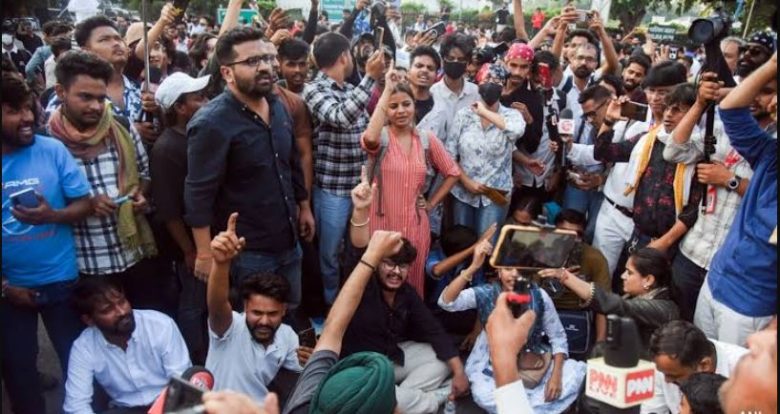
Indian forces personnel detained National Students’ Union of India (NSUI) activists during the “Ungli Toh Uthegi-Hallabol March.” The march proceeded from NSUI headquarters towards Jantar Mantar. Protesters demanded the resignation of Chief Election Commissioner Gyanesh Kumar.
The signatories are based in or have studied across four continents. They include individuals affiliated with the Massachusetts Institute of Technology (MIT), Oxford, Cambridge, Harvard, Yale, Stanford, Princeton and Columbia universities. Others are associated with the London School of Economics, National University of Singapore and University of Toronto.
‘Grammar of Anarchy’ warning
The statement maintains that Indian democracy has shown resilience since Independence. It says institutions function through checks and balances, while peaceful transfers of power remain an enduring feature.
The signatories express concern over what they describe as attempts to question democratic processes after unfavourable election outcomes. They also criticise challenges to judicial independence following adverse judgments and the involvement of the armed forces in partisan discourse.
“Pending judicial matters are being used to sow doubts about Indian democracy, with such arguments subsequently amplified through street protests.
Such actions, even when undertaken in the name of defending democracy, could undermine constitutional governance,” the statement read.
Citing B. R. Ambedkar, the architect of the Indian Constitution, the statement urges adherence to constitutional methods. It cautions against resorting to what it calls the “grammar of anarchy”.
The signatories acknowledge dissent as an essential component of democracy. However, they argue that disagreements should be resolved through constitutional mechanisms.
“We urge all social and political forces to take cognisance of our distress and desires and resolve differences through debate, discussion, dialogue and dissent under the roof of constitutional institutions,” the statement said.
The statement calls on India to set an example for democracies worldwide. It expresses hope that wisdom will prevail amid continuing opposition allegations of electoral irregularities and concerns over election integrity.