India’s hypocrisy on natural resource exploitation exposed
Mining projects continue in Manipur, Kerala and IIOJK despite opposition from local populations
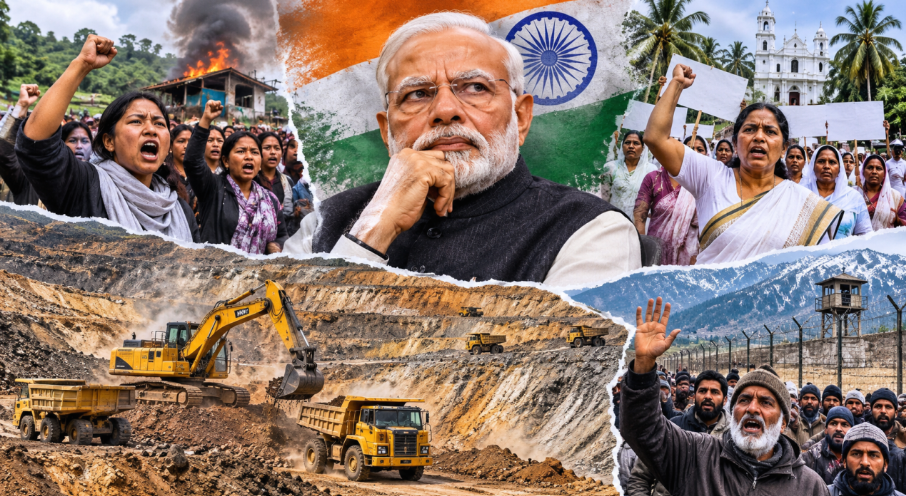
Islamabad: India, which lectures the world on preventing the exploitation of natural resources, is itself carrying out large-scale mining in its tribal hill regions, southern coastal states and Indian illegally occupied Jammu and Kashmir (IIOJK), despite opposition from local populations.
According to Kashmir Media Service, India’s actions expose a glaring contradiction between its claims and actual policies. Local populations and regional governments in Manipur, Kerala and IIOJK have raised serious concerns over mineral exploration and mining projects in their respective regions.
In Manipur, the BJP-led state government signed 39 memorandums of understanding (MoUs) with private companies during 2017-18. Under these agreements, plans were made to explore chromite, limestone, nickel, copper and platinum group metals in Ukhrul, Kamjong, Tengnoupal and Chandel districts, located along the Myanmar border. These hilly areas contain an estimated 6.66 million tonnes of chromite, of which around 5.5 million tonnes are located in Ukhrul and Kamjong districts.


On February 23, 2019, a 20-year agreement was signed with a company for chromite mining over 85 hectares in the Shingcha-Gamnom area of Kamjong district. According to local student organisations, no public consultation was held before these projects were initiated, nor were the required forest and environmental clearances obtained. Critics maintain that ethnic violence is being exploited to advance these projects. Around 300 people have so far been killed in the ongoing ethnic conflict in Manipur.
Forests in northeastern India are also facing the impact of mineral exploration projects. Under the Forest Conservation Amendment Act, 2023, the requirement for forest clearance has been removed for projects located within 100 kilometres of international borders. Most of northeastern India falls within this zone. Nagaland, Tripura, Mizoram and Sikkim have raised objections to the legislation, although the BJP or its allies are in power in some of these states.
In the southern state of Kerala, differences have also emerged between the BJP-led Indian government and the Congress-led state government over the exploitation of natural resources. The Modi government issued tenders for offshore blocks covering 242 square kilometres off the coast of Kollam. These areas contain an estimated 302 million tonnes of coastal mineral sand. The royalties generated from these projects will go to the Indian government rather than Kerala. The Kerala Assembly unanimously passed a resolution urging New Delhi to withdraw the relevant legislation. However, New Delhi has not halted the tendering process.
India is also involved in exploiting mineral resources in IIOJK. The Indian government has twice attempted to auction 5.9 million tonnes of lithium reserves in Reasi district. In November 2025, it also launched the first-ever e-auction of seven limestone blocks in the territory.
Meanwhile, India has also refused to accept international legal rulings on the Indus Waters Treaty. On August 31, 2026, the Court of Arbitration in The Hague unanimously ruled that India’s suspension of the treaty had no legal validity. However, New Delhi rejected the ruling and insisted on maintaining its suspension of the agreement.
New Delhi, meanwhile, signed its own critical minerals agreement with Washington on May 26, 2026, while Pakistan’s mineral-sector agreements with the US have been made public.
These developments raise serious questions about India’s policies on natural resource management. While New Delhi advocates equitable resource utilisation and respect for sovereignty at the international level, its own policies have drawn criticism over disregard for the rights of local populations and regional interests.