 In Delhi’s notorious Tihar Jail, Nayeem Ahmed Khan—a prominent Hurriyat leader whose life embodies unyielding resistance—has been left to languish under the haunting shadows of a dark cell for past seven years; without trial or formal conviction, denied access to justice and the basic principles of fair play. His continued and illegal imprisonment is nothing but a deliberate attempt to silence him and the ideology he represents.
Khan, who heads Jammu Kashmir National Front, is now in his late fifties, carries a lifelong legacy of political struggle dating back to his student day. His story is not merely one of personal endurance, but of a deep-rooted commitment to the cause of his people, forged in the crucible of Kashmir’s turbulent history. Currently held in the notorious Tihar Jail, his year’s long incarceration marks another chapter in a life largely spent behind bars, yet never silenced.
Khan’s journey into the heart of Kashmir’s resistance movement began during his college years in Srinagar. While pursuing a diploma in engineering, it was not blueprints and circuits that captured his imagination, but the resounding call for justice and selfdetermination echoing across the Valley. It was then that he joined the Islamic Students League, quickly rising to become its president. This early step was more than youthful idealism; it was the continuation of a family legacy steeped in resistance. His father, the late Ghulam Muhammad Khan, was a close associate and jail companion of the legendary revolutionary leader, Maqbool Ahmed Bhat. This paternal connection to the iconic martyr profoundly influenced Nayeem, instilling in him the principles of unwavering dedication and sacrifice that would define his life.
After his time with the Islamic Students League, Khan’s path led him to the Jammu

Kashmir People’s League, wherein he became an indispensable figure, a close associate of Shabir Shah, one of the most prominent resistance leaders. Khan’s role went far beyond that of a follower; he emerged as a principal architect, an accomplished organizer, and above all, a shrewd strategist behind the movement.
He played a monumental role in organising the People’s League, transforming it from a nascent group into a formidable force. Crucially, he understood the power of projection, working tirelessly to establish Shabir Shah’s stature as a leading voice of the resistance. Khan’s strategic mind and tireless efforts were instrumental in building the very foundations upon which much of the valley’s political movement would stand.
His commitment, however, came at a steep personal price. Incarceration became a
recurring theme in Nayeem Ahmed Khan’s life. He has been jailed numerous times, spending the majority of his adult life behind bars. Yet, each release saw him emerge not broken, but resolute. He would step back into the public eye, immediately resuming his work, organising rallies, mobilising support, and keeping the flame of resistance alive. His resilience became legendary. He understood that physical confinement could never imprison an idea or a spirit.
Beyond his organizational prowess, Khan possessed a visionary understanding of the importance of narrative and information. Recognizing the necessity of media in amplifying the Kashmiri voice to the world, he took a bold and unprecedented step. He invested the party’s funds into publishing the first-ever English daily newspaper from the Kashmir Valley. It was not just a business venture but a revolutionary step, a direct challenge to the information blockade and a crucial platform for articulating the aspirations and grievances of his people to a global audience.
Even his critics, a testament to his character, concede that Nayeem Ahmed Khan has never wavered in his principles. Detractors—some within the resistance itself—have accused him of being too uncompromising, too unwilling to bend to shifting political winds. Yet this very refusal to dilute his demands, to barter away the right to self-determination for personal freedom or political convenience, is what has earned him the deepest respect among the youth.
In a landscape fractured by factionalism, Khan was seen as a rare constant: the man who never cut a deal, never disowned the gun when the gun was the only voice left, and never disowned the people when the gun was taken from them.
His last imprisonment came as a result of carefully plotted trap by the Indian agencies. By early 2017 the Indian security grid had begun labelling him in their dossiers as “the new mobiliser,” while many in the Hurriyat old guard began to ask if the apprentice had outgrown his mentors.
On 30 May 2017, Times Now’s prime-time bulletin detonated the severest trial of Nayeem Khan’s life. Grainy, secretly filmed clips—shot, the channel claimed, with hidden cameras—at different place and different weathers, talking about financial transection . Within minutes the footage was viral, the National Investigation Agency had slapped him with the explosive charge of “waging war against the state,” and every screen in India replayed the same damning loop. Instead of capitulating, Khan converted the ambush into a masterclass in crisis control, turning the moment of apparent ruin into the opening move of a fierce political fight.
Far from crumbling under the pressure, Nayeem Khan navigated the ensuing storm with strategic precision. The broadcast sent shockwaves through the Hurriyat camp, prompting a hurried midnight meeting of Hurriyat. Hurriyat faction suspending him “pending explanation” was widely seen less as a disciplinary action and more as a panicked move. Through it all, Nayeem Khan maintained his poise, treating the legal and political onslaught not as a defeat but as a platform. He understood the power of narrative a moment of alleged vulnerability into a testament of his influence—a man whose reach and impact were significant enough to warrant such a concerted effort to undermine him. He emerged not diminished, but as a formidable figure who could indeed change the tides, knowing that true leadership is proven not in calm waters, but in the heart of the storm.
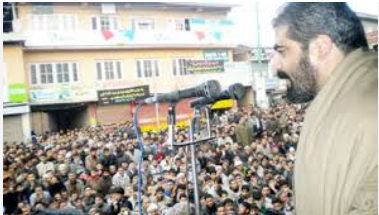
Aware that the state’s architecture—and even some of his own colleagues—disapproved, Nayeem also knew that many others stood with him. Meeting the crisis head-on, he toured Budgam’s central district, drawing thunderous crowds to rallies where he saluted the fallen freedom-fighters. Friends of the struggle were quick to praise the tour as masterful damage-control—and to credit Nayeem with turning the moment into leadership.
India may lock up Nayeem Khan and others like him, but it can never cage the ideals and ideology, which remain deeply etched in the Kashmiris’ collective memory.
Author is the chairman of Islamabad based think tank—Kashmir Institute of International
Relations (KIIR)—he can be reached via email: [email protected]