7,000 injured, 200 blinded; pellet terror leaves generation scarred in Kashmir
India uses torture, pellets, Pava, mines to disable oppressed Kashmiris
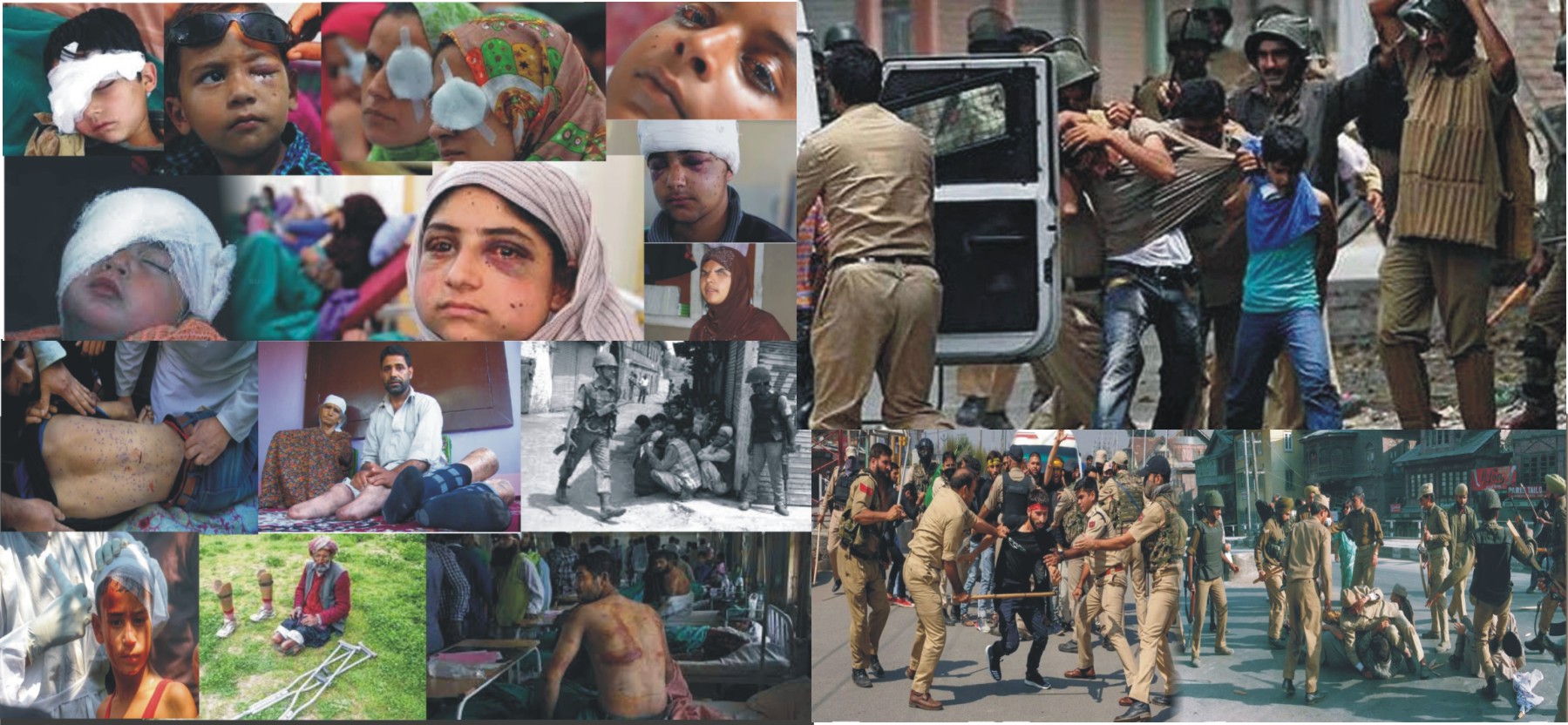 Srinagar: As the world observes International Day of Persons with Disabilities, today, oppressed people of people in illegally occupied Jammu and Kashmir continue to suffer from disabilities caused or exacerbated by the ongoing political injustice and systematic human rights violations.
A report released by Kashmir Media Service on the day, India continues to systematically use torture to disable the people in illegally occupied Jammu and Kashmir.
Human rights reports document various brutal torture techniques employed in interrogation centers, such as electric shocks, severe beatings, and burning with heated objects, which have left individuals permanently disabled or dead. The Victims of conflict-related disabilities often face a lack of proper healthcare, rehabilitation facilities, and financial or job compensation, making them highly dependent on their families, report said.
The draconian laws like the Armed Forces Special Powers Act (AFSPA) have been cited by human rights groups as contributing to an environment of impunity for Indian forces, where perpetrators of violence are rarely prosecuted in occupied territory.
The report maintained that the people with disabilities in the territory face double discrimination, stemming from both their disability and the general challenges of living in a disputed and war like occupied zone, often leading to social isolation and difficulty in accessing education and employment opportunities.
These findings have been detailed in reports by organizations such as the Jammu Kashmir Coalition of Civil Society (JKCCS), the Association of Parents of Disappeared Persons (APDP), Amnesty International, and the UN Office of the High Commissioner for Human Rights (OHCHR).
The report said brutal and inhuman torture techniques, employed by Indian forces personnel have left thousands of Kashmiris disabled for life, including hundreds losing eyesight in one or both eyes while over a thousand young boys and women’s faces and bodies were targeted in the Kashmir valley.
Among the most brutal tactics used by Indian forces personnel including army, paramilitary, police and Special Operation Groups to disable and maim the Kashmiris include firing of bullets, pellets, teargas and PAVA shells on peaceful protesters and mourners in the valley.
Besides, people are subjected to severe beating, electric shock, crushing the leg muscles with a wooden roller, burning with heated objects and hanging upside down by the Indian occupation forces’ personnel in interrogation centres.
The report deplored that besides, booby traps, landmines and mine blasts were also used against the hapless Kashmiris which had caused thousands of deaths and disabled innocent people of Kashmir since 1947.
Cases of disabilities have increased manifold since India started using deadly pellets as over three thousand Kashmiris are at the verge of losing vision in one or both eyes, it added.
Several thousand people have been injured, and hundreds permanently disabled (especially blinded) by pellets, bullets, tear gas shells, and PAVA in Kashmir valley since the widespread protests began in July 2008. The data said that between July 2016 and early 2019, highlight the severe impact of these pellet, Pava, teargas and bullet measures.
Over 6,200 people were reportedly injured by pellets between July 2016 and February 2017, according to a statement by the then Chief Minister Mehbooba Mufti.
At least 139 people were permanently blinded (lost sight in both eyes or one eye) due to pellet injuries, according to Human Rights Watch.
Around 1,459 people sustained eye injuries from pellets between 2016 and 2019, many requiring multiple surgeries, with a poor prognosis for regaining full vision. In a study of 777 patients with ocular injuries in late 2016, 82.4% had a final visual acuity of counting fingers or worse after treatment.
Beyond eye injuries, pellets, bullets, and other munitions have caused a range of other severe injuries, including damage to the abdomen, chest, and extremities, often requiring significant surgical interventions and resulting in long-term physical and psychological trauma.
According to reports and statistics cited by the Kashmir Media Service and other human rights sources, more than 7,000 people fell victim to pellet gun injuries since July 8, 2016, with over 200 losing their vision.
• In the four months between July and November 2016 alone, a single hospital in Srinagar recorded 777 patients with pellet gun-related ocular injuries.
• Doctors at SMHS hospital in Srinagar treated over 1,000 people with pellet injuries in the two years following the 2016 uprising.
• By April 2018, it was reported that a total of 1,314 eyes of 1,253 victims had been impaired since 2016.
• Between 2016 and 2019, Human Rights Watch reported that as many as 4,592 people sustained injuries from pellet shots, with 1,459 having eye injuries that permanently blinded 139 people.
• A Jammu Kashmir government report from January 2018 stated that 6,221 people had been injured by the guns.
Many of the victims were children and teenagers, and many were not involved in protests when they were shot.
Memories haunt Zuhaib Maqbool, 32, a photojournalist, on the 2016 recurrence of traumatic memories, like hundreds of other restless pellet victims who live in all major towns and villages in Kashmir find it hard to cope with the trauma of being hit by pellet shotguns. It was on September 4, 2016, when Zuhaib, like hundreds of others, was hit by a volley of pellets in his left eye. In his case, he was covering a protest in Srinagar’s Rainawari area, when hot metal balls pierced his left eye and the upper body. It was dark for 15 seconds, and thereafter, his life stands changed from being a storyteller to becoming a sad story himself. “I have a handicap to nurse all my life now. The world has grown hazy for me. I have to live behind shades. Every time I am alone in the bathroom or bedroom, I cry. It’s hard to be alone now,” Mr. Maqbool told media.
The photojournalist endured three procedures comprising six surgeries to save some degree of his eyesight, but they have not yielded the desired results. “Doctors have suggested three more procedures to rectify the damaged retina. It’s all in Allah’s hand now. Even painkillers fail to provide relief,” he said.
In 2018, Mr. Maqbool went to meet a person who was born blind to lessen his anxiety. “He asked me ‘how is the world outside’. I said it’s hazy. He replied ‘say thanks to the Almighty that it’s not black,” recalls Mr. Maqbool, who has also met counsellors.
The study titled ‘Psychiatric Morbidity in Pellet Injury Victims of the Kashmir Valley’, conducted by the Department of Psychiatry, Government Medical College (GMC), Srinagar, has thrown a spotlight on hundreds of pellet victims that are now a part of Kashmir’s growing population living with anxiety and depression. The study carried out by the GMC on 380 pellet and pellet-plus firearm injury patients showed that many of them were diagnosed with major depressive disorders (25.79%), followed by other issues — adjustment disorder (15.79%), panic disorder (12.11%), PTSD (9.21%), generalised anxiety disorder (7.89%), mixed anxiety with depression (5%), substance abuse (4.21%), specific phobia (2.89%), and hypomania (2.11%).
Between 1999 and 2015, the Landmine and Cluster Munition Monitor identified a number of 2,107 victims of activated mines, IEDs, and Explosive Remnants of War (ERW) were injured in occupied Jammu and Kashmir.
A 2008 study focusing specifically on the Poonch district estimated that more than 700 people were disabled by mines in 1998-2008.
In the Tosa Maidan area in Budgam district, a former Indian army’s artillery drill range, official figures indicate that more than 150 people were disabled by unexploded ordnance. Local residents, however, said the figures are much higher.
In 1965, Tosa Maidan in the Budgam district of Jammu and Kashmir was given on lease to the Indian Army for artillery drills and military exercises. At least 75 people were killed in Tosa Maidan ,The greatest number of deaths being reported by the Shungli Pora village.
One source mentions that between 1947 and 1989, more than 2,000 mine victims had been recorded in the Rajouri-Poonch district. In October 25 2024, a 40 year old civilian, Haneef was injured when he stepped on a landmine in Shahpur area of Poonch district. This only serves to demonstrate how landmines remain deadly hazards throughout the region, endangering both military individuals, and landmine incidents have always remained a reminder of the challenges in the disputed territory.
Landmines pose a particular risk to civilians including children who may mistake them for toys.
The infamous pellet shotguns used by Indian forces have blinded hundreds, including children. Who needs dreams when your vision has been stolen in the name of “crowd control”? Shall we send these survivors an invitation to the International Day of Disabled Persons celebrations? Perhaps we can ask the organizers to print Braille programs for the pellet-blinded teenagers from Kashmir. We can send them pictures of Hiba Nasir and Insha Mushtaq or maybe we can wheel in those who had their spines shattered in interrogation cells.
The report urged the international community to take notice of Indian government’s inhuman act of disabling the Kashmiris under a systematic torture mechanism in IIOJK.
#UseOfTortureToDisableKashmiris