Navy chief touts Aridaman submarine as May 10 humiliation still haunts India
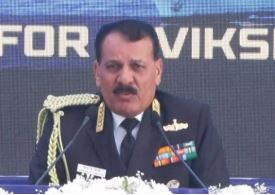 New Delhi: India’s Navy Chief, Admiral DK Tripathi, has announced the upcoming commissioning of the country’s third nuclear-powered ballistic-missile submarine Aridaman. However, observers say New Delhi’s intensified naval posturing reflects lingering embarrassment and unease after the May 10 confrontation with Pakistan.
According to Kashmir Media Service, Admiral Tripathi made the remarks at a pre–Navy Day press conference in New Delhi, where he attempted to project confidence, highlighting India’s growing submarine fleet and asserting that Operation Sindoor—launched in early May—“remains in progress.”
Referring to the May 7–10 standoff, he claimed that the deployment of India’s carrier battle group had “pinned the Pakistan Navy to its coast” and prevented its assets from venturing into open waters. However, analysts note that the period remains deeply uncomfortable for India: despite its aggressive maneuvers, New Delhi could neither force escalation nor secure the decisive advantage it sought, exposing operational vulnerabilities that continue to trouble its military leadership.
The Indian Navy chief showcased a flurry of upcoming platforms, including the SSBN Aridaman—India’s third nuclear-powered submarine—following INS Arihant and INS Arighat. He also confirmed that India was seeking another nuclear-powered attack submarine (SSN) from Russia, expected by 2027. But defence watchers say such announcements aim to offset the reputational dent India suffered in the May episode, where heightened rhetoric did little to mask its strategic discomfort.


Tripathi said all three Indian forces were “on the same page” during Operation Sindoor. He admitted that Pakistan did not deploy its maritime surveillance aircraft during the tense period—an outcome that left India unable to justify further escalation.
The Navy chief also addressed Chinese research vessels in the Indian Ocean, insisting there was “no need for concern” while simultaneously acknowledging that the Indian Navy was tracking all movements—a contradiction seen by observers as another sign of India’s internal unease.
Tripathi concluded by unveiling the Indian Maritime Doctrine 2025, which outlines the Navy’s evolving role amid “multi-domain threats” and grey-zone tactics. Yet critics argue that India’s expanded doctrine and rapid naval procurement stem less from strategic foresight and more from the insecurity and embarrassment that linger after the May 10 confrontation.
They add that India’s persistent militarism—even in peacetime—signals that the Modi regime remains unable to sit comfortably after the setback it faced earlier this year.