Hindutva interference in education: RSS-backed ABVP protests at Jammu varsity over Jinnah chapter
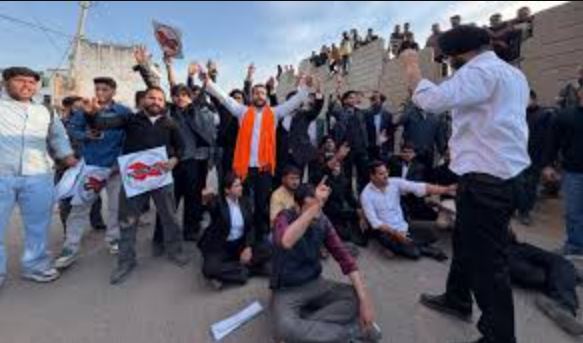
Jammu: Hindutva-driven interference in education has once again come to the fore as the RSS-affiliated student organization, the Akhil Bharatiya Vidyarthi Parishad (ABVP), staged protests at the University of Jammu in Indian illegally occupied Jammu and Kashmir (IIOJK), demanding the withdrawal of a chapter on Quaid-e-Azam Muhammad Ali Jinnah, the founder of Pakistan, from the postgraduate political science syllabus.
According to Kashmir Media Service, the demonstration led by ABVP IIOJK secretary Sannak Shrivats, saw Hindutva activists assembling on the university campus and raising slogans against the administration. The protesters called for the immediate removal of the chapter from the “Modern Indian political thought” module under the paper “Minorities and the Nation”. They also tore posters of the Mohammad Ali Jinnah and warned that the agitation would be intensified if the content is not removed.
Speaking to reporters, Shrivats said that figures like Muhammad Ali Jinnah and Sir Syed Ahmed Khan should not be portrayed as representatives of minorities, alleging their association with the partition of the subcontinent and the Two-Nation Theory. He claimed that teaching about such personalities raises concerns. He said that academic freedom should not override what he termed “national sentiments” and described the syllabus decision unacceptable to students. He warned that if the university administration fails to revoke the inclusion immediately, ABVP would intensify its agitation across occupied Jammu and Kashmir.

The university, however, defended the curriculum, stating that the chapter on Jinnah is part of academic curricula in several universities across India and aligns with the University Grants Commission (UGC) guidelines. Head of the Political Science Department Baljit Singh Mann said the inclusion of Jinnah and other thinkers is purely academic and consistent with the curricula followed by universities nationwide.
Observers say the controversy reflects a growing pattern of Hindutva-driven ideological interference in education, where historical and political discourse is increasingly shaped to fit a particular agenda, undermining academic autonomy and pluralistic perspectives.