Growing Gen Z-led student movement poses biggest challenge to Modi govt in years
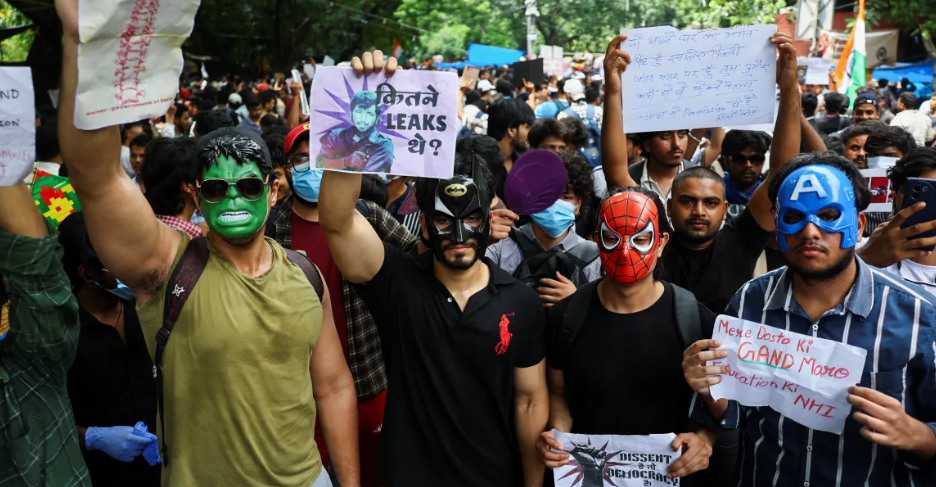
New Delhi : Thousands of Generation Z students, led by the Cockroach Janta Party (CJP), continued their anti-government protests in New Delhi and several other Indian cities despite and intensified crackdown, with analysts describing the movement as the most significant public challenge to the Modi government since the 2020-21 farmers’ agitation.
.
According to Kashmir Media Service, the protests, driven by mounting youth unemployment, examination paper leaks and declining economic opportunities, began on June 6 with students demanding the resignation of Indian Education Minister Dharmendra Pradhan over irregularities in the NEET examination.
The demonstrations gained further momentum after Sonam Wangchuk, a Ladakh-based activist and educator, joined the movement through a hunger strike that has now entered its 26th day. He is currently receiving medical care.
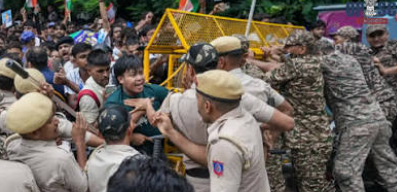
The protests escalated after students marching towards the Indian Parliament on Monday were tear-gassed and baton-charged by Delhi Police, leaving dozens injured. Protesters said that the police used excessive force to suppress the demonstration rather than disperse the crowd peacefully.
Speaking to the media, student protester Lavanya Singh said the examination paper leak reflected the government’s repeated failure to protect the interests of students, adding that feelings of betrayal, anger and hopelessness had united thousands of young people in protest
Political analyst Atman Trivedi, a partner at the Washington-based DGA Albright Stonebridge Group, told CNBC that the ongoing demonstrations could become the most significant public challenge to the Modi government since the farmers’ movement in 2020-2021. He said the CJP, which began as an online political satire campaign, has now turned into a “serious, real-world protest movement.”
The CJP was launched on May 16 by political communications strategist and Boston University student Abhijeet Dipke after Chief Justice of India Surya Kant reportedly likened unemployed youth and activists to “cockroaches” during a court hearing. Since then, the movement has gained massive traction on social media, attracting more than 22 million followers before its account was taken down. Dipke said that the Modi government was behind the action.
Meanwhile, opposition parties have intensified pressure on the BJP-led government to address the students’ demands and take action against those responsible for the police assault on protesters. The movement has also received support from regional political parties, civil society groups and farmers’ organizations, with prominent farmers’ leader Rakesh Tikait announcing solidarity with the students.
As protests spread to Bengaluru, Mumbai, Lucknow, Patna, Chandigarh and several other cities, CJP leaders declared that the “nation has awakened.” Student protester Angad Chabra from Bengaluru said frustration among young people had reached unprecedented levels and that the movement had given them a platform to collectively voice their grievances.
Adding to the concerns, India ranks as the “highest-risk country” in the Verisk Maplecroft’s Civil Unrest Index, a global risk analysis firm. Grievances are increasing in size, and average protest participation has more than doubled over the past year, while unrest is now geographically dispersed across India, Reema Bhattacharya, head of Asia research at Verisk Maplecroft, said in a note.