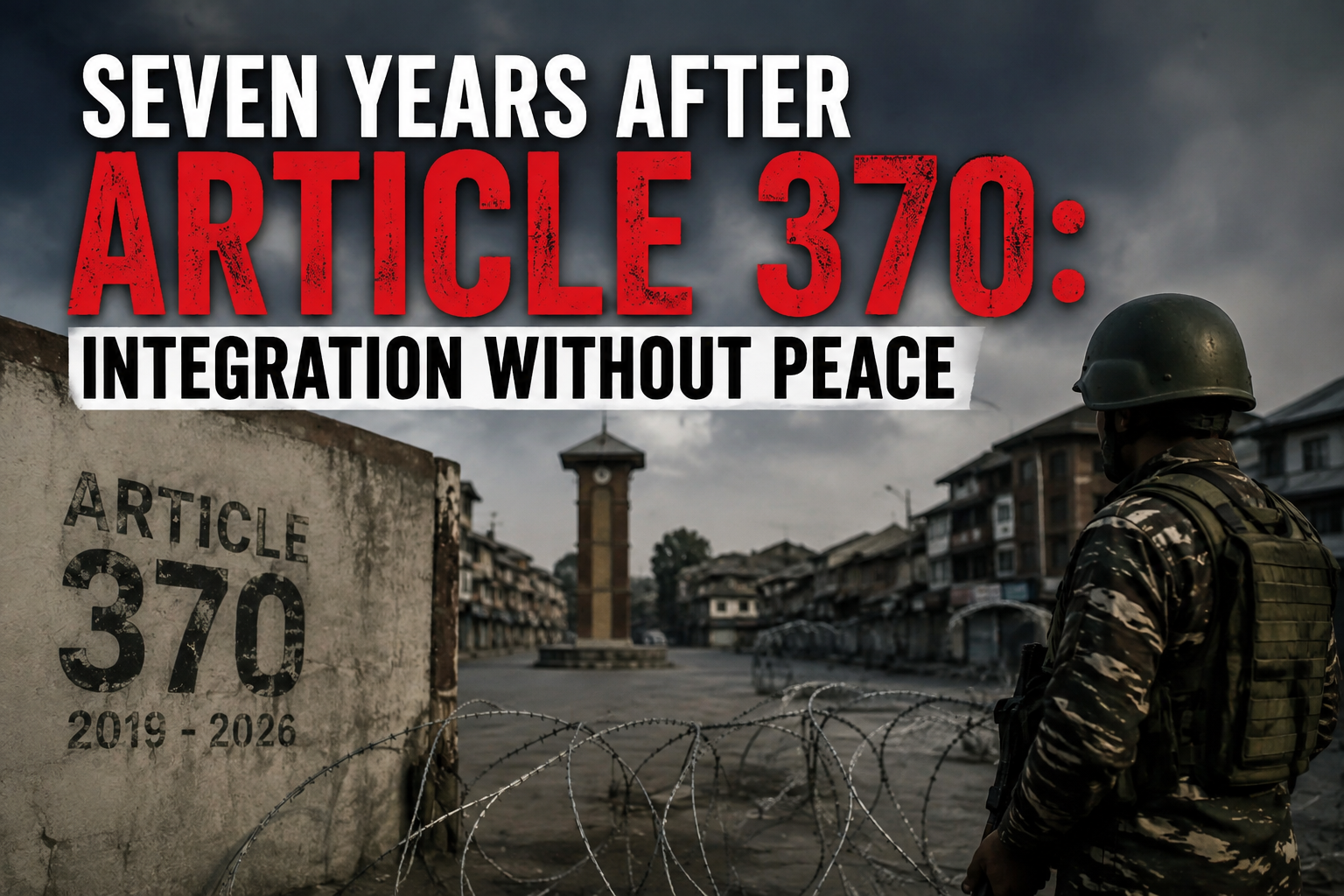
 “Occupation is the denial of freedom,” Noam Chomsky. Seven years after the abrogation of Article 370, Noam Chomsky’s observation provides a powerful lens through which to examine the situation in Indian Illegally Occupied Jammu and Kashmir (IIOJK). On 5 August 2019, the Government of India revoked Kashmir’s special constitutional status and divided the former state into two Union Territories under direct federal administration. The decision was promoted as a historic reform that would bring peace, development, investment, employment and an end to decades of conflict. Yet seven years later, the promised transformation remains elusive. Instead of political reconciliation, Kashmir has witnessed deeper centralization of authority, shrinking democratic space, continuing militarization and growing alienation among Kashmiris.
The events of 5 August 2019 represented far more than a constitutional amendment. They fundamentally altered the political relationship between Kashmir and the Indian Union. The region’s limited constitutional autonomy was removed without the consent of its elected legislature, which had already been dissolved. Statehood was downgraded to Union Territory status, placing key administrative and security decisions under New Delhi’s direct control. This was not an act of democratic integration but the unilateral restructuring of their political future.
The years that followed have been characterized by an unprecedented expansion of central authority. New domicile regulations widened eligibility for permanent residence, while amendments to land laws opened greater opportunities for land ownership by non-residents. Electoral constituencies were redrawn through the delimitation process and governance increasingly shifted from locally accountable institutions to centrally appointed administrators. Although presented as administrative reforms, these measures have generated widespread concerns about demographic change, political marginalization and the gradual erosion of Kashmir’s distinct identity.

Perhaps the most visible outcome of the post-2019 framework has been the narrowing of democratic space. Political leaders across the ideological spectrum were detained immediately after the constitutional changes, while prolonged restrictions were imposed on political activity. Journalists, lawyers, civil society organizations and human rights defenders have repeatedly reported increased legal pressure, surveillance and restrictions on freedom of expression. The continued use of security legislation, including the Public Safety Act (PSA) and the Unlawful Activities (Prevention) Act (UAPA), has reinforced concerns about preventive detention, prolonged incarceration and limited judicial safeguards. A political dispute cannot be sustainably managed when institutions for peaceful dissent and democratic participation become increasingly constrained.
Heavy security deployment continues to define everyday life across IIOJK. The persistence of violence demonstrates that constitutional restructuring has not addressed the deeper political drivers of the conflict. Stability maintained primarily through extensive security measures should not be mistaken for durable peace.
The implications extend beyond Kashmir itself. The constitutional changes of August 2019 further strained already fragile relations between India and Pakistan, both nuclear-armed neighbours with competing claims over the disputed territory. Although the 2021 ceasefire understanding reduced hostilities along the Line of Control, meaningful political dialogue between the two countries has remained limited. The dispute therefore continues to shape regional security while leaving the aspirations of Kashmiris largely absent from diplomatic engagement.
Seven years after Article 370’s abrogation, the gap between official narratives and political realities remains striking. The promises of peace, prosperity and normalcy were accompanied by expectations that constitutional integration would resolve one of South Asia’s longest-running conflicts. Instead, administrative integration has been accompanied by deeper political centralization, continuing debates over civil liberties and persistent questions about democratic legitimacy. The conflict has not disappeared; it has entered a different phase in which constitutional change has been followed by administrative consolidation rather than political reconciliation.
History demonstrates that enduring peace cannot be built through constitutional restructuring alone. It requires dialogue, democratic participation, accountability and the confidence of the people whose lives are directly shaped by state policy. Until political grievances are addressed in line with Kashmiris’ aspirations, claims of normalcy will remain contested. Seven years after 5 August 2019, Kashmir continues to remind the world that genuine peace is measured not by the extent of administrative control, but by the degree to which justice, political agency and human dignity are protected.
The writer is a student at the National Defense University and currently serving as a Research Associate at the Kashmir Institute of International Relations.