Statehood Denied: Seven Years of Union Territory Rule in Indian-Occupied Kashmir
Muhammad Waleed Akhtar
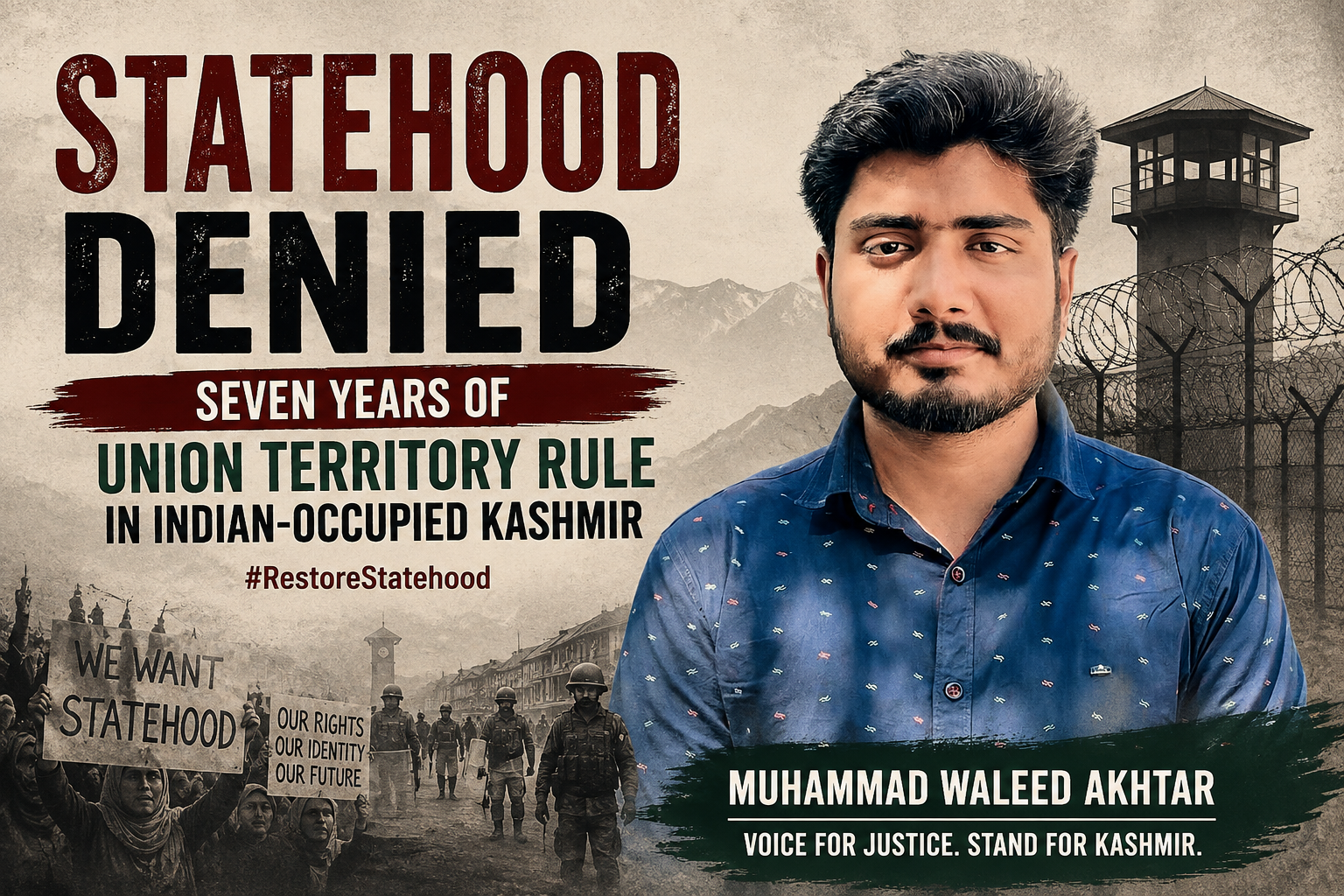
Nearly two years after taking office, Chief Minister Omar Abdullah still lacks authority over key functions of governance in Indian Illegally Occupied Jammu and Kashmir. He cannot control the police, appoint senior bureaucrats, or decide the leadership of the Anti-Corruption Bureau without the approval of the Lieutenant Governor, who answers to New Delhi rather than the elected assembly. These restrictions are embedded in the legal framework governing the Union Territory. Following the revocation of occupied Jammu and Kashmir’s special status on 5 August 2019, the Indian Supreme Court upheld the decision in December 2023 but directed that assembly elections be held by September 2024 and recorded the New Delhi’s assurance that statehood would be restored “at the earliest.” Elections were held on schedule, and Omar Abdullah assumed office in October 2024. Yet statehood remains pending. While India cites security concerns as justification, these do not explain why an elected government still lacks meaningful governing authority.
The reason is Section 53 of the Jammu and Kashmir Reorganisation Act, 2019. It establishes a Council of Ministers to aid and advise the Lieutenant Governor, but only on matters the assembly has power to legislate on. It then requires the Lieutenant Governor to act in his own discretion on any matter outside the assembly’s purview, any matter where discretion is required by law, and, explicitly, on all India Services and the Anti-Corruption Bureau. Since the assembly is separately barred from legislating on public order and police, those subjects fall automatically into the Lieutenant Governor’s domain too. The statute then closes the loop: if any question arises over whether a matter is discretionary, the Lieutenant Governor’s own determination is final, and it cannot be challenged in court on the ground that he ought or ought not to have treated it as his to decide. In July 2024, months before a single newly elected MLA took a seat, the Indian Home Ministry amended the territory’s business rules to tighten the Lieutenant Governor’s control over police postings, senior bureaucratic transfers and judicial appointments still further.

The Reorganisation Act invokes Article 239A, the same constitutional provision that governs Puducherry, as its model. The comparison is instructive precisely because it does not flatter Jammu and Kashmir. Puducherry’s founding statute, the Government of Union Territories Act of 1963, never names the bureaucracy or an anti-corruption body as the Administrator’s automatic preserve, and when Lieutenant Governor Kiran Bedi asserted sweeping authority over Puducherry’s administration in 2017, it took three years of litigation to settle the question. A single judge ruled in 2019 that she could not run a parallel government. A division bench then set that ruling aside in 2020, restoring much of her claimed authority, but only after the elected government had a real court fight to make its case. Section 53 forecloses even that. It writes the Lieutenant Governor’s supremacy into the statute itself and insulates his own judgment about its scope from review. Puducherry produced a contested case. IIOJK produces a foregone conclusion.
The 2022 delimitation exercise reinforced the same pattern in the electoral arithmetic. The Delimitation Commission raised the assembly’s total seats from 83 to 90 and gave Jammu six of them against one for the Kashmir Valley, shifting the chamber’s composition before a single vote was cast under the new boundaries, in a territory where the Valley had historically held the larger population share.
Nearly two years into Omar Abdullah’s term, the pattern has produced a predictable politics. His government drafted new business rules in early 2025 seeking clearer lines with the Lieutenant Governor; the file was returned unresolved. Indian Home Minister Amit Shah has repeated, as recently as October 2025 and again this year, that statehood will come “at the appropriate time,” without naming one. On 20 July, the National Conference brought that unmet promise to Delhi’s streets, and a petition asking the Supreme Court to set an actual deadline is listed for hearing on 8 August, three days after the seventh anniversary of the reorganisation that started the clock.
Seven years is longer than any previous period of direct central rule over the territory since independence. An assembly exists, and it was fairly elected. But an assembly that cannot direct its own police, choose its own senior officials, or oversee its own anti-corruption machinery is a legislature in name before it is one in function. India can point to the ballot box in Indian-Occupied Kashmir. It has not yet had to answer for what waits on the other side of it.
The author is a graduate in International Relations from the International Islamic University, Islamabad, and is currently serving as a researcher at the Kashmir Institute of International Relations, Islamabad.