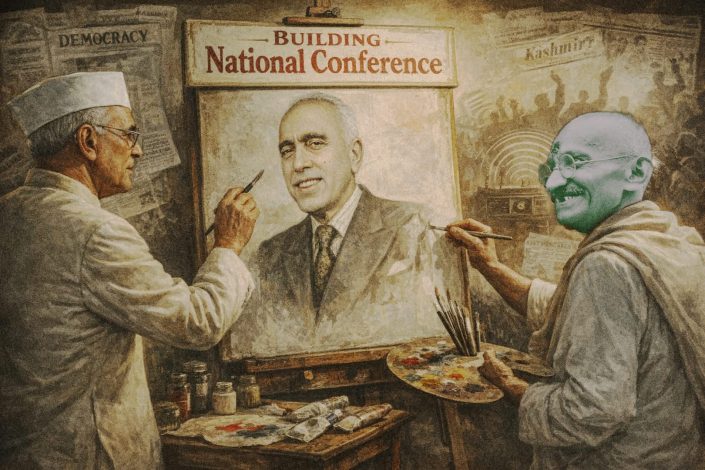
Few figures in the modern history of Jammu and Kashmir embody the contradictions of Kashmiri politics more vividly than Sheikh Mohammad Abdullah. He emerged as a formidable popular leader, challenged Dogra rule and helped mobilize Kashmiris politically. Yet after 1947, his politics increasingly converged with New Delhi, eventually bringing him back to power within India’s constitutional framework. Understanding that transformation is essential to understanding Kashmir’s unresolved political history.
A central pillar of the Indian narrative is that, had Pakistani tribesmen not entered Jammu and Kashmir in October 1947, India would not have intervened militarily and Kashmir might have emerged as an independent country. But when the events of 1947 are examined as a chronology rather than as a single episode, that proposition becomes increasingly difficult to sustain.


British historian Alastair Lamb examined this chronology extensively in Kashmir: A Disputed Legacy and Birth of a Tragedy: Kashmir 1947. He pointed to evidence that Patiala State forces had reached Jammu and Kashmir around October 17, 1947—several days before tribal forces crossed the Jhelum at Domel on October 21–22. Lamb further noted that when Indian troops arrived in Srinagar on October 27, Patiala troops were already present there. This chronology fundamentally complicates the claim that military developments in Kashmir began only after the tribal incursion.
The 1947 crisis therefore cannot be reduced to the tribal intervention alone. The Poonch uprising, the Maharaja’s changing position, the prior presence of Patiala forces, political calculations in New Delhi, Sheikh Abdullah’s established political relationships, the tribal entry, the accession controversy and the arrival of Indian troops formed an interconnected sequence of events. The work of Dr. Iqbal Qazilbash and other historians and researchers of the period adds to the broader body of scholarship challenging simplistic accounts of the crisis.
A.G. Noorani’s documentary scholarship provides another crucial link. His examination of Sheikh Abdullah’s relationship with Jawaharlal Nehru, Kashmir’s constitutional future and the political developments preceding October 1947 demonstrates that the relationship between Sheikh Abdullah and India’s political leadership did not suddenly emerge after Indian troops entered Kashmir. Its foundations had been laid considerably earlier.
Most revealing is Nehru’s own note on Kashmir dated June 17, 1947—more than four months before Indian troops entered Srinagar. Nehru wrote that the National Conference supported Kashmir joining India’s Constituent Assembly and described this as the “normal and obvious course.” (nehruarchive.in) The document seriously undermines the proposition that India’s political interest in Kashmir emerged only after the tribal intervention.
Another June 1947 record of a conversation between Nehru and Lord Mountbatten refers to Sheikh Abdullah’s release and political role. (nehruarchive.in) The documentary record thus points to a political relationship involving New Delhi and Sheikh Abdullah well before the Indian military intervention of October 1947.
Taken together, these documents support a compelling historical inference: New Delhi had incorporated Kashmir’s political future into its strategic calculations well before October 27. In that strategy, Sheikh Abdullah’s popularity and the National Conference’s organizational reach were of exceptional value. He was not simply a local political leader; his influence offered New Delhi an important political instrument through which its position in Kashmir could acquire a measure of local legitimacy.
Yet Sheikh Abdullah’s own earlier political position adds a profound contradiction to this story. His 1946 “Quit Kashmir” movement was rooted in the principle that political authority should derive from the people rather than simply from the Maharaja. Within a few years, however, his political trajectory had moved toward an accommodation in which Kashmir’s future was increasingly addressed within India’s constitutional framework.
His dismissal and imprisonment in 1953 exposed the limits of his relationship with New Delhi. After years of political struggle, the 1975 Indira–Sheikh Accord brought him back to office within India’s constitutional structure. A leader who had once mobilized Kashmiris around popular political authority had ultimately returned to power through an arrangement that accepted India’s constitutional sovereignty over the territory.
That contradiction lies at the heart of Sheikh Abdullah’s legacy. Political compromise is an unavoidable feature of political life. But when political office is secured by narrowing the political aspirations of the people whose support made a leader powerful, history must examine the price of that compromise.
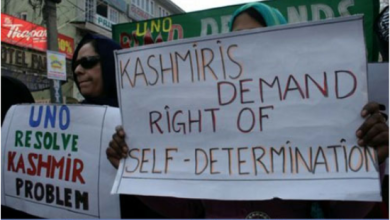
The United Nations record remains particularly important. Security Council Resolution 47, adopted on April 21, 1948, addressed the restoration of peace and order in Jammu and Kashmir and provided a framework for conditions conducive to a free and impartial plebiscite. The resolution stands as an international documentary record that Kashmir’s political future was not simply a matter for unilateral determination by India.
Nearly eight decades later, neither Sheikh Abdullah’s political compromises nor India’s official narrative has erased Kashmir’s underlying political question. Leaders have died, governments have changed and political arrangements have been rewritten, but the historical record remains.
Sheikh Abdullah’s legacy must therefore be examined as part of the larger history of Kashmir: the political developments preceding 1947, the competing narratives surrounding the tribal intervention, the military chronology, the relationship between New Delhi and Kashmiri political leadership, and the subsequent constitutional arrangements.
History does not belong to one government, one party or one political leader. It belongs to the record. And the record of Kashmir remains unfinished.