OIC Contact Group reaffirms support for Kashmiris’ right to self-determination
Raises concern over Indian actions in IIOJK, says South Asia peace hinges on Kashmir settlement
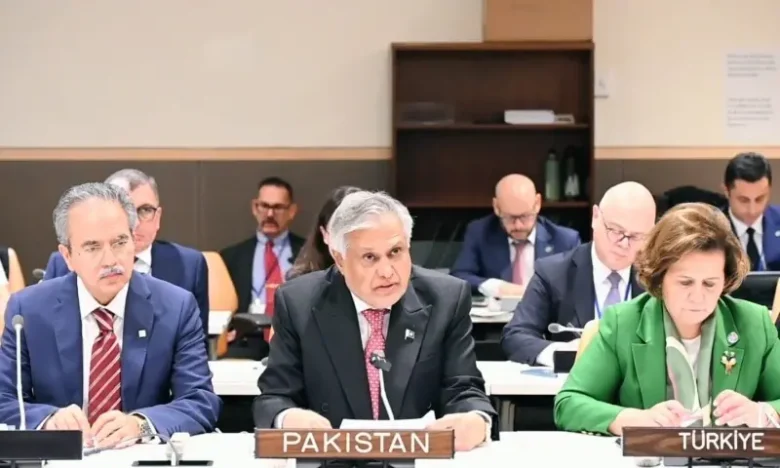 New York: The Organization of Islamic Cooperation’s (OIC) Contact Group on Jammu and Kashmir has reaffirmed its unwavering support for the Kashmiri people’s inalienable right to self-determination, as enshrined in relevant United Nations Security Council.
OIC Secretary-General Ismail Ould Cheikh Ahmed chaired the Contact Group meeting, held on the sidelines of the 81st session of the United Nations General Assembly in New York. Foreign ministers and senior officials of the Contact Group’s member states, Azerbaijan, Pakistan, Türkiye, Saudi Arabia and Niger, attended the meeting, the OIC said in a statement.
OIC Secretary-General Ismail Ould Cheikh Ahmed reaffirmed the organization’s commitment to supporting the Kashmiri people’s inalienable right to self-determination as the foundation for a just and lasting peace in South Asia, in accordance with UN Security Council resolutions and the principles of international law.
In a Joint Communique issued after the meeting, the Contact Group reaffirmed earlier OIC pronouncements and resolutions on the Jammu and Kashmir dispute and reiterated the joint communiques adopted by the group since September 2019.

The members expressed solidarity with the government and people of Pakistan and voiced deep concern over the military escalation in South Asia in May 2025, including the unlawful and unwarranted strikes at multiple locations in Pakistan and Azad Jammu and Kashmir. They stressed the need to exercise maximum restraint and avoid actions that could destabilize the region.
The Contact Group underscored that durable peace and stability in South Asia would remain contingent upon a final settlement of the Jammu and Kashmir dispute in accordance with relevant UN Security Council resolutions and the aspirations of the Kashmiri people.
The group expressed concern over the crackdown launched by Indian authorities in Indian illegally occupied Jammu and Kashmir (IIOJK) following the Pahalgam attack, including the arrest of around 2,800 persons and demolition of about three dozen houses. It also denounced the continued issuance of domicile certificates in IIOJK, noting that more than 3.4 million such certificates had been issued since 2019.
The members expressed serious concern over the continued detention and denial of bail to prominent Kashmiri pro-freedom leaders Muhammad Yasin Malik, Asiya Andrabi and Shabbir Ahmed Shah, who had been diagnosed with cancer.
They further condemned the prolonged detention of thousands of Kashmiri political workers, dissenters and human rights defenders, the banning of a number of Kashmiri political parties and the ongoing campaign to confiscate properties of Kashmiri activists.
The Contact Group also denounced restrictions on religious congregations at Srinagar’s historic Jamia Masjid and Eidgah during important occasions including Eid-ul-Azha and Eid-ul-Fitr.
It reiterated its rejection of India’s actions of August 5, 2019, and subsequent steps which it said were aimed at undermining the internationally recognized disputed status of IIOJK and altering its demographic structure and political landscape.
The members stressed that any electoral exercise in IIOJK under the Indian Constitution could not serve as a substitute for granting the people of Jammu and Kashmir their right to self-determination.
The contact group requested the OIC Secretary-General and member states to highlight the plight of the Kashmiri people at international forums, including the United Nations.
The participants also expressed concern over statements by some Indian leaders regarding Azad Jammu and Kashmir and Gilgit-Baltistan, describing such claims as a threat to regional peace.
The Contact Group called on the OIC Secretary-General and member states to continue highlighting the plight of the Kashmiri people at international forums, including the United Nations.