Books Banned, History Confined: A New Path toward Hindutva’s Ideological Domination in Kashmir
 Mushtaq Hussain
In Indian occupied Jammu and Kashmir, the removal of thousands of books from colleges, educational institutions and libraries on the grounds that they contain “objectionable” material is far more than an administrative exercise in screening publications. It raises fundamental questions about access to knowledge, academic freedom, intellectual inquiry and the right of readers to engage with diverse ideas. According to figures presented to the Jammu and Kashmir Legislative Assembly, 2,181,582 books and other publications have been reviewed, resulting in the withdrawal of 4,249 books from circulation, including 3,996 from institutions in the Kashmir region. In addition, 518 copies of 19 previously banned titles have been removed, while another 1,752 books have been referred for expert examination.
The significance of this action lies not only in the numbers, but also in what these books represent. A substantial portion of the literature concerned is connected, in one way or another, to Kashmir’s history, politics, society, literature, Islamic civilization and heritage, religious and cultural identity, and collective historical memory. To restrict a people’s access to their historical sources, literary heritage, cultural identity and competing intellectual and political perspectives is not simply to empty library shelves. It risks narrowing the collective consciousness of an entire generation. When young people are effectively told what they may read and what they may not, which historical accounts are acceptable and which are not, education risks becoming an instrument of an approved narrative rather than a means of inquiry, questioning and critical thought.
This development assumes even greater significance in the context of the far-reaching changes introduced after August 5, 2019. On that date, India revoked the constitutional provisions governing occupied Jammu and Kashmir’s special status and reorganized the former state into two federally administered territories. Subsequent changes to domicile, land and other laws have generated concerns about the region’s political and demographic future. United Nations human rights experts have also raised concerns about the potential discriminatory implications of some of these changes, particularly in relation to land, employment and political rights.
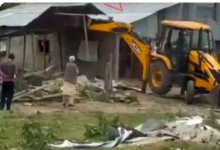
These developments cannot be viewed in complete isolation from concerns about Kashmir’s demographic composition and the future of its majority community’s political and cultural role. When constitutional safeguards are dismantled, rules governing domicile and land are substantially altered, and literature relating to a region’s history, politics and cultural identity is simultaneously subjected to increasingly restrictive scrutiny, the cumulative implications deserve serious examination.
At the same time, the growing visibility of cultural and ideological currents associated with Hindutva has deepened these concerns. The promotion of Vande Mataram in educational and official settings is one example. In recent years, questions have repeatedly arisen over the song’s place in schools, public institutions and official ceremonies, including disputes over whether its recitation should be compulsory.
The expanding influence of the Rashtriya Swayamsevak Sangh (RSS) and the increasing public projection of religious and cultural practices associated with Hindutva also warrant attention in this broader context. The proposed “Tantra in Silence” retreat in Gurez, Bandipora, scheduled for September 2026, became another point of controversy. The local administration and tourism authorities made clear that no official permission had been granted for the event. Yet the controversy itself cannot simply be detached from wider questions about the changing cultural landscape of Kashmir and the space being accorded to different religious and cultural traditions.
By contrast, actions against Islamic educational institutions and institutions associated with an Islamic educational environment have become increasingly consequential. The government has taken control of the management of hundreds of schools associated with the Falah-e-Aam Trust. In August 2025, management of 215 schools affiliated with the organization was taken over, followed in April 2026 by the takeover of another 58 schools in the Valley.
Another significant example is Darul Uloom Jamia Siraj-ul-Uloom in Shopian, a well-known religious educational institution. In April 2026, the Jammu and Kashmir administration declared it an “unlawful entity” under the Unlawful Activities (Prevention) Act (UAPA), citing alleged links to the banned Jamaat-e-Islami and other grounds set out in the administrative order. Subsequent legal and administrative action has placed the institution and its associated foundation under severe restrictions.
The central issue, therefore, is not any single book, song or institution. It is the future of Kashmir’s intellectual, cultural and civilizational identity. If literature dealing with Islamic and Kashmiri history and culture is removed from libraries, Islamic educational institutions face closure or state control, while a particular majoritarian ideological and cultural framework gains greater space in educational and official settings, these developments can no longer be viewed merely as isolated administrative decisions. Their cumulative impact demands scrutiny.
Fear of books can become fear of questions. A healthy educational system depends on the freedom to encounter competing perspectives, ask difficult questions, examine historical evidence from multiple sources and reach independent conclusions. History should be studied through evidence, scholarship and open intellectual debate—not filtered through an officially sanctioned framework.
The international community should therefore take a serious and independent interest in these developments. The titles of all withdrawn books, their authors and publishers, and the specific grounds for their removal should be made public. An independent review mechanism involving historians, scholars, educators, writers and librarians should be established to assess disputed material according to transparent and internationally recognized academic standards. Political, historical or ideological disagreement should not, by itself, become grounds for denying students and readers access to books.
At the same time, books documenting Kashmir’s history, Islamic civilization and heritage, languages, literature and cultural traditions urgently need to be digitized, systematically archived, preserved in international repositories and made available to scholars worldwide. Kashmiri universities, researchers, writers and cultural institutions should work together to create a comprehensive digital archive so that the region’s intellectual and historical memory cannot be erased or diminished by administrative decree.
The world must recognize that books are not merely pages bound between covers. They are repositories of a people’s memory, identity, history, civilization and intellectual inheritance. When books are banned, questions are confined; when questions are confined, history risks becoming one-dimensional; and when history becomes one-dimensional, the formation of a new generation’s consciousness can increasingly fall under the influence of a single ideological framework.
The way forward is therefore clear: policies governing books, educational institutions, religious and cultural expression, and historical literature in Kashmir must be subjected to transparent, independent and internationally credible scrutiny. Knowledge must remain free, history must be preserved, Kashmir’s Islamic and indigenous cultural identity must be respected, and education must remain protected from ideological domination.
Preserving Kashmir’s historical, Islamic and cultural memory is not merely a responsibility owed to Kashmiris. It is a responsibility shared by everyone who believes that history, knowledge, pluralism and intellectual freedom must remain beyond the reach of political control.