New law allows commercial use of IIOJK farmland, experts warn famine, disaster
Allowing high-rises on farmland a deliberate to undermine Kashmir economy
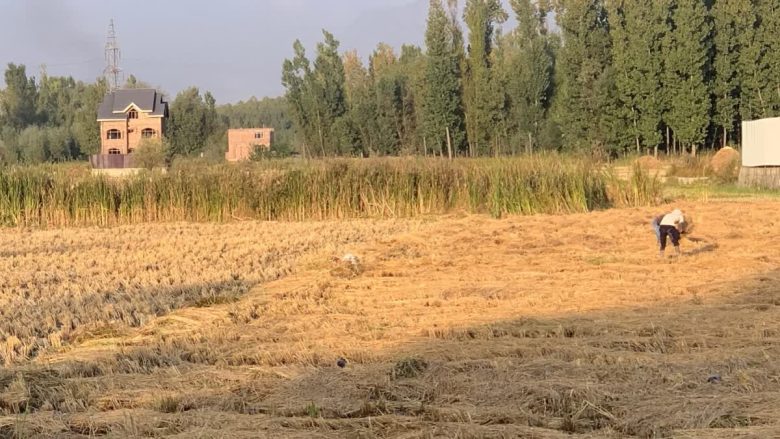
Srinagar: Indian illegally occupied Jammu and Kashmir’s agriculture-based economy faces deliberate destruction under new business law.
People of Kashmir solely depend on agriculture for their livelihood and sustenance. Their source of income is being deliberately undermined by allowing high-rises on farmland. New Jammu and Kashmir Ease of Doing Business Bill 2026 allows commercial construction on agricultural land. Bill was tabled by Chief Minister Omar Abdullah on September 28 in assembly. Lieutenant Governor Manoj Sinha gave nod, setting stage for implementation across territory.
Under new law, only Red and Orange category industries are prohibited on farmland. Activities not classified by Central Pollution Control Board (CPCB) are allowed freely. Service and infrastructure development sectors are permitted on agricultural and horticulture land. This marks departure from existing policy banning construction on agricultural land. Earlier, conversion required permission from District Collector after district-level committee recommendation under 2022 Regulations. Now owners just need third-party certification by government-approved consultant for construction.


Agriculture mainstay under threat
Agriculture remains mainstay of occupied Jammu and Kashmir economy sustaining 70 percent population. Total cultivable land area is 10.97 lakh hectares as of 2024-25. Horticulture sector spans 3.47 lakh hectares supporting over 7 lakh families. It represents approximately 35 lakh individuals dependent on orchards for survival. According to official data, agriculture contributes nearly 10 percent to Gross Domestic Product (GDP).
It generates estimated annual income around Rs 10,000 crore for territory. One hectare of orchard generates about 400 man-days employment annually, official estimates show. Chief Minister reportedly received briefing from law department at civil secretariat Srinagar. He did not raise objection to document during detailed presentation. Senior official said they expected opposition to corner government over controversial provisions in assembly.
One provision allows commercial activities inside residential areas barring heavy industries. Cold storage, freight complexes, night clubs and liquor shops are excluded. New law allows residential properties up to 24 metres high, approximately eight storeys. Total built-up area of 5,000 square metres can bypass Floor Area Ratio (FAR) limits. Commercial malls with same specifications can be built without government approval.
Seismic and flood risks ignored
Norms contrast sharply with government’s own hazard profile of occupied Jammu and Kashmir. Major parts of Kashmir Valley and Doda, Ramban, Kishtwar fall under Zone V. Zone V indicates very high seismic vulnerability housing 50 percent population. In 2025, Bureau of Indian Standards (BIS) classified 60 percent landmass under moderate-to-high risk. Although updates were withdrawn, mapping underscored Kashmir’s high-risk structural vulnerability. Last major earthquake in 2005 measuring 7.6 Richter scale wreaked havoc. It claimed 75,000 lives in Azad Kashmir and about 1,400 in occupied Jammu and Kashmir. Around 112,000 houses were damaged leaving millions homeless in region. Recent 2026 study analysed soil data from 87 wards of Srinagar city. It found high to severe susceptibility to liquefaction along River Jhelum. Loose alluvial deposits and shallow groundwater worsen ground failure during shaking.
Experts have warned about serious consequences including famine and destruction. Former Chief Town Planner Iftikhar Ahmad Hakim said IIT experts earlier disallowed high-rise government housing due to liquefaction risk. Liquefaction occurs when water-logged sediments lose strength during strong shaking. It causes major damage to buildings, United States Geological Survey explains. Kashmir faced catastrophic flood in 2014 displacing one million people. More than one third of Srinagar was submerged along with villages.
“You are allowing eight-storey buildings with no setbacks,” Hakim said. “Buildings in waterlogged seismic conditions will float in water,” he added. Multiplying vulnerability of city through such construction is dangerous, he warned. Citing Karnataka, Telangana and Gujarat examples, planner said those states reduced friction. But they did so under master plan framework, not bypassing it. New law was passed without public consultation bypassing master plan completely, he said.
Master plan violated, concrete jungle feared
Master plan is vision document prepared through technical analysis and public participation. It determines infrastructure requirements and land-use regulation based on population parameters. Randomly allowing land use conversion without infrastructure will create urban crisis, Hakim told media. Group of Concerned Citizens led by former bureaucrat Khurshid Ganai expressed concern. They have no objection to ease of business but oppose Schedules 2, 3 and 5.
Allowing white and green industries in residential areas violates master plan, he said. It will wreak havoc in residential areas of Kashmir, he warned. Ganai said law allows free-for-all construction by relaxing building norms completely. It is license to create concrete jungle affecting ordinary people’s lives, he said. He asked government to revisit law for fresh revision and amendment.
Environmental Policy Group (EPG)
Convenor Fiaz Bakshi flagged Section 22 breadth of powers. Jammu and Kashmir faces seismic vulnerability, floods, landslides and wetland loss, he said. Srinagar Master Plan recognises flood-absorption basins, wetlands and seismic constraints. Development without risk screening increases disaster exposure, he warned. Ease of doing business must not become ease of building anywhere, he added.
Allowing commercial high-rises on farmland deliberately undermines Kashmiri economy and ecology. It paves way for demographic change through non-local business takeover of land. Destruction of orchards will snatch livelihood of lakhs dependent on agriculture.
Deliberate attempt to undermine economy
Agriculture and horticulture are backbone of occupied Jammu and Kashmir economy. Indian government since August 5, 2019, has introduced laws to alter land ownership. New business law is seen as extension of settler-colonial project in territory.