Pakistan urges UNSC to implement its resolutions on Kashmir
 United Nations:
Pakistan has called on the international community to implement the long-standing UN Security Council resolutions guaranteeing the right to self-determination for the Kashmiri people, saying those resolutions have no expiry date.
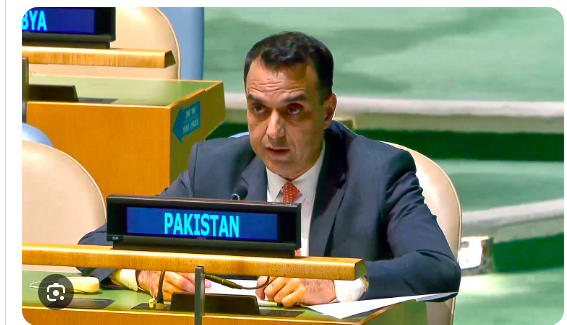
Pakistan’s Acting Permanent Representative to the United Nations, Ambassador Usman Jadoon, addressing the UN General Assembly’s Fourth Committee deliberations on decolonization and special political affairs, underscored the systematic denial of these fundamental freedoms. He described the resolutions on the Jammu and Kashmir dispute as an essential obligation for global peace and stability.
The Pakistani envoy, speaking on the implementation of the Declaration on Decolonization, said that while settler colonialism remained an enduring reality in certain occupied territories, the promise of self-determination also remained unfulfilled for the peoples of Occupied Palestine and Indian Illegally Occupied Jammu and Kashmir.
Pakistan to continue its political, diplomatic and moral support for Kashmiris’ legitimate struggle
Ambassador Jadoon said Pakistan had stood firmly with peoples struggling to determine their own future since independence, pledging to continue its political, diplomatic and moral support for their legitimate struggle.
He said Security Council resolutions provide for a free and impartial plebiscite under UN auspices and were accepted by both India and Pakistan. “Time does not extinguish these commitments,” he pointed out.
The Pakistani envoy also highlighted growing concerns over intensifying restrictions on fundamental freedoms in occupied Kashmir, alongside deliberate legislative and administrative attempts to alter the region’s demographic and political character.
India’s illegal measures of 5 August 2019 and subsequent unilateral actions, he warned, could not alter Jammu and Kashmir’s internationally recognized disputed status.
“Domestic legislation and sham electoral exercises cannot substitute for self-determination.”
Ambassador Jadoon demanded that India halt these violations, release detained political leaders and human rights defenders, reverse its unlawful measures imposed in the occupied territory since 5 August 2019, allow independent international human rights scrutiny and implement UN Security Council resolutions to ensure that the Kashmiri people realize their right to self-determination.
Pakistan seeks peaceful relations with all its neighbours
Pakistan seeks peaceful relations with all its neighbours, he said, emphasizing that durable peace in South Asia requires a just settlement of the Jammu and Kashmir dispute in accordance with Security Council resolutions and the wishes of the Kashmiri people.
“The international community must actively advance this objective,” he added.
On the Palestinian tragedy, the Pakistani envoy said that despite the ceasefire, continuing violence, displacement and restrictions on humanitarian assistance were perpetuating the humanitarian catastrophe. Since October last year, he said, more than 1,400 people had been killed.
“The ceasefire must be fully implemented; humanitarian assistance must flow safely, unimpeded and at scale, with UNRWA enabled to fulfil its mandate.”
Pakistan supports US-proposed Gaza Peace Plan and implementation of UN resolution 2803
Pakistan supports the US-proposed Gaza Peace Plan and the implementation of UN Security Council Resolution 2803.
The recovery of war-shattered Gaza must uphold Palestinian ownership and the enclave’s unity with the West Bank, including East Jerusalem, Ambassador Jadoon said.
“Forced displacement and demographic alteration must be rejected,” he said, stressing that illegal settlements, organized settler violence and land seizures threatened the two-state solution to the Israel-Palestine dispute. The E1 project would undermine Palestinian territorial contiguity and must be stopped, he added.
“Lasting peace requires an end to occupation and an independent, sovereign, viable and contiguous State of Palestine on the pre-1967 borders, with Al-Quds Al-Sharif as its capital,” he maintained.
Ambassador Jadoon’s strong remarks in support of the Kashmiri people’s right to self-determination drew a response from an Indian delegate, who accused Pakistan of abusing the forum.
Exercising her right of reply, Mahima Kumari Mewar, a member of the Indian Parliament, said Jammu and Kashmir would always remain an integral and inalienable part of India and commented on Pakistan’s internal affairs.
Reacting to India’s “false” statement, Pakistani delegate Ansar Shah said, “Jammu and Kashmir is neither an ‘integral part’ of India nor its internal matter.”
“Repetition cannot rewrite history. Occupation cannot create sovereignty. And denial cannot erase an internationally recognized dispute,” asserted Shah, a first secretary at the Pakistan Mission to the UN.
Jammu and Kashmir internationally recognized as a dispute before the UN
Highlighting that Jammu and Kashmir is an internationally recognized dispute before the United Nations, Shah said numerous Security Council resolutions reaffirm the principle that the territory’s future must be decided by its people through the exercise of their inalienable right to self-determination.
The Pakistani delegate rejected as “absurd” India’s repeated attempts to draw comparisons between Azad Jammu and Kashmir and Indian Illegally Occupied Jammu and Kashmir.
In Azad Jammu and Kashmir, he insisted, Kashmiris live freely and express themselves. “They protest. They participate in political life. They raise their voices.”
“In Indian illegally occupied Jammu and Kashmir, political voices are silenced, dissent is criminalized, thousands have faced detention, demographic changes are imposed and the fundamental right to self-determination remains denied,” Shah said.
The real question, he asked, was whether India would honour Security Council resolutions and Article 25 of the UN Charter and allow the promised free and impartial plebiscite under UN auspices.