Modi govt’s development claims contradicted by plight of IIOJK lecturers
Over 4,000 educators await promotion confirmation and service benefits; some died awaiting justice
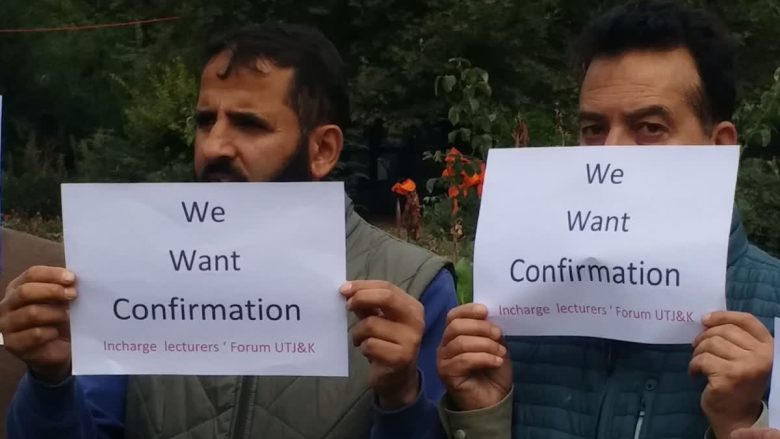 Srinagar: More than 4,000 in-charge lecturers in Indian illegally occupied Jammu and Kashmir (IIOJK), including over 2,000 who have retired and more than 2,000 who remain in service, are awaiting confirmation of their promotions and the service benefits attached to the posts. Some have died while their cases remain unresolved, while others continue to face salary anomalies and uncertainty over their pensions.
The IIOJK Education Department promoted teachers in 36 subjects as in-charge lecturers, but their promotions remain unconfirmed, delaying the release of their due service benefits.
Makhmoor Ahmad Bichoo was appointed as a teacher in the Education Department in 1997 and promoted to lecturer in Commerce in 2013. He retired this year but has continued to receive the salary applicable to a master, the post to which he was promoted in 2010.
For 13 years, Bichoo taught Commerce students at different schools and performed various duties as a gazetted officer, yet he continued to draw the salary of a master.
Vilayat Hussain was promoted as an in-charge lecturer in 2014 and retired in April 2022. He, too, is awaiting confirmation and receives a pension based on the post of master, despite having served as a lecturer since 2014.

Besides Bichoo and Hussain, more than 2,000 in-charge lecturers promoted since 2013 have reportedly retired without receiving the service benefits due to delays in confirming their promotions.
“We moved our files from one department to another in the Civil Secretariat. We met dozens of officers during these years, but our confirmation as lecturer has not been finalised yet,” Bichoo was quoted by ETV Bharat as saying.
Ravijeet Singh, a teacher from south Kashmir’s Islamabad district, said he was promoted as an in-charge lecturer in Punjabi in 2019 but had yet to receive confirmation or service benefits. “I fear I will also retire without being confirmed as a lecturer, which is my right,” he said.
Singh said several of his colleagues had died during the intervening years, while their files remained pending in the Civil Secretariat. “Our files are gathering dust. The elected government must address our confirmation issue,” he said.
In addition to those who have retired, over 2,000 serving lecturers promoted from the post of master to in-charge lecturer in 2019 have faced salary anomalies for the past seven years because their promotions remain unconfirmed.
“Our confirmation is also awaited, and there are bundles of files lying in different offices of the Civil Secretariat,” Bashir Ahmad Paddar, an in-charge lecturer, said.
Paddar said the lecturers had been assigned the responsibilities of gazetted officers but continued to receive the pay applicable to masters.
Nasir Shabir, who was promoted as an in-charge lecturer in English in 2019, is also awaiting confirmation and remains uncertain about whether his service will be recognised at the lecturer level.
“We are not paid a charge allowance. The government must resolve our issue and not treat us as beggars,” he said.
IIOJK Education Department officials said the cases were being examined by the Human Resource Management Section, where the lecturers’ documents were under scrutiny.
“This process has been going on for the last decade. We are hearing the same arguments from the officers in the education department. The finance department has concurred with our confirmation, yet our department is not clearing our files,” Shabir said.
The plight of thousands of in-charge lecturers highlights the contrast between the Modi government’s development claims in IIOJK and the difficulties faced by educators. The fact that some have retired or died before their cases were resolved underscores the human cost of bureaucratic delays, while continued salary disparities and pending service benefits raise questions about administrative accountability and the government’s response to employees’ grievances.