Two RSS-linked Hindutva outfits in US raise millions through donations
Money funnelled to India by RSS-linked organisations, donor-advised funds
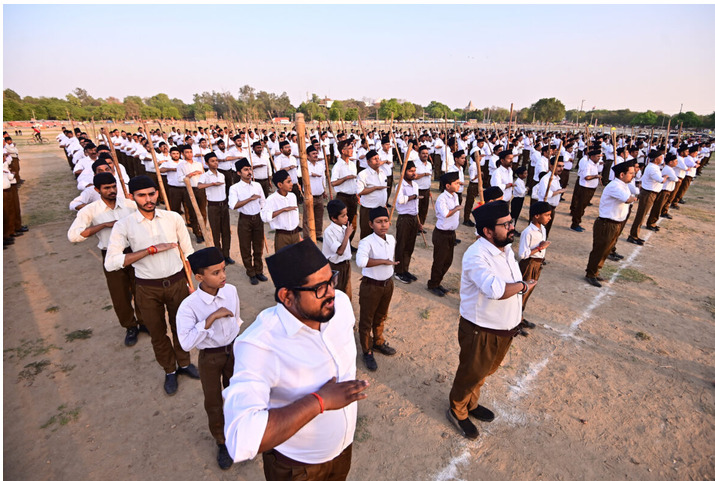
Washington : A Bellingcat investigation has revealed that two US-based charities linked to the Rashtriya Swayamsevak Sangh (RSS) network—Ekal Vidyalaya Foundation of USA and Sewa International Inc.—raised a combined $117.8 million between 2020 and 2024.
According to Kashmir Media Service, two US-based organisations linked to the wider Rashtriya Swayamsevak Sangh (RSS) network received a combined $117.8 million (approximately Rs 926 crore) in contributions and grants between 2020 and 2024, according to an investigation by Bellingcat, an independent investigative journalism organisation specialising in open-source research.
“The RSS functions without independent oversight of its resources, finances, influence, and activities,” said Dr Angana P. Chatterji, an anthropologist and scholar of South Asian studies at the University of California, Berkeley. “This is not proportional to the vast power, reach, and influence it possesses. Its leadership and cadre are protected from accountability and scrutiny,” she added.


The right-wing Hindu nationalist organisation is widely considered the ideological parent of India’s ruling Bharatiya Janata Party (BJP). Indian Prime Minister Narendra Modi is a former RSS worker, while Home Minister Amit Shah is one of its most prominent supporters.
The Bellingcat investigation traces millions of dollars in transfers to India and identifies donor-advised funds as a source of funding whose original donors may remain undisclosed. A portion of these funds was routed through donor-advised funds (DAFs), sparking debates over transparency and regulation.
Total funds raised: The two Houston, Texas-based organisations collected $117.8 million over the five-year period (2020–2024).
The findings have intensified discussions among transparency advocates, civil society groups and lawmakers in the US and India regarding cross-border nonprofit funding and the influence of Hindu nationalist networks abroad.
The investigation examined tax filings from the Houston, Texas-based Ekal Vidyalaya Foundation of USA Inc. (Ekal USA) and Sewa International Inc. (Sewa USA), focusing on their fundraising activities, financial transfers and the role of donor-advised funds (DAFs), which can allow original donors to remain anonymous.
According to the investigation, Ekal USA reported receiving more than $48.4 million (approximately Rs 380 crore) in contributions and grants during the five-year period. Its tax filings show that it transferred $33.7 million (around Rs 265 crore) to Ekal Vidyalaya in India.
Sewa USA, meanwhile, reported receiving nearly $69.4 million (approximately Rs 545 crore) in contributions and grants over the same period. Its expenditure statements show transfers of $29.7 million (around Rs 233 crore) to India and South Asia, while approximately $622,613 (around Rs 5 crore) went to recipients in the United States.
The filings cited in the investigation do not establish whether all funds transferred by Sewa USA to India and South Asia went to Sewa Bharti, an organisation associated with the RSS. The report, however, examines the institutional links between the US-based organisation and the broader Sewa network.
The rupee equivalents cited here use an average exchange rate of $1 to Rs 78.58 for the period 2020–2024.

Anonymous contributions
At least $24.4 million (about 20.7% of total contributions) came through 34 organisations managing DAFs, which can obscure the identities of original individual donors in public records.
A major finding of the investigation concerns the role of donor-advised funds, a mechanism through which donors contribute money to charitable sponsoring organisations and recommend which charities should ultimately receive grants.
The investigation found that Ekal USA received at least $8.3 million (approximately Rs 65 crore) through donor-advised fund grants. Sewa USA received at least $16 million (around Rs 126 crore) through the same channel, according to filings identifying it as a grant recipient.
Together, the two organisations received at least $24.4 million (approximately Rs 192 crore) from 34 organisations managing donor-advised funds. This represented about 20.7% of their combined $117.8 million in reported contributions and grants during the period under examination.
The investigation cautioned that the actual amount received through donor-advised funds could be higher because its analysis covered complete calendar years and excluded certain filings covering partial years outside the selected period.
Donor-advised funds are commonly used in the United States for charitable giving and can provide tax benefits to donors. Once the money is contributed, the sponsoring organisation legally holds the funds, while the donor may recommend which charities receive grants. The original donor’s identity may not be publicly disclosed in the recipient organisation’s filings.
The report cited legal experts who said donor-advised funds may face less regulatory scrutiny than private foundations.
Samuel Brunson, a law professor at Loyola University Chicago, explained that donor-advised funds are generally treated as public charities rather than private foundations, resulting in a different oversight framework.
Lloyd Hitoshi Mayer, a law professor at the University of Notre Dame who specialises in nonprofit law, also discussed the regulatory framework governing grants to US organisations with tax-exempt status under Section 501(c)(3) of the Internal Revenue Code.
The findings highlight how the structure of charitable giving in the United States can make it difficult to identify the original sources of donations received by particular organisations.
Links between Ekal and RSS
Ekal USA: Reported receiving over $48.4 million, of which $33.7 million was sent to Ekal Vidyalaya in India.
The investigation examined Ekal USA’s organisational history and its relationship with the wider Hindu nationalist network.
According to the report, Ekal USA was established to support the Ekal Vidyalaya initiative, which seeks to expand the reach of its educational programmes in Indian villages.
Shyam Tiwari, a spokesperson for the Vishwa Hindu Parishad of America (VHPA), told Bellingcat that Ekal USA began as a VHPA programme in the late 1990s before becoming an independent organisation in the early 2000s.
The report also documented appearances by RSS chief Mohan Bhagwat at Ekal Vidyalaya events in India over the years, including events dating back to 2014 and a more recent appearance in May 2026.
The Vishwa Hindu Parishad (VHP), another Hindutva organisation, is widely associated with the RSS-led family of Hindu nationalist organisations. Its US counterpart, VHPA, has played a role in the overseas network supporting Ekal Vidyalaya.
The Ekal Vidyalaya initiative has faced criticism from opponents who allege that its educational programmes promote Hindu nationalist ideology among children in disadvantaged and rural communities. Critics have raised concerns about reported portrayals of Muslims and Christians as hostile to this form of Hindu nationalism.
Ekal Vidyalaya in India did not respond to multiple requests for comment sent by the investigators, according to the report.
Sewa USA and its links to Sewa network
Sewa USA, also based in Houston, describes itself as a Hindu faith-based humanitarian nonprofit organisation. The investigation noted that it is listed under the Sewa Movement on the website of India-based Sewa International.
Sewa USA Vice President of Public Affairs Rakhi Israni told Bellingcat by email that the organisation “does not operate as a branch or affiliate of the RSS” and does not participate in political activity.
The investigation nevertheless examined connections between the Sewa network and Sewa Bharti, an organisation associated with the RSS. It cited references to Sewa Bharti on the RSS website, including its appearance in RSS annual reports and links between the organisations’ online platforms.
While the financial filings establish transfers by Sewa USA to India and South Asia, the precise recipients of all those transfers cannot be determined from the figures alone.
This distinction is important when assessing the scale and destination of overseas funding without attributing every transfer to a particular Indian organisation in the absence of transaction-level evidence.
Wider network of overseas organisations
The investigation adds to previous reporting on the international network of organisations associated with the RSS.
An earlier report published by People’s Democracy on January 4, 2026, cited a network of more than 2,500 RSS-affiliated organisations, including approximately 260 in 39 foreign countries. The United States was reported to have 107 such organisations.
Among the organisations discussed in earlier reporting was the India Development and Relief Fund (IDRF), a Maryland-based US nonprofit. It has been described as a source of funding for various organisations in India, including groups associated with the RSS network, such as Sewa Bharti, the Akhil Bharatiya Vidyarthi Parishad (ABVP) and Vanvasi Kalyan Ashram.
Support a Child USA, associated with the Hindutva organisation Vishwa Hindu Parishad of America, has also been cited in discussions of overseas charitable funding connected to organisations in India.
The extent of financial and institutional links varies across organisations. The latest investigation concerns Ekal USA and Sewa USA; its findings should not automatically be treated as proof that every organisation associated with the wider network has the same funding arrangements.
The investigation comes amid continuing political debates in India over foreign funding, the activities of civil society organisations and allegations that overseas money is being used to influence domestic politics.
The Bellingcat investigation documents substantial fundraising by two US-based organisations associated with the broader RSS-linked network, along with significant transfers to India and the use of donor-advised funds through which the original donors may remain unidentified in public filings.
Its findings raise questions about transparency in overseas charitable funding and the extent to which the public can trace the original sources and ultimate destinations of donations.
The investigation provides a detailed account of the scale of fundraising by Ekal USA and Sewa USA. It also illustrates how US nonprofit structures can complicate efforts to establish who ultimately finances organisations operating in India.
Meanwhile, Israeli researcher and conservative thinker Yeshaya Rosenman has said that he found ideological common ground with the Rashtriya Swayamsevak Sangh (RSS). He cited shared views on several issues concerning world affairs and praised what he described as the organisation’s emphasis on meritocracy.
Rosenman, who specialises in political religion, including Zionism, Hindutva, Evangelicalism and political Islam, contributed to the book Hundred Years Young: Rashtriya Swayamsevak Sangh, which examines the RSS and its evolution over the past century.
Explaining his association with the organisation, Rosenman said he had made friends among RSS members through events organised by the Israeli diplomatic team in India.
“They introduced me to other friends and they realised that we shared an ideological alliance. We agreed on many different issues concerning world affairs. For me it was an opportunity to be introduced to the real India and the grassroots of Indian society,” he said.
His remarks have drawn attention to ideological links between Hindu nationalism and Zionism, as well as efforts to strengthen engagement between the RSS and sections of Israeli society.
RSS engagement with Israel
Rosenman said his contribution to the book was also intended to encourage engagement between the RSS and people outside India, particularly in Israel and the wider Jewish community.
“I hope my article, which takes a comparative approach and examines Israeli and Indian societies and cultures, will serve as a hand extended to the RSS to reach out to Israel and the Jewish world,” he said.