India ranks 100th among 122 countries in Global Hunger Index, remains in ‘serious’ category
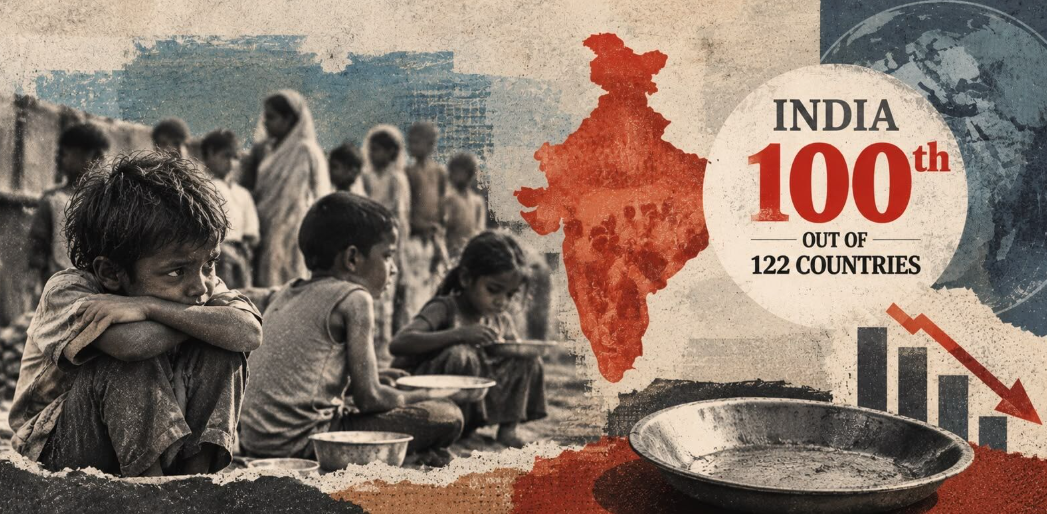
New Delhi: India has ranked 100 among 122 countries in the 2026 Global Hunger Index (GHI), scoring 24.1 and remaining in the “serious” hunger category, according to the latest report.
According to Kashmir Media Service, the index is published by the German aid agency Welthungerhilfe (WHH) and Concern Worldwide, an Irish organisation, along with partner institutions: the Institute for International Law of Peace and Armed Conflict (IFHV) and the Swiss organisation Helvetas. It measures hunger and undernutrition at global, regional and national levels. The 2026 edition of the index draws on data from 2021 to 2025.
The GHI uses a 100-point scale, with lower scores indicating less hunger. Scores below 10 fall in the “low” category, those from 10 to 19.9 are classified as “moderate”, scores from 20 to 34.9 indicate “serious” hunger, while scores from 35 to 49.9 fall in the “alarming” category.

India’s score of 24.1 keeps it in the serious category. According to the report, 9.8 per cent of the country’s population is undernourished, while 29.3 per cent of children under five suffer from stunting, reflecting chronic undernutrition. Child wasting stands at 19 per cent, the highest rate in South Asia, indicating acute undernutrition.
India’s progress in reducing hunger has slowed considerably. Its score improved by just 1.7 points between 2018 and 2026, from 25.8 to 24.1, compared with an 8.2-point improvement between 2006 and 2012.
The report also highlighted the broader food-security challenges facing South Asia, where child wasting remains a major concern. It warns that climate-related pressures could further threaten food security in the region.
The GHI assesses hunger through four indicators: undernourishment, which measures the share of the population with insufficient caloric intake; child stunting, which reflects chronic undernutrition; child wasting, which indicates acute undernutrition; and child mortality, which measures the proportion of children who die before reaching the age of five.
The report also flags the risk of an intensifying El Niño and a potentially deficient 2026 monsoon in South Asia. It cites an India Meteorological Department forecast indicating a 60 per cent probability of below-normal rainfall across the Monsoon Core Zone, which covers much of India’s rain-fed agricultural land.