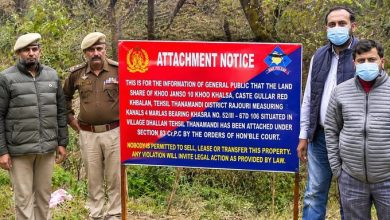
Indian police attach properties of three Kashmiris in IIOJK
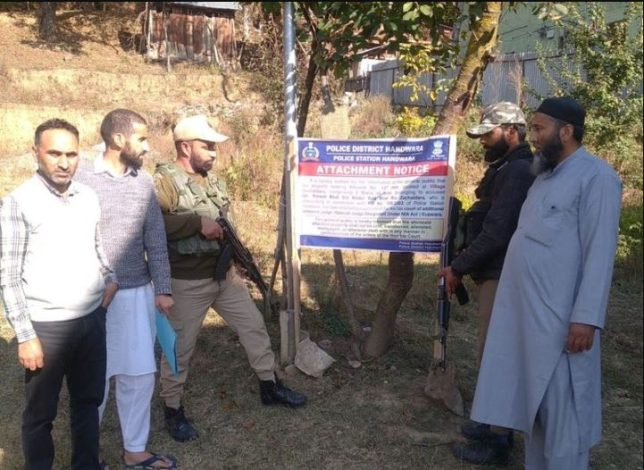
Srinagar: Indian police have attached the agricultural land of three Kashmiri activists in the Handwara area of Kupwara district in Indian illegally occupied Jammu and Kashmir (IIOJK) under the draconian Unlawful Activities (Prevention) Act (UAPA).
The Bharatiya Janata Party-led Indian regime has continued a campaign of attaching, seizing and demolishing properties belonging to local residents, activists and individuals accused of supporting the Kashmiri freedom movement in the occupied territory.
Indian police, operating under the administration of Lieutenant Governor Manoj Sinha and the BJP-led government in New Delhi, have attached the agricultural land of Ghulam Rasool Butt, Abdul Samad Mir and Sher Ali Khatana in Handwara. Police said the attachment proceedings were conducted in the presence of revenue officials.


Action links to FIR registered in 2023
The action is reportedly linked to an FIR registered against the three individuals at Handwara Police Station in 2023 under various charges.
Thousands of properties, including residential houses, commercial buildings, agricultural land and offices associated with Jamaat-e-Islami and Hurriyat leaders, have reportedly been targeted since August 2019. Reports have also indicated that more than 4,000 private properties were listed for potential confiscation by Indian police and investigative agencies, including the State Investigation Agency (SIA) and the National Investigation Agency (NIA).
In 2026, the BJP-led regime continued attaching agricultural land and residential properties belonging to pro-freedom activists in Kupwara, Srinagar, Baramulla, Pulwama, Islamabad, Doda and other areas of the territory under the UAPA.
Attachments intend to economically weaken Kashmiris
The All Parties Hurriyat Conference (APHC) and local residents have described such property attachments and demolitions as part of a systematic punitive strategy that is intended to economically weaken Kashmiris, silence dissent and alter the region’s demographic composition.
Political observers and analysts in the territory say that property attachments and demolitions under various laws are increasingly being used to deprive Kashmiris of their homes and other assets, further weakening them economically and socially. They maintain that the attachment or demolition of residential properties can amount to collective punishment, affecting entire families, including women and children.
Such measures create fear, insecurity among residents
They added that such measures have created fear and insecurity among residents, as part of broader policies aimed at undermining the economic security of Kashmiris and tightening control over the occupied territory.