Journalists facing victimization for speaking Truth in IIOJK and India
 t
t
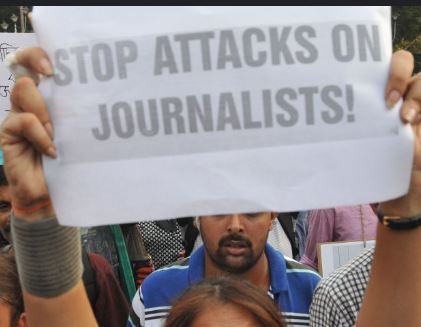
Islamabad: As the world observes the International Day to End Impunity for Crimes against Journalists today, Kashmiri journalists continue to face harassment, arrests, and threats at the hands of Indian forces’ personnel in Indian illegally occupied Jammu and Kashmir.
A report released by Kashmir Media Service on the occasion said journalists in the occupied territory are working under the most trying conditions and are being booked under draconian laws for speaking the truth.
The report said the BJP-led Indian government is using strong-arm tactics to strangulate the media in the occupied territory.

Journalists in IIOJK face harassment including arrests, interrogations, and legal action under stringent laws such as the Unlawful Activities (Prevention) Act (UAPA) and the Public Safety Act (PSA). Specific incidents include journalists being questioned about their sources, having their equipment confiscated, and facing charges for social media posts or news reports deemed “anti-national.” This has created a climate of fear and self-censorship within the media community in the occupied territory.
Since the revocation of Article 370 in 2019, press freedom in Indian-occupied Jammu and Kashmir has sharply declined. Local journalists face harassment, surveillance, and anti-terror charges, while foreign correspondents are denied access or deported for critical reporting. These measures—aimed at controlling the region’s narrative and projecting false normalcy—have drawn widespread criticism from international watchdogs warning of increasing suppression of both domestic and foreign media.
Al Jazeera, in its November 2024 report, said that on a chilly October afternoon, Ahmad, 33, a journalist in occupied Kashmir with over ten years of experience, received a call from an unknown number. The caller, identifying himself as a police official, questioned Ahmad about his personal and professional life. This was not the first time — over the past five years, Ahmad has received such calls every few months. “They inquire about what I am doing, where I currently write, the kinds of stories I cover, and even whether I have travelled abroad recently,” Ahmad told Al Jazeera, requesting anonymity for fear of reprisals.
A journalist in Srinagar told KMS that over the last six years, at least a dozen prominent journalists have been placed under constant surveillance. They are routinely asked to disclose details about their reporting or travel, raising concerns over privacy and press freedom. Most of their passports have been seized, preventing them from travelling abroad. This environment has forced journalists to self-censor and avoid sensitive topics.
Types of Harassment
Legal action: Journalists have been charged under black laws such as the UAPA and PSA, which allow detention without trial.
Arrests and detention: Reporters have been arrested and detained on dubious grounds, often facing “revolving-door arrests,” where they are re-arrested on new charges immediately after being released on bail.
Interrogation: Journalists have been summoned for prolonged questioning regarding their sources or reporting content.
Equipment seizure: The BJP regime has confiscated journalists’ equipment, often never returning mobile phones, laptops, or cameras.
Physical violence: Several journalists have been beaten by police while covering protests.
Examples of Cases
- Aasif Sultan: Arrested under the PSA in August 2018 for an article linked to a gunfight in Srinagar.
- Masarrat Zahra: Charged under the UAPA in April 2020 for social media posts described as “anti-national”; now living in exile.
- Sajjad Gul: Arrested in January 2022 and detained under the PSA despite a court order for release, as reported by Al Jazeera and BBC.
- Irfan Mehraj: Arrested in March 2023 under draconian laws on anti-India charges.
- Fahad Shah: Detained under the PSA for publishing reports critical of the BJP regime and its policies in IIOJK.
- Peerzada Ashiq: A complaint was filed against him in April 2020 over a story about the exhumation of alleged militants’ bodies.
Several prominent journalists — including Pulitzer Prize-winning photojournalist Sanna Irshad Mattoo and writer Gowhar Geelani — have repeatedly been barred by Indian authorities from travelling abroad to attend international conferences, award ceremonies, and exhibitions in countries like France, the United States, and Germany.
The report said the Indian BJP government is using strong-arm tactics, including revolving-door arrests, to stifle media freedom in the territory. Noted journalists such as Aasif Sultan, Fahad Shah, Majid Hyderi, and Sajjad Gul were arrested before and after the abrogation of Article 370 under the draconian PSA and UAPA for performing their professional duties. It lamented that prominent journalist Irfan Meraj continues to languish in Delhi’s Tihar Jail under the same repressive laws.
Since coming to power in 2014, the BJP regime has arrested and summoned dozens of journalists in Kashmir. The report said India has made independent journalism almost impossible in IIOJK following the introduction of the so-called “media policy” in 2020. Journalists are harassed, abducted, threatened, and tortured for doing their job, it deplored.
It added that India is hiding ground realities in IIOJK by criminalizing journalism and urged the international community to come forward to rescue independent media in the occupied territory. The report emphasized that the BJP regime must be pressured to allow media to operate freely in Kashmir.
An analysis by The Wire revealed that editorial pages of Srinagar-based newspapers have been engineered to promote pro-BJP narratives. The analysis found that these papers’ opinion sections avoided discussing political issues such as the Kashmir dispute, instead focusing on non-political topics.
Several op-eds were reportedly written using AI, while some editorials were lifted from the Observer Research Foundation without credit. “Nearly all articles reflect the ruling party’s worldview on the political situation in Kashmir,” the analysis said.
In 2024, French journalist Vanessa Dougnac, who had long been in the crosshairs of Modi’s Hindutva government for her reporting on Kashmir and other sensitive issues, was expelled from India.
The report said that since 2014, the BJP government has arrested more than 20 journalists across IIOJK and India.
In India, the recent murder of journalist Rajiv Pratap, known for investigating political scandals, has renewed focus on the dangers faced by journalists. Pratap went missing on September 18, 2025, in Uttarakhand, and his body was found ten days later at the Joshiyara hydroelectric barrage in Uttarkashi district.
Similarly, Raghvendra Bajpai, a Dainik Jagran correspondent, was shot dead on March 8, 2025, near Hemapur railway crossing in Sitapur district of BJP-ruled Uttar Pradesh.
Investigations revealed that a temple priest orchestrated his killing after Bajpai caught him in a compromising situation and recorded it on camera. The priest reportedly arranged the murder to prevent exposure.
The killing drew international condemnation, with UNESCO Director-General Audrey Azoulay urging a full investigation to ensure justice, warning that impunity for such crimes emboldens those who seek to silence journalists and undermine press freedom.
In another case, Mukesh Chandrakar, a 33-year-old freelance journalist from Bijapur district of Chhattisgarh, went missing on January 1, 2025, after exposing corruption in a INR 120 crore road-construction project in the Bastar region. Two days later, his body was found in a septic tank at a property owned by the prime suspect, a local contractor. The post-mortem revealed blunt-force trauma to the head, chest, and back.
The report noted that the risk is even greater for freelance journalists like Chandrakar, who lack institutional protection or compensation in case of harm. They often work in dangerous conditions for meagre pay, highlighting the precarious nature of independent journalism in India.
As the world marks the International Day to End Impunity for Crimes against Journalists, the International Press Institute (IPI) has urged the global community to take urgent and concrete steps to end impunity for crimes against journalists. It reiterated its 2025 General Assembly resolution calling on states to exercise political will to tackle the culture of impunity, which is strengthening authoritarianism around the globe.







One Comment