Pakistan’s military doctrine is fundamentally defensive, deterrence-driven: Masood Khan
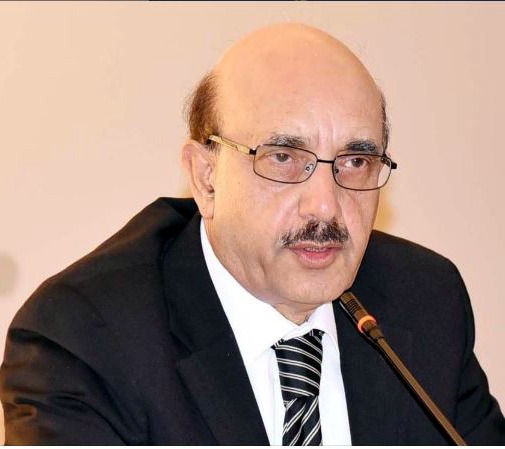 Islamabad: Former president of Azad Jammu and Kashmir and former ambassador of Pakistan to the United States Sardar Masood Khan has said that Pakistan’s military doctrine is fundamentally defensive, deterrence-based and deeply rooted in the country’s civilisational values rather than aggression or expansionism.
According to Kashmir Media Service, Sardar Masood Khan made these remarks while speaking at a high-level panel discussion attended by defence experts, academics, diplomats, and students.
He said Pakistan’s military doctrine has evolved steadily in response to changing threat environments, progressing from a conventional framework to nuclear deterrence and subsequently to a “full-spectrum” posture. He said this evolution was driven primarily by India’s escalating capabilities and doctrines, while Pakistan consistently emphasized restraint, responsibility, and strategic stability as core principles.
Highlighting newer dimensions of defence policy, he noted that Pakistan has incorporated cyber capabilities, information warfare, space-related assets, and emerging technologies into its doctrine, reflecting the realities of modern and post-modern warfare. He stressed that contemporary conflicts are no longer confined to traditional battlefields but are increasingly shaped by technology, data, and public participation.
Masood Khan underscored that Pakistan’s nuclear doctrine remains centered on “credible minimum deterrence,” emphasizing defence rather than offense. He credited strategic institutions and planners for maintaining clarity, discipline, and consistency in nuclear policy, adding that Pakistan has always prioritized crisis management, arms control, and dialogue—particularly with India—over escalation.
He highlighted the critical role of diplomacy as an integral arm of military doctrine, noting that Pakistani diplomats in global capitals and multilateral forums have worked persistently to legitimize and explain Pakistan’s deterrence posture internationally. “Military strength without diplomatic engagement risks delegitimization,” he cautioned, stressing that both must function in tandem.
Turning to regional and global developments, he said Pakistan’s defence calculus has expanded to include maritime security in the Indian Ocean Region, protection of sea lanes of communication, and emerging security implications stemming from Gulf rivalries and the Iran-Israel confrontation. He warned that instability in the wider region could indirectly affect Pakistan’s strategic assets and overall security environment.
He emphasized that economic strength is inseparable from national defence, observing that sustained military capability cannot be maintained without a robust economic base. He welcomed Pakistan’s increasing focus on trade, energy, connectivity, and pragmatic economic diplomacy, describing recent policy flexibility as a positive step in safeguarding long-term national interests.
Masood Khan also pointed to Pakistan’s progress in indigenization, noting a shift from arms imports to domestic manufacturing, including advanced platforms such as the JF-17 aircraft. He said future preparedness depends on investing in universities, research, and emerging fields such as artificial intelligence, autonomous systems, drones, and advanced munitions, supported by a strong technological ecosystem.
Concluding his remarks, he cautioned against complacency despite recent successes, citing continued hostile rhetoric from India. He called for restrained confidence, political stability, policy continuity, and diplomatic diversification, reiterating that Pakistan will avoid bloc politics and maintain balanced relations with major powers.