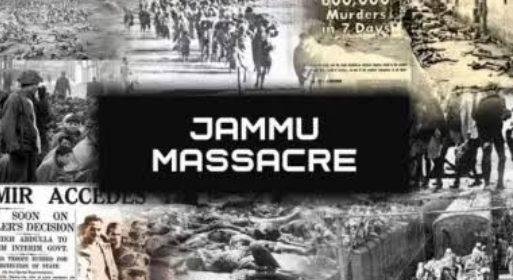
The Jammu massacre of 1947 remains one of the darkest and most neglected episodes of the partition violence in South Asia. While the massacres of Partition are widely remembered, the systematic violence against Muslims in Jammu has received comparatively little attention in mainstream historical narratives. Thousands were killed, displaced, abducted or forcibly converted during the violence that unfolded in Jammu in October and November 1947. For the people of Kashmir and Pakistan, the episode remains a painful historical memory. For the wider international community, it demands serious examination because its consequences extended beyond the immediate loss of life: it fundamentally altered the demographic character of Jammu.
To understand the massacre, it is necessary to place it within the political crisis surrounding the end of British rule. The princely state of Jammu and Kashmir was given the option to accede to either India or Pakistan, while the political future of the state remained deeply contested. Muslims constituted the majority of the population of Jammu and Kashmir, and the All Jammu and Kashmir Muslim Conference had advocated accession to Pakistan. In Jammu, however, the political leadership under Maharaja Hari Singh faced a population whose demographic composition posed a significant political challenge to the future direction of the state.
The violence that followed was not simply an eruption of spontaneous communal hostility. A growing body of historical literature points to the involvement of state forces in the targeting of Jammu’s Muslim population. Muslims were disarmed in several areas and concentrated in particular locations before being attacked. Contemporary and later accounts describe killings, forced displacement, abductions, sexual violence and forced conversions. British diplomatic and journalistic reports also recorded widespread destruction of Muslim villages and the displacement of entire communities.
Historian Alistair Lamb argues that the systematic removal of Muslim personnel from the state’s police and military institutions under Maharaja Hari Singh formed part of a broader process that preceded the violence. Ian Stephens, in Horned Moon, described the attacks as systematic savageries directed against Jammu’s Muslim population. His account suggests that the violence and displacement were sufficiently extensive to transform the demographic balance of the region within a matter of weeks.
Prem Nath Bazaz, a Kashmiri politician and scholar, also wrote about the distribution of arms among Hindu groups and RSS cadres under state supervision. Christopher Snedden has argued that a systematic plan to remove Muslims was highly plausible in parts of eastern Jammu, where demographic change could facilitate the settlement of Hindu and Sikh refugees arriving from West Punjab. Victoria Schofield similarly interprets the violence as a calculated attempt to alter Jammu’s demographic balance and suppress potential opposition to the Maharaja’s political objectives.
Contemporary evidence makes the episode even more difficult to dismiss as merely communal rioting. British diplomat C. Duke, who visited Jammu in October 1947, reported seeing villages along the Chenab reduced to ashes and noted that Muslims were overwhelmingly the victims in the areas he observed. Such accounts are significant because they were produced during the events themselves rather than decades later in the context of competing national narratives.
The precise death toll remains contested because no comprehensive official investigation established the number of victims. Estimates in historical and journalistic accounts vary considerably. Horace Alexander, writing in The Spectator in January 1948, estimated that approximately 200,000 people had been killed. A report published by The Times of London in August 1948 referred to 237,000 Muslims being systematically exterminated. Other historians have offered different figures, particularly when deaths, expulsions and migration are considered together. The uncertainty surrounding the exact number should not become an excuse to deny the scale of the atrocity.
The most consequential outcome was demographic. Accounts cited by Saeed Naqvi indicate that Muslims constituted around 61 percent of Jammu’s population before the violence. Following mass killings and the forced displacement of Muslims into what became Pakistan, their demographic presence was dramatically reduced in several parts of Jammu. The transformation from a Muslim-majority population to a significantly reduced minority was not simply a demographic accident. It was accompanied by extraordinary violence and displacement during one of the most politically consequential moments in Kashmir’s modern history.
The Jammu massacre therefore deserves to be understood not as an isolated episode of Partition violence but as an important chapter in the political history of Jammu and Kashmir. Its significance lies not only in the number of people who were killed, but in the destruction of communities and the demographic transformation that followed.
For decades, the Jammu massacre has remained marginal in dominant accounts of the Kashmir conflict. That silence has consequences. Historical memory cannot be selective if reconciliation and justice are to be meaningful. The victims of Jammu deserve recognition, their families deserve acknowledgement, and historians deserve the freedom to examine the available evidence without political constraints.
The massacre of 1947 changed Jammu forever. Remembering it is not an attempt to reopen old wounds. It is an insistence that those wounds should not be erased from history. A conflict cannot be understood by remembering only the events that support one side’s narrative. The killings, expulsions and suffering of Jammu’s Muslims are part of Kashmir’s history, and confronting that history honestly is essential to understanding the roots of the conflict that continues to shape the region today.
The writer is a Research Associate at the Kashmir Institute of International Relations.