IIOJK families of enforced disappearance victims await justice
#EnforcedDisappearancesInIIOJK #UnmarkedGraves #HalfWidows
Srinagar: As the world observed the International Day of the Victims of Enforced Disappearances today, families of thousands of Kashmiris subjected to enforced disappearance in Indian custody over the past thirty-seven years in Indian illegally occupied Jammu and Kashmir still await justice.
A report released by the Research Section of Kashmir Media Service on the occasion said that occupied Jammu and Kashmir, being the most militarized zone in the world, has witnessed extrajudicial killings, enforced disappearances, torture, molestation, rape and other brutalities at the hands of Indian forces. The issue of missing persons and enforced disappearances remains a profound source of trauma, public anxiety, and grief across Kashmir.
Local communities, human rights organizations, and international observers continue to express severe concern over the thousands of unresolved cases. At least 8,000 innocent civilians have vanished in Indian forces’ custody since 1989. The report maintained that intensified Indian military crackdowns and the rising number of extra-judicial killings, both in custody and in fake encounters, are part of the anti-Kashmir designs of the Hindutva-inspired Indian BJP government.

Ironically, the report added, Kashmiri youth have been a specific target of over one million occupation troops deployed in the territory. The report revealed that the families and relatives of victims of enforced disappearances have moved from pillar to post to trace their missing loved ones, but to no avail. The families of the disappeared also suffer economically because, in most cases, the breadwinner of the family was targeted.
The report maintained that disappearances not only silence opponents but also create uncertainty and fear in the wider community. This inhuman, savage and insensate act has been committed by all the tributaries of the so-called security apparatus comprising Indian military, paramilitary and special task forces, as well as counter-insurgents working under the superintendence, control and direction of the armed forces.
Human rights activists have documented thousands of unmarked graves across the disputed region. Local inquiries and activist investigations have revealed that a portion of the bodies belong to disappeared local residents.
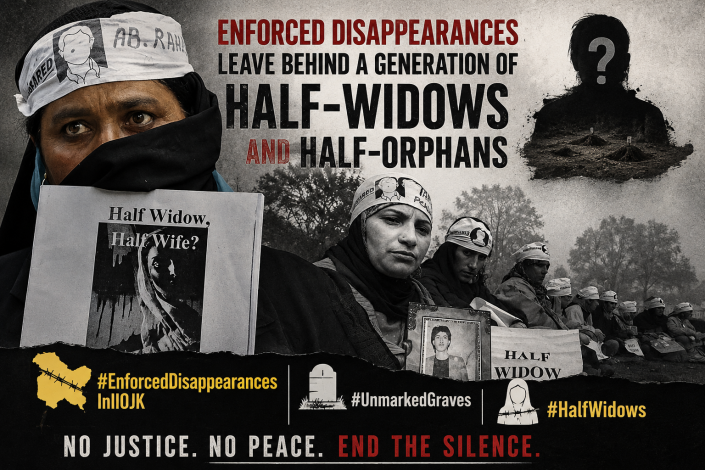
The cruel practice of enforced disappearances has given rise to a new class of people called “half-widows” and “half-orphans,” now common phrases used in occupied Kashmir. The impunity provided to forces’ personnel through draconian laws like the Disturbed Areas Act, Armed Forces Special Powers Act, Public Safety Act, and Unlawful Activities (Prevention) Act has given them license to kill, terrorize, arrest, harass and silence the people, and to besiege, snatch and ransack their property without being questioned.
Family members of the victims told media persons that their dear ones had been subjected to enforced disappearance by Indian forces and related agencies after being picked up from their homes, streets and even roads.
Following the illegal abrogation of Articles 370 and 35A, public alarm has intensified over reports of missing women and girls in IIOJK. Reports presented to bodies like the European Parliament highlight that nearly 10,000 women and girls have gone missing in occupied Jammu and Kashmir in recent years, prompting localized protests and demands for immediate investigation.
According to figures presented by Ajay Kumar, India’s Minister of State for Home Affairs, in the Indian Parliament, 9,765 females — including 1,148 girls under the age of 18 — have been reported missing from occupied Jammu and Kashmir since 2019.In July 2026, a local court issued a landmark ruling ordering a formal death certificate for Abdul Rashid Wani, a man who vanished from military custody in 1997. The court cited a police probe finding that an Indian army officer had murdered him in custody. This rare acknowledgement reopened deep community wounds while highlighting the long legal struggles families face.
On February 13, 2026, Riyaz, 25, Showkat Ahmad, 18, and Mukhtar left the nearby village of Qazigund to attend a wedding in the Ashmuji area of Kulgam district. They never reached the venue and disappeared.
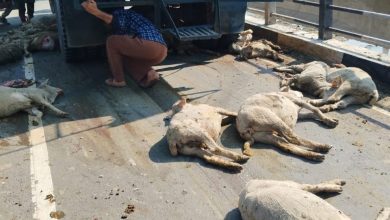
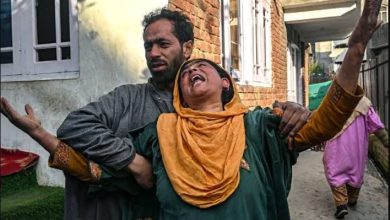
A month later, the bodies of the two brothers, Riyaz, 25, and 18-year-old Showkat Ahmad, were found near a canal in Kulgam district, about 10km from their homes. “This wasn’t an accident,” the 72-year-old father of the victims screamed, his voice cracking with anguish as he spoke to Al Jazeera outside his home. “They were tortured and killed.” “My sons were brutally murdered,” Sadiq insisted.
Mukhtar Ahmad Awan, a 24-year-old man who also disappeared along with Riyaz and Showkat, has not been found.In Kathua district, three civilians — Yogesh Singh, 32, Darshan Singh, 40, and Varun Singh, 15 — went missing on March 05, 2025, while traveling to a wedding in Lohai Malhar. They were found dead in a deep gorge in the Billawar area of Kathua two days later.
Days later, in March 2025, two other teenagers — Mohammad Din and Rehman Ali — went missing in Kathua.The fear of the Indian BJP regime and Indian forces runs particularly deep in IIOJK and far-flung areas among the Gujjar community.
In 2020, an Indian army officer allegedly abducted and killed three young Gujjar men in Rajouri district. The police filed a chargesheet against the officer, accusing him of abducting and killing the three laborers in a staged encounter. A court martial held the officer guilty and recommended life imprisonment. But in November 2023, an Armed Forces Tribunal suspended the sentence and granted bail to the officer.
The Association of Parents of Disappeared Persons and APHC leaders, in their statements in Srinagar, said Indian forces were using black laws including the Armed Forces Special Powers Act in IIOJK, and demanded that India must fulfill its obligations on Jammu and Kashmir under international human rights laws.
The Armed Forces (Special Powers) Act (AFSPA) grants broad legal protections to military personnel in designated “disturbed areas,” which critics and human rights organizations argue creates an effective shield against prosecution for abuses. Indian forces can search properties, make warrantless arrests, and use lethal force.
Organizations such as Amnesty International and Human Rights Watch state that the requirement for Indian government sanction creates virtual immunity, preventing victims from seeking justice in civilian courts for extrajudicial killings, torture, and enforced diasappearances.
Meanwhile, the APHC-AJK chapter, in connection with the International Day of the Victims of Enforced Disappearances, demanded the trial of Indian troops directly involved in the disappearances of Kashmiris by an international crimes court. They appealed to the international community to play its role in tracing the whereabouts of the thousands of Kashmiris subjected to custodial disappearance. KMS—1R