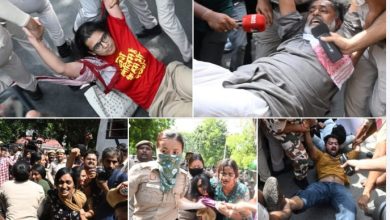
Islamabad: India’s treatment of Muslim religious and community institutions is entering an increasingly contentious phase, with the Waqf (Amendment) Act, 2025 and a succession of demolition drives placing questions of minority rights, religious freedom, property protection and due process firmly at the centre of a widening political and legal dispute.
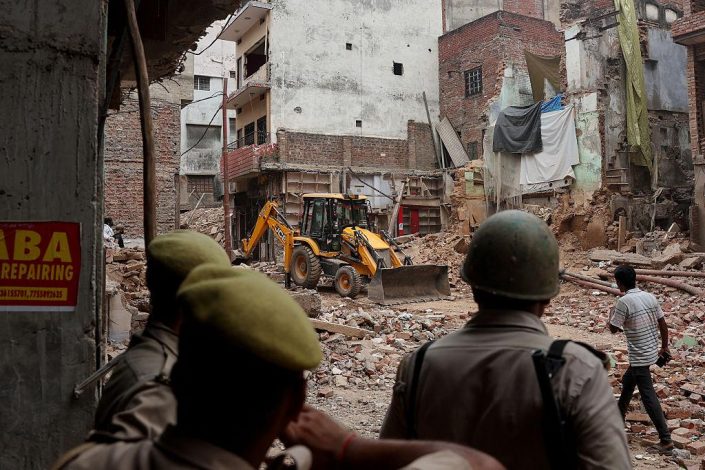
An investigative report released by Kashmir Media Service on Wednesday, documents a widening wave of demolitions and removals involving mosques, mazars, dargahs, madrasas, Eidgahs and Muslim graveyards across BJP-ruled states and territories. While authorities describe the operations as anti-encroachment measures targeting unauthorised structures, Muslim organisations, opposition parties and international observers warn that their scale, concentration and execution raise serious questions about discrimination, religious freedom and the erosion of safeguards for India’s Muslim minority.
The controversy has intensified since the enactment of the Waqf (Amendment) Act, 2025, also referred to as the UMEED Act, in April last year. The legislation substantially alters the legal and administrative framework governing Waqf properties under the Waqf Act, 1995, giving the state a more pronounced role in their registration, verification and administration.
Official figures put the number of immovable Waqf properties at about 8.72 lakh, with reported tallies ranging between 8,72,328 and 8,72,352. They include approximately 1.19 lakh mosques in some compilations, besides graveyards, dargahs, educational institutions and charitable properties spread across millions of acres. Their estimated value has been placed at around ₹1.2 lakh crore, making Waqf boards among the largest landholders in India after the armed forces and the railways. Since its implementation, Indian authorities have stepped up demolition and removal drives against approximately 861 reported Muslim religious sites, including 57 mosques, 563 mazars, 6 dargahs, 226 madrasas/Islamic school structures, 6 Eidgahs, 1 Muslim graveyard and 2 minarets, under legal pretexts. These figures, covering a wide range of Muslim religious and educational sites, form a significant part of the broader pattern of demolition and removal actions documented in several BJP-ruled jurisdictions.

The new legislation requires the digitisation and registration of Waqf properties through a central portal within prescribed deadlines. It transfers important survey and verification functions towards district collectors and revenue authorities, removing the previous unilateral powers associated with Section 40 of the old law. It also places restrictions on the creation of new Waqf, including requirements concerning the dedicator’s period of practising Islam and ownership of the property.
The legislation further abolishes the concept of “Waqf by user” for future claims, while protecting many existing registered properties except where disputes arise or government land is involved. It provides for the inclusion of non-Muslim members and greater representation of women on Waqf boards, while making clearer provisions concerning government property and Waqf status.
The BJP-led Indian government has presented these changes as ‘necessary’ reforms intended to tackle alleged mismanagement, encroachment, lack of transparency and the underutilisation of Waqf assets.
 However, critics see something considerably more consequential.
Muslim organisations and opposition parties argue that the law has increased state control over institutions historically administered by the Muslim community and risks weakening the constitutional autonomy guaranteed under Articles 25 and 26. The legislation soon came under intense judicial scrutiny. In interim orders issued around September 2025, the Supreme Court of India stayed certain provisions of the amended law, particularly aspects of the inquiry process that could result in the immediate loss of Waqf status merely on an allegation that a property belonged to the government. The court found such aspects prima facie arbitrary, while allowing other provisions of the law to remain in operation. It also underscored the importance of due process, making clear that the status of a disputed Waqf property was not to be treated as extinguished while the matter remained pending before the appropriate tribunal or High Court. For Muslim organisations and critics of the legislation, the intervention reinforced their contention that the new framework could expose historic religious properties to potentially irreversible challenges without adequate procedural safeguards. They warn that undocumented historic properties, including religious sites whose legal records may have become complicated over decades or centuries, could become particularly vulnerable to disputes and denotification.
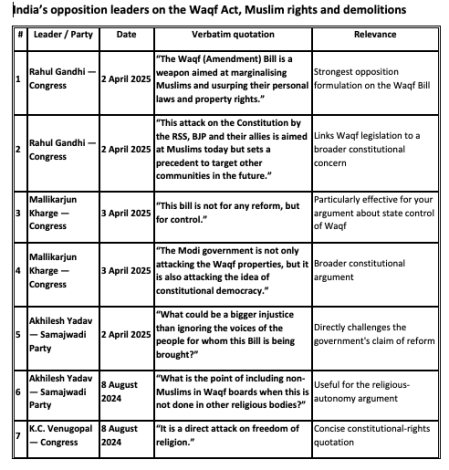
 Rahul Gandhi, Congress leader and India’s opposition leader in Lok Sabha on 2 April, 2025 in his post on X formerly known as Twitter said, “The Waqf (Amendment) Bill is a weapon aimed at marginalising Muslims and usurping their personal laws and property rights.”
While, Mallikarjun Kharge, Congress President and Leader of Opposition, Rajya Sabha on April 3, 2025 said, This is no ordinary law – it is being weaponised for political gain.”
Kharge argued that the legislation was being used by the Modi government to “weaken the Indian Diversity” and said it represented an attempt to shift Waqf institutions from reform towards government control.
“From Waqf properties and centuries-old mosques to dargahs, madrasas and Eidgahs, a widening series of legal and demolition actions is reshaping the landscape of Muslim religious institutions across India. Authorities describe the drives as anti-encroachment measures; critics see a troubling pattern of selective enforcement and shrinking constitutional safeguards.”
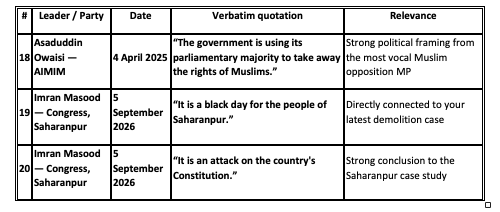
While, Mayawati, president of the Bahujan Samaj Party on 6 September, 2026 after the demolition of Saharanpur Collectorate Mosque said, “The ongoing government campaign in the entire state of UP… which daily declares mosques illegal in great haste and proceeds to demolish them, is not right…”
The All-India Muslim Personal Law Board has described the legislation as communally motivated and warned that its consequences could prove more damaging than the Babri Masjid controversy, potentially exposing mosques, madrasas, dargahs and cemeteries to prolonged disputes.
The Jamaat-e-Islami Hind, including leaders such as Syed Sadatullah Husaini, and Jamiat Ulama-e-Hind factions associated with Arshad Madani and Mahmood Madani have also condemned the legislation, describing the expanded role of collectors and revenue officials as “Collector Raj” and arguing that the changes undermine the autonomy of Muslim religious institutions.
The controversy has not remained confined to Parliament or the courts.
It has increasingly taken physical form on the ground.
The demolition of the 500-year-old Babri Masjid on December 6, 1992 remains an indelible reference point in the political and religious history of modern India. Since then, concerns over the destruction or removal of Muslim religious sites have repeatedly resurfaced.
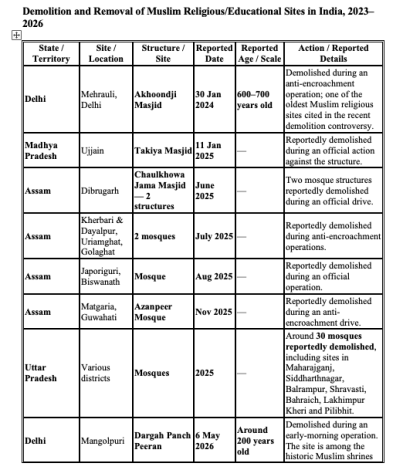
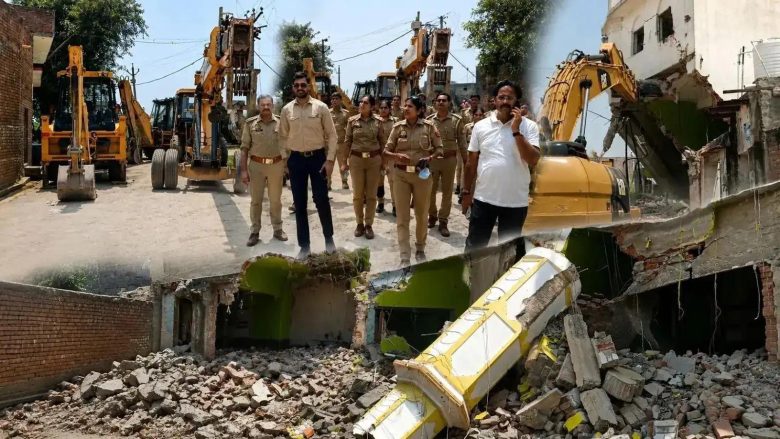
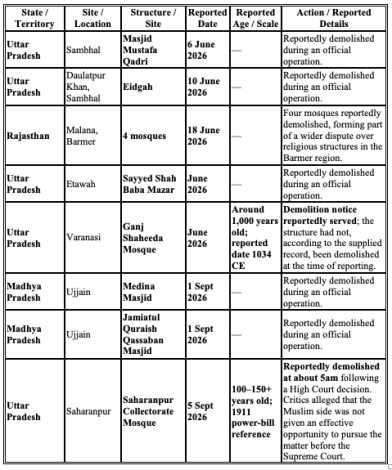
Among the more recent cases cited by critics are the Akhoondji Masjid in Mehrauli, Delhi, described as being between 600 and 700 years old and demolished on January 30, 2024; the Ajgaib Shaheed Mosque in Varanasi, described as around 200 years old and demolished on June 2–3, 2026; the Ganj Shaheeda Mosque in Varanasi, described in reports as dating back roughly 1,000 years to 1034 CE and served with a demolition notice in June 2026; and Dargah Panch Peeran in Mangolpuri, Delhi, demolished on May 6, 2026.
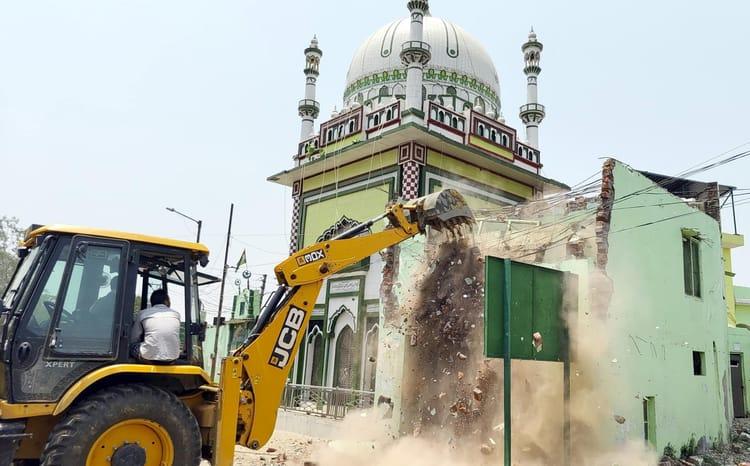
The latest and particularly contentious case is the Saharanpur Collectorate Mosque, reportedly between 100 and 150 years old, with a power-bill reference dating back to 1911. The mosque was demolished at around 5am on September 5, 2026, following a High Court decision. Critics have alleged that the Muslim side was not given an effective opportunity to pursue the matter before the Supreme Court, turning the demolition into a fresh flashpoint over due process.
The geographical spread is striking.
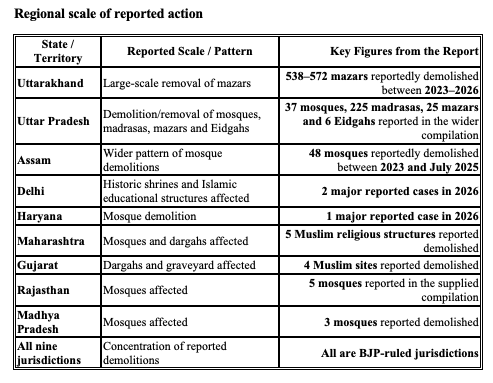
Uttarakhand, Uttar Pradesh, Delhi, Rajasthan, Gujarat, Maharashtra, Haryana, Assam and Madhya Pradesh have all figured prominently in reports concerning the removal or demolition of Muslim religious and educational structures. All nine are BJP-ruled jurisdictions, a concentration that critics say warrants closer scrutiny.
In Uttarakhand alone, authorities reportedly demolished between 538 and 572 mazars between 2023 and 2026, including sites in Kashipur, Ramnagar, Haridwar and Kundeshwari. Officials have justified the operations by pointing to alleged encroachments and said that thousands of acres of land were reclaimed.
The figures from Uttar Pradesh are similarly striking.
Under Chief Minister Yogi Adityanath, around 30 mosques were reportedly demolished during 2025 in districts including Maharajganj, Siddharthnagar, Balrampur, Shravasti, Bahraich, Lakhimpur Kheri and Pilibhit.
The campaign continued into 2026.
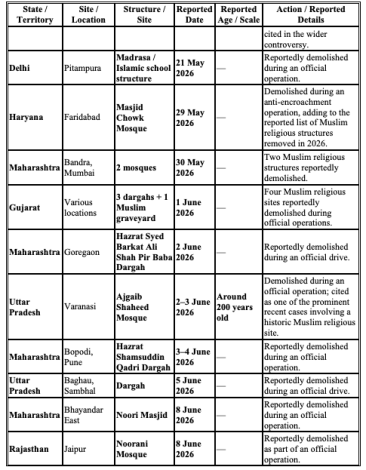
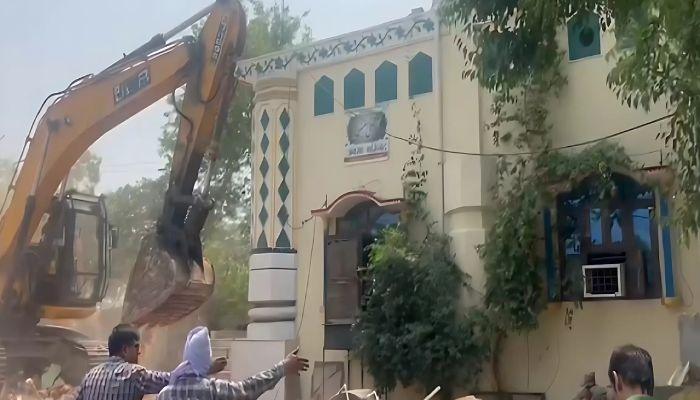
Reported demolitions or removals included the Ajgaib Shaheed Mosque in Varanasi on June 2; a dargah in Baghau, Sambhal, on June 5; Masjid Mustafa Qadri in Sambhal on June 6; an Eidgah in Daulatpur Khan, Sambhal, on June 10; and the Sayyed Shah Baba Mazar in Etawah during June.
Compilations cited in the debate put the wider Uttar Pradesh total at 37 mosques, 225 madrasas, 25 mazars and six Eidgahs.
In Delhi, Dargah Panch Peeran in Mangolpuri, described as a 200-year-old shrine, was demolished during an early-morning operation on May 6. A madrasa or Islamic school structure in Pitampura was also demolished on May 21.
In Haryana, Masjid Chowk in Faridabad was demolished on May 29.
Maharashtra witnessed the reported demolition of five Muslim religious structures, including two mosques in Bandra, Mumbai, on May 30; Hazrat Syed Barkat Ali Shah Pir Baba Dargah in Goregaon on June 2; Hazrat Shamsuddin Qadri Dargah in Bopodi, Pune, on June 3–4; and Noori Masjid in Bhayandar East on June 8.
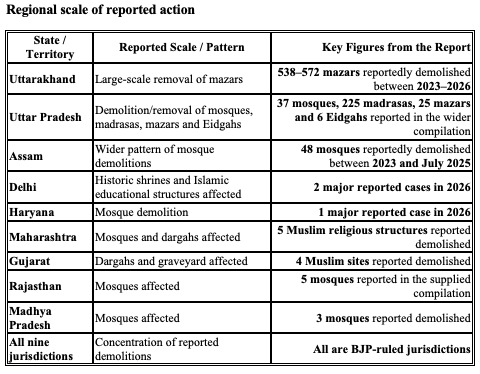
Gujarat recorded the reported demolition of four Muslim sites on June 1 — three dargahs and one Muslim graveyard.
In Rajasthan, five mosques were reportedly demolished, including Noorani Mosque in Jaipur on June 8 and four mosques in Malana, Barmer, on June 18.
Madhya Pradesh saw the demolition of Takiya Masjid in Ujjain on January 11, 2025, followed by Medina Masjid and Jamiatul Quraish Qassaban Masjid in Ujjain on September 1, 2026.
Assam has also featured prominently in the debate. Six specific mosque demolitions have been reported: two mosques in Kherbari and Dayalpur, Uriamghat, Golaghat, in July 2025; two structures belonging to Chaulkhowa Jama Masjid in Dibrugarh in June 2025; a mosque in Japoriguri, Biswanath, in August 2025; and Azanpeer Mosque in Matgaria, Guwahati, in November 2025.
Broader compilations have reported 48 mosque demolitions in Assam between 2023 and July 2025.
A separate compilation published in June 2026 documented 23 Muslim religious structures demolished within a period of only 45 days, intensifying concerns over what critics describe as the accelerating pace of action against Muslim religious sites.
The authorities, for their part, maintain that the operations are directed against illegal construction and encroachment rather than religion. In several BJP-ruled states, demolition drives have targeted structures allegedly situated on government, railway, forest or municipal land.
 That distinction is central to the dispute.
The BJP government argues that the law must apply equally to all unauthorised structures. Critics counter that even where an encroachment exists, the demolition of historic religious sites raises a separate question: whether affected communities are being afforded adequate notice, hearings, judicial remedies and an opportunity to exhaust the legal process before an irreversible act is carried out.
The Supreme Court’s intervention in the Waqf dispute has added another layer to the controversy.
In interim orders around September 2025, the court stayed certain provisions, particularly aspects of inquiries that could result in the immediate loss of Waqf status on an allegation of government ownership. Such provisions were viewed prima facie as raising concerns of arbitrariness. Other provisions were allowed to operate, with the court stressing the importance of due process and maintaining that disputed status should remain protected pending resolution through the appropriate tribunal or High Court process.
For Muslim organisations, however, the concern goes beyond individual buildings.
They argue that the Waqf system forms a vast institutional network supporting worship, education, charity, welfare and community life. Weakening control over those assets, they say, risks weakening the very infrastructure through which generations of Muslims have maintained their religious and social institutions.
That argument is reinforced by the sheer scale of the Waqf estate.
Government figures record 872,328 Waqf properties covering approximately 3.82 million acres. These include mosques, dargahs, graveyards, educational establishments and charitable assets.
Consequently, a dispute over Waqf cannot always be reduced to a dispute over a piece of land.
It can become a dispute over a mosque, a school, a cemetery, a charitable institution, a source of income or a community’s historic connection with a place.
The implications are potentially wider still.
India’s Muslim population stands at roughly 200 million. Muslims accounted for 14.2 per cent of the population in the 2011 Census, making them the country’s largest religious minority. Yet demographic size has not necessarily translated into commensurate economic or political representation.
Official PLFS 2023–24 figures show labour-force participation among Muslims at 38.2 per cent, compared with 46.2 per cent among Hindus. The disparity is sharper among women: Muslim female labour-force participation stood at 21.4 per cent against 33.3 per cent for Hindu women.
Such differences have direct consequences for household income, savings, asset ownership and economic resilience.
When property disputes, demolitions, displacement, discrimination or disruption of traditional livelihoods are added to an already unequal economic environment, vulnerable families may find themselves increasingly dependent on outside employers, landlords, welfare systems and majority-controlled economic networks.
“The controversy over India’s 2025 Waqf law has moved far beyond questions of property management. As opposition leaders warn of expanding state control and Muslim organisations raise concerns over religious autonomy, demolition drives across BJP-ruled states have intensified a debate over minority rights, due process and the future of Muslim institutions.”
Political representation presents another concern.
Only 24 Muslims were elected to the 543-member Lok Sabha in 2024 — approximately 4.4 per cent of the chamber — despite Muslims constituting 14.2 per cent of the population according to the 2011 Census.
Had representation broadly reflected population share, the figure would have been around 77 MPs, leaving a gap of approximately 53 seats.
That disparity matters because parliamentary representation is not merely symbolic. It affects the ability of communities to shape legislation, influence public debate and exert institutional pressure when policies directly affect their interests.

Human-rights concerns add yet another dimension.
India Hate Lab documented 1,165 anti-minority hate-speech events in 2024, a 74.4 per cent increase over the 668 incidents recorded in 2023. According to the organisation, 1,147 of those incidents — 98.5 per cent — targeted Muslims, either exclusively or alongside Christians.
Hate speech does not operate in isolation.
Persistent communal rhetoric, insecurity and allegations of discriminatory treatment can influence where minorities live, work, worship, conduct businesses and participate in public life. Over time, such pressures can produce a form of social marginalisation that is less visible than a demolished building but potentially more enduring.
The resulting concern, therefore, is not simply that individual mosques, mazars or madrasas are being removed.
 It is that a network of institutions supporting Muslim religious, educational, charitable and social life may be progressively weakened.
A mosque provides a place of worship. A madrasa provides education. A graveyard preserves the community’s relationship with its dead. A dargah can sustain a religious tradition and local economy. A Waqf property can finance charitable activities and social welfare.
Remove enough of these pillars and the consequences may extend far beyond the individual structure.
This is where the debate over economic and political marginalisation intersects with the Waqf controversy.
A community with weaker economic participation, limited political representation and shrinking institutional assets may become progressively more dependent upon institutions over which it has little control.
The cycle is potentially self-reinforcing: the weakening of religious and charitable institutions reduces community support; economic vulnerability limits financial independence; political underrepresentation restricts institutional influence; and persistent human-rights concerns deepen insecurity and social marginalisation.
The consequence could be a growing dependence on government institutions, politically connected intermediaries, employers, landlords and majority-controlled economic and social networks for employment, housing, welfare, education and even protection.
This does not, however, establish by itself that every demolition forms part of a centrally coordinated strategy.
Publicly available evidence remains uneven. Some structures involved in these operations have been declared unauthorised, and quantitative evidence establishing a single nationwide governmental plan specifically designed to create Muslim dependency remains incomplete and contested.
But the accumulation of cases, critics argue, cannot simply be dismissed as a collection of unrelated administrative exercises.
The political opposition has seized upon precisely this argument.
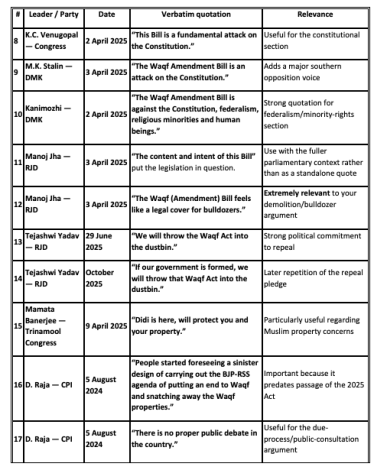
The Congress, AIMIM led by Asaduddin Owaisi, AAP and other opposition voices have condemned the Waqf legislation as majoritarian and damaging to minority rights. They have also criticised demolition campaigns as manifestations of “bulldozer justice”, alleging selective enforcement, political polarisation and failures of due process. Owaisi, reacting to the Saharanpur demolition on 5 September 2026, questioned the timing and manner of the early-morning action and challenged the Uttar Pradesh government’s justification for the demolition.
Muslim organisations have made similar arguments, pointing to cases where communities claimed Waqf registration, longstanding religious use or historical possession but where the legal questions had not, in their view, been conclusively tested before demolition made any subsequent remedy practically meaningless.
International scrutiny has meanwhile intensified.
UN human-rights experts in 2025 called on India to halt arbitrary or punitive demolitions that disproportionately affect minorities and marginalised communities. They raised concerns about actions presented as anti-encroachment or security measures but alleged to have discriminatory consequences.
The United States Commission on International Religious Freedom has repeatedly recommended that the United States designate India a Country of Particular Concern, citing wider patterns of concern that include property-related actions and changes to Waqf governance.
The Council on American-Islamic Relations has also urged US action over the Waqf legislation.
Independent expert groups and reports, including work cited by the Peterson Institute for International Economics, have documented broader allegations concerning the treatment of Muslim communities, including demolitions and institutional interference.
The question is whether laws ostensibly framed as administrative reforms are being implemented with equal regard for every community, whether judicial remedies are genuinely available before irreversible action is taken, and whether the burden of enforcement falls disproportionately upon one religious minority.
India’s constitutional promise is particularly significant in this context.
Articles 25 and 26 guarantee freedom of conscience and the right to profess, practise and propagate religion, while also recognising the rights of religious denominations to manage their own affairs in matters of religion, subject to constitutional limitations.
For Muslims, the Waqf controversy therefore represents more than a property dispute.
It concerns the relationship between the state and a religious community’s institutional life.
It also raises a fundamental question about the future of minority autonomy in the world’s largest democracy.
The demolition of a centuries-old mosque cannot be viewed merely through the value of bricks, land or construction. A religious site can embody memory, identity, history and community belonging accumulated over generations.
The destruction of such a site may therefore leave a wound considerably deeper than the physical absence of a building.
The same applies to madrasas, graveyards and dargahs.
Their removal can disrupt religious education, displace students and orphans, eliminate prayer spaces, cause profound emotional distress and, in some cases, affect livelihoods linked to the sites.
The Mehrauli demolition, for example, was accompanied by concerns over students and orphans associated with the madrasa attached to the site.
 Taken together, the developments raise the spectre of an erosion not merely of individual properties but of what can be described as India’s Muslim religious, economic, political and social ecosystem.
The evidence for each component is not equally strong, and the claims surrounding individual demolitions require verification against official records, court judgments, land documents and other credible evidence.
But the pattern being described by Muslim organisations and political opponents is unmistakable: a community already confronting economic disparities, political underrepresentation and rising hate speech is also facing disputes over the institutions and properties that underpin its collective religious and social life.
This is why the Waqf legislation and demolition drives cannot be treated as entirely separate stories.
They converge around a single question: how much institutional space will India’s Muslim minority retain to manage its religious property, preserve its historic places, educate its children, support vulnerable families and maintain an autonomous community life?
The answer will ultimately depend not on political rhetoric alone but on the operation of courts, administrative authorities, legislatures and civil society.
It will also depend upon whether the international community is prepared to scrutinise these developments consistently.
India frequently presents itself as a defender of minority rights and regularly criticises Pakistan over its treatment of minorities. Yet critics point to what they regard as a striking contradiction between that posture and developments affecting Muslim religious sites inside India.
The contrast has become particularly pointed when India highlights episodes such as the renovation of temples in Chakwal, Pakistan, while Muslim mosques, mazars, dargahs, madrasas, Eidgahs and graveyards in India face demolition or removal.
For its critics, this is not simply a matter of competing political narratives.
It is evidence of what they describe as selective outrage, double standards and hypocrisy in the application of minority-rights principles.
The responsibility now extends beyond India’s political opposition and Muslim organisations.
The international community, particularly the Organisation of Islamic Cooperation, faces a clear obligation to consistently highlight documented cases of discrimination, human-rights violations and alleged persecution affecting Muslims in India, while insisting that every allegation be examined against verifiable evidence and due legal process.
 The issue is ultimately larger than Waqf.
It is about whether a constitutional democracy can protect the religious identity, institutional autonomy, property rights, political participation and social resilience of one of its largest communities while simultaneously enforcing laws against encroachment and unauthorised construction.
If the answer is to be credible, the test cannot be applied selectively.
India’s treatment of its Muslim citizens will increasingly be judged not by its declarations but by what happens to their mosques, schools, graveyards, shrines, properties, livelihoods and political voice.
And if the cumulative erosion of these institutions continues, the central question will no longer be whether individual structures were legally authorised.
It will be whether, brick by brick, institution by institution and case by case, the foundations of an independent Muslim community life are being dismantled.