Over 4,200 books withdrawn from IIOJK colleges, libraries, assembly told
Critics describe move as assault on knowledge, academic freedom
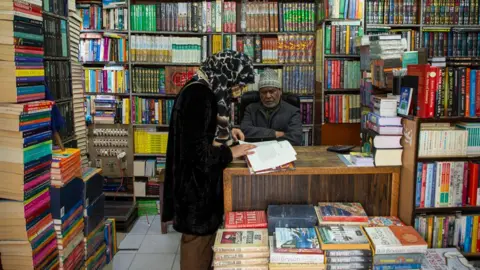
Srinagar: The authorities in Indian illegally occupied Jammu and Kashmir have withdrawn 4,249 books from circulation in colleges and libraries across the territory after declaring them “objectionable,” the Legislative Assembly has been informed.
3,996 books were withdrawn from institutions in the Kashmir division and 253 from the Jammu region, highlighting the much larger scale of the scrutiny in Kashmir.
The government told the Assembly that a total of 21,81,582 books and publications had so far been examined, including 12,48,641 in Kashmir and 9,32,941 in Jammu.


The figures do not include books that had already been formally banned. Separately, 518 copies of 19 titles prohibited under government order S.O. 203, issued on August 5, 2025, have also been removed from circulation.
The Higher Education Department said scrutiny of other material deemed objectionable was still under way and could take additional time because of the scale and nature of the exercise.
The government said “clear and objective” criteria had been adopted for identifying material requiring scrutiny in accordance with prescribed directions.
The large-scale removal of books from educational institutions comes amid continued scrutiny of academic and cultural spaces in IIOJK, where authorities have increasingly invoked official regulations in dealing with educational material and public institutions.
Kashmiri academics and historians have opposed the move, warning that the large-scale screening and withdrawal of books amounts to an assault on knowledge and academic freedom. They argue that students need access to diverse and competing perspectives to develop critical thinking and conduct objective research, rather than being exposed to a narrowly curated version of history and politics.
Critics have further cautioned that restricting literature on Kashmir risks turning educational institutions into instruments of ideological conditioning, with the removal of alternative narratives potentially serving the broader ideological agenda associated with the BJP and its ideological parent, the Rashtriya Swayamsevak Sangh (RSS).