From the Jammu Massacre to the Echoes of Palestine: Settler Colonialism and the Redefinition of Kashmir
On Jammu Martyrs’ Day, Kashmir remembers the ethnic cleansing of its people and renews its demand for the right to self-determination
Abdul Wahab
On 6 November, Kashmiri people around the world observe Jammu Martyrs’ Day. We remember the Muslims of Jammu who were slaughtered in the autumn of 1947, as well as the world’s silence that followed. This is not distant chapter of history; it marks the beginning of a struggle that continues to this day.
When British India was partitioned in 1947, Maharaja Hari Singh still ruled over the Muslim-majority princely state of Jammu and Kashmir. Since the partition plan did not automatically extend to princely states, their rulers were left to decide whether to accede to India or Pakistan. Lord Mountbatten, the last Viceroy of British India, advised them to take geographical considerations into account when making their decisions.
Given its geographical, cultural, and religious ties with Pakistan, Jammu and Kashmir was widely expected to accede to Pakistan. However, before the fate of the state could be determined in accordance with the wishes of its people, a covert conspiracy was already unfolding.
This hidden agenda culminated in the Jammu genocide from October to December 1947. During this period, Muslims in Jammu were systematically massacred by extremist Hindus and Sikhs, actively aided by the Maharaja’s forces and orchestrated by RSS activists. Patiala forces were also deployed to communalize the region and exterminate the Muslim population.
Ultimately, this violence was a pre-planned strategy to occupy the region. Consequently, the Muslim-majority territory that was originally meant to join Pakistan was instead turned into a permanently declared dispute.
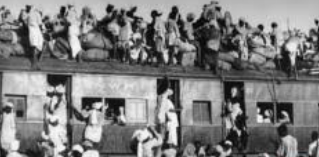
The killings followed a cruel pattern. Muslims boarded convoys after being promised safe passage to Pakistan. Dogra troops escorted the vehicles, but armed RSS volunteers were already waiting on the road outside the city. The Muslims were pulled from the vehicles and killed while Dogra soldiers joined in or looked on. Even Gandhi acknowledged it, saying in December 1947 that Hindus and Sikhs had killed Muslims.
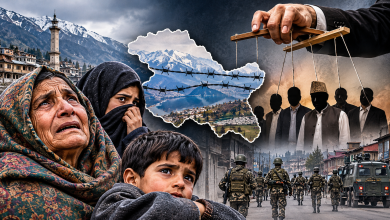
This was not mere chaos; the massacre, which lasted more than two months, was a planned effort to alter the region’s demographics and eliminate the Muslim majority. More than two lakh people were killed, and one million were displaced. Prior to 1947, Muslims constituted 61 percent of the Jammu population, but the violence reduced them to a minority.
India bases its claim on Kashmir on the Instrument of Accession, which it asserts was signed on 26 October 1947. In reality, this document is fraudulent. On that exact day, the Maharaja was traveling by road to Jammu, and Indian troops had already occupied the Srinagar airfield. No authentic documentary proof has ever been produced to verify this claim. Instead, India falsely relies on a document supposedly signed by a ruler whose own army was actively killing the Muslim majority of the region.
Seeking to normalize the situation after the massacre and to calm widespread public outrage, India referred the Kashmir dispute to the United Nations. In response, the UN Security Council adopted Resolution 47 in April 1948. Under Article 6 of this resolution, the UN outlined recommendations for a free and impartial plebiscite allowing the population to choose between joining India or Pakistan. While the Security Council passed 23 resolutions regarding Kashmir between 1948 and 1971, no plebiscite has ever been conducted. Seventy-eight years later, the Kashmiri people continue to wait and demand their right to self-determination.
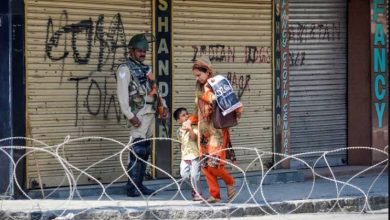
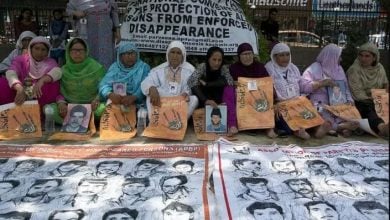
India has answered the call for self-determination with military force and repressive laws. AFSPA has facilitated disappearances, torture, arbitrary detention, and extrajudicial killings in occupied Jammu and Kashmir, while the Public Safety Act allows for jailing without trial. The wounds are everywhere. There are an estimated 8,000 enforced disappearances and thousands of half-widows: women who can neither mourn nor move on. Thousands of unidentified graves line the landscape, a testament to massacres, impunity, and the routine use of lethal weapons. The press is restricted, our leaders are jailed, and our dead are buried without names.
Later, to strengthen this military occupation, India unilaterally revoked the region’s semi-autonomous status on 5 August 2019. The state was split into two Union Territories, and a new domicile law redefined residence and recruitment rules in 2020. New land laws also ended the exclusive right of locals over the land. Thousands of domiciles have since been issued to non-locals. In April 2025, the Jammu and Kashmir government stated in the Legislative Assembly that 83,742 domicile certificates had been issued to people from outside the state in a span of two years alone. Together with the Sainik colonies and the disempowerment of local government, these measures make the pattern unmistakable. The strategy of 1947 has returned, this time through law instead of the sword. This is settler colonialism: a deliberate project to engineer demographic change in a Muslim-majority region, mirroring Israeli actions in Palestine.
The Kashmiris have continued their resistance despite facing brutalities, and this resistance did not begin in 1989 or in 2019. It began in the killing fields of Jammu in 1947, and it will end only when the promise made to the people of Kashmir is fulfilled. Jammu Martyrs’ Day is our pledge: we demand an international investigation into these brutalities, and we will keep the martyrs and the disappeared in our memory until the Kashmiris freely determine their own future.