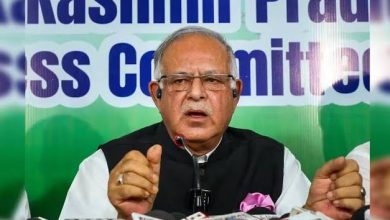
Tarigami decries harassment of Kashmiri youth in the name of police verification
Says arbitrary denial of security clearance violates fundamental and constitutional rights

Srinagar: In Indian illegally occupied Jammu and Kashmir (IIOJK), senior leader of the Communist Party of India (Marxist) [CPI-M] and member of the Legislative Assembly, Muhammad Yousuf Tarigami, has expressed serious concern over the harassment and humiliation of ordinary citizens and the violation of their fundamental and constitutional rights in the name of police verification in the territory.
Tarigami, in a media interview, said that although the High Court of IIOJK had, through several judgments, made it clear that no person could be denied security clearance solely on the basis of the alleged past or involvement in unlawful activities of their relatives, the occupied territory’s administration continued to disregard these judicial directives.
Referring to the High Court’s recent observations in a case involving a village headman (Numberdar), he said the court had also questioned how the principle of making one person suffer for another’s alleged actions could be applied. Tarigami regretted that educated and hardworking youth were being denied clearance for passports and government jobs because of the alleged past activities of distant relatives who had died decades ago, even before these young people were born.
Citing a case from his personal experience, he said a young Kashmiri man already employed in a government department had previously been denied clearance over allegations that one of his relatives was an overground worker (OGW). Although the matter was subsequently cleared, the same young man, after qualifying for the post of junior engineer through hard work, was again subjected to delays in verification on the basis of the same old allegation.


Taking the Indian government and the Lieutenant Governor’s administration in IIOJK to task, Tarigami said that since the police and the Home Department were directly under the control of the LG administration and India’s Ministry of Home Affairs, they had a constitutional responsibility to uphold the rule of law. He questioned how peace could be maintained if those entrusted with enforcing the law themselves violated the law and the Constitution.
He said the Indian government appeared unable to accept the public mandate given in the 2024 IIOJK Assembly elections, but whether the region had an elected Assembly or was under Governor’s Rule, the Constitution guaranteed fundamental rights to every citizen.
Commenting on official claims about peace in the Kashmir Valley, Tarigami said that before the 1990s, IIOJK had been among the most peaceful regions, where tourists travelled without fear, even to remote areas. He added that Kashmiris remained among those most desirous of peace, having suffered for decades under the shadow of guns and amid crossfire.
Tarigami warned that lasting peace could not be achieved through the LG-led administration’s authoritarian attitude and arbitrary actions. He said depriving young Kashmiris of educational opportunities and the chance to earn a livelihood abroad would only widen the gulf between the people and the administration, creating conditions that could be exploited by elements opposed to peace.
He urged the Indian government and agencies to immediately review the existing verification system and ensure lasting peace in the territory by winning public trust and treating people with dignity rather than resorting to force and coercion.