Call for International Monitoring of the Ground Situation in occupied Kashmir
By Raies Mir (HR activist)

 The people of Jammu and Kashmir have long pursued a peaceful struggle for their political rights and the right to self-determination — rights that are clearly enshrined in international law, including the United Nations Charter and multiple UN Security Council resolutions. Despite these legal assurances, the people of Indian-Occupied Jammu and Kashmir (IOJK) continue to suffer under an intensified and prolonged Indian military occupation.
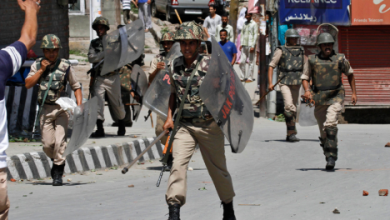
Indian forces personnel including army, paramilitary, police and agencies have been widely documented engaging in practices that violate fundamental human rights. These include arbitrary arrests and detentions under draconian laws, demolition of residential homes, curtailment of media freedom, and sweeping restrictions on civil liberties. The use of collective punishment — such as property attachments and mass demolitions — has created a pervasive climate of fear and repression throughout the region.
The resistance movement in Jammu and Kashmir is a direct response to decades of systemic oppression, widespread human rights abuses, and the international community’s continued indifference. Rather than addressing the legitimate demands of the Kashmiri people, the Indian government has attempted to equate these demands with terrorism — a false narrative aimed at justifying its repressive actions and delegitimizing Kashmiri aspirations.

India’s refusal to grant the people of Kashmir their right to self-determination under UN Security Council resolutions has led to immense suffering. Tens of thousands have been killed or injured, and countless others have faced grave violations, including the abuse of women and destruction of property. Following the unconstitutional and unilateral revocation of Article 370 and 35 A on August 5, 2019, Indian occupied Kashmir has increasingly resembled a prison under siege, with restrictions on movement, communication blackouts, and the silencing of dissent.
The UN General Assembly Resolution 37/43 (1982) reaffirms the legitimacy of peoples’ struggles against foreign occupation and colonial domination. It recognizes the right to resist by all available lawful means, including armed struggle. This resolution has been cited in various contexts, including the Palestinian cause, which was recently reaffirmed at the International Court of Justice (ICJ). On February 22, 2024, Chinese Foreign Ministry legal adviser Ma Xinmin stated before the ICJ that armed struggle under illegal occupation is distinct from terrorism, emphasizing that all parties must nonetheless comply with international humanitarian law.
In the case of Kashmir, the people have categorically rejected all forms of terrorism — including state-sponsored terror — and continue to seek their rights through democratic and peaceful means. However, Indian authorities, backed by elements of Hindu Hindutva groups, continue to conduct misinformation campaigns to mislead the international community and deflect attention from the human rights crisis in the disputed region.
The failure to investigate incidents such as the Pahalgam episode, and the destruction of homes on mere suspicion without judicial due process, exemplifies the culture of impunity that prevails under Indian administration. The lack of accountability and transparency highlights the urgent need for international oversight.
Appeal to the Global Community
The people of Jammu and Kashmir earnestly call upon:
• The United Nations
• The United States
• The European Union
• The Organization of Islamic Cooperation (OIC)
to urgently dispatch independent, impartial fact-finding missions to Indian-occupied Jammu and Kashmir. These missions are critical to:
• Document and verify ongoing human rights violations
• Assess the humanitarian situation on the ground
• Ensure accountability for violations of international law
• Reassert the right to self-determination for the people of Kashmir
The time for action is long overdue. Justice delayed must not become justice denied. The international community must uphold its moral and legal responsibility to protect vulnerable populations living under foreign occupation, and to support a peaceful and just resolution to the Kashmir conflict in accordance with international law.
This need to be understood that in current times that there are massive anti India sentiments existing on the ground of occupied Jammu and Kashmir.