Academic Freedom Shrinking in India as BJP-RSS Tighten Grip on Universities
Humayun Aziz Sandeela
India’s premier universities and professional institutes that were once considered the republic’s most independent and vibrant spaces of inquiry are being steadily transformed into ideological instruments. The resignation of Professor Ram Kumar Kakani, Director of the Indian Institute of Management (IIM) Raipur, in mid-2025, marks yet another chapter in the long erosion of institutional autonomy under NarendraModi government.
As The Indian Express reported on October 9, 2025, Kakani became the third IIM head in five years to quit after clashes with politically influenced boards. He cited “constriction of professional space” and the shrinking of institutional freedom. His exit followed a Chhattisgarh High Court ruling that disciplinary authority lay with the Board rather than the Director under the IIM Act 2017, effectively reducing directors to figureheads. The New Indian Express, on October 10, 2025, observed that the debate on IIM autonomy has “reached a breaking point.”


This pattern is not new. Former IIM Calcutta directors Anju Seth (2021) and Uttam Kumar Sarkar (2023) also resigned following board interference. Their departures, reported by The Wire and The Indian Express, illustrate how governance reforms once touted as “liberalisation” have, in practice, enabled greater central control through government-nominated boards.
The phenomenon extends beyond the IIMs. India’s standing in international assessments of academic freedom has dropped sharply in recent years. The Academic Freedom Index and Scholars at Risk’s 2024 Free to Think report describe India as a country where “academic freedom has deteriorated seriously since 2014.” (PIE News, March 2024). The reports note pressures on universities, from ideological monitoring of syllabi to political influence over faculty appointments.
The experience of Ashoka University — once held up as India’s liberal beacon — exemplifies the climate of fear. In August 2023, Assistant Professor Sabyasachi Das resigned after controversy over his working paper on the 2019 general election, which suggested statistical irregularities favoring the ruling party. Al Jazeera reported on August 28, 2023 that Ashoka distanced itself from the paper amid political backlash, prompting Das’s resignation. Soon after, economist PulapreBalakrishnan also resigned in protest, calling the university’s response a “grave error of judgement,” as noted by The Hindu on August 17, 2023. Two years earlier, in March 2021, political scientist PratapBhanu Mehta and economist Arvind Subramanian had left Ashoka, citing the administration’s inability to shield academic independence — a development covered by The Print and The Wire.
The chilling effect has reached beyond academia’s private enclaves. The International Studies Association (ISA) warned on April 10, 2024, that “academic freedom and institutional autonomy are being systematically eroded by political control and interference by the state and ruling parties,” urging vigilance against the politicisation of higher education governance.
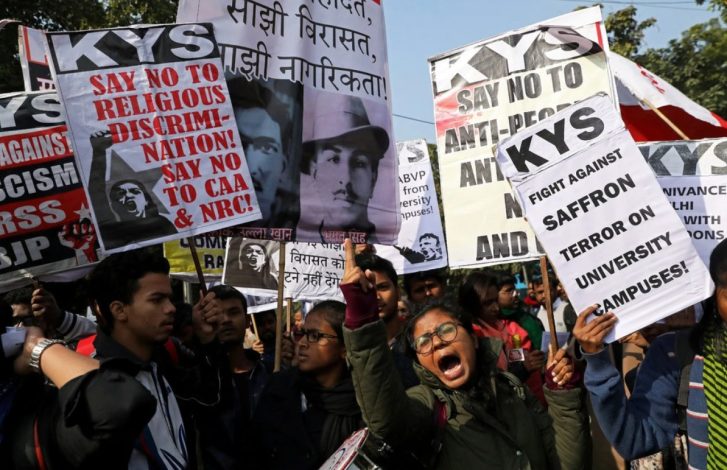
This politicisation is equally visible on India’s public-sector campuses. During the Citizenship Amendment Act (CAA) protests in December 2019, Delhi Police entered the JamiaMilliaIslamia campus, firing tear gas inside the library and beating students — acts documented by The Guardian and Al Jazeera (February 16, 2020). The Delhi High Court later criticised the use of force on students exercising their right to protest. Only weeks later, on January 5, 2020, masked attackers stormed Jawaharlal Nehru University (JNU), injuring students and faculty. Scroll.in (January 6, 2020) and Time magazine (January 8, 2020) reported widespread allegations of police inaction and links between the assailants and the student wing of the ruling party.
Earlier, the purge reached media education. In December 2018, senior journalist Amit Sengupta of the Indian Institute of Mass Communication (IIMC) was abruptly transferred to Dhenkanal, Odisha — a move widely viewed as punitive after he criticised government policies. The Caravan magazine’s January 2019 report titled “Amit Sengupta’s Removal from IIMC Shows Government’s Grip on Media Education” detailed the incident, quoting Sengupta’s resignation letter decrying “ideological policing within journalism education.”
The government’s defenders insist these are isolated incidents. Yet taken together — the resignations at IIMs and Ashoka, the violent crackdowns at Jamia and JNU, the coercive transfers at IIMC — they reveal a coordinated project of campus capture. The strategy is subtle but systemic: reshape boards, install compliant administrators, weaponise bureaucracy, and stigmatise dissent as disloyalty.
As independent journalist Abhisar Sharma argued in an interview with Newslaundry on October 9, 2025, the BJP and its ideological mentor, the RSS, are “tightening control over universities — from JNU and BHU to IITs and IIMs — eroding their independent character.” While the government’s media allies celebrate “academic excellence,” India’s finest institutions are being hollowed out from within.
The Boundary 2 Journal, in its June 26, 2025 essay “Hinduizing the University: Academic Unfreedom on the Indian Campus,” described how intellectual spaces are being “re-engineered to reward conformity and punish critical scholarship.” That transformation is not confined to curriculum or research but extends to the very ethos of learning — from inquiry to obedience, from debate to dogma.
The consequences are profound. Universities are where democratic conversation begins, where dissent matures into thought. If these spaces lose their autonomy, a nation forfeits its intellectual sovereignty. The Modi government’s tightening grip over India’s knowledge institutions may yield short-term ideological triumphs, but it is draining the lifeblood of democratic imagination.
A society that fears free minds will soon find itself ruled by obedient ones.