Dr Fai highlights Indian atrocities in occupied Jammu and Kashmir
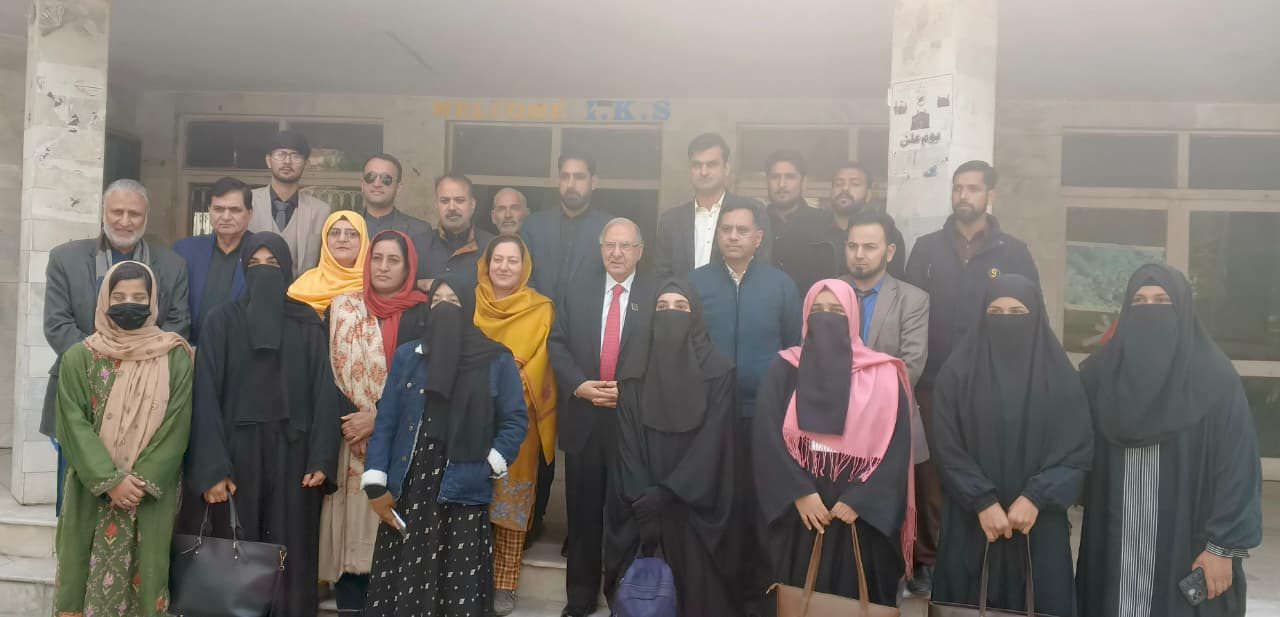
Muzaffarabad: The Chairman of World Forum for Peace, Dr Ghulam Nabi Fai, has highlighted Indian atrocities in occupied Jammu and Kashmir.
According to Kashmir Media Service, Dr Ghulam Nabi Fai addressing faculty and students at Institute of Kashmir Studies in University of Azad Jammu and Kashmir (UAJK), Muzaffarabad, said the people of the occupied territory have endured decades of economic exploitation, cultural erosion, educational degradation, and military occupation.
He warned that a new and alarming phase had emerged—systematic de-Islamization—which posed a serious threat to Kashmir’s religious and cultural identity. He lamented that Kashmiri language instruction had been banned in IIOJK schools while Hindi had been made compulsory.
Dr Fai said the Hindutva ideology poses a direct threat to Kashmiri culture and identity. “There is a deliberate attempt to erase Kashmir’s distinct cultural and religious heritage,” he said, adding educational institutions are under sustained assault.
Describing the current situation as a siege, Dr. Fai cited renowned genocide scholar Dr Gregory Stanton, who has warned that Kashmir is at the brink of genocide. He also referenced the Committee to Protect Journalists, which has declared that independent journalism in Kashmir is nearing extinction.
He highlighted the plight of Kashmiri leadership and civil society, noting that Yasin Malik has been sentenced to two life imprisonments, with calls by the Modi government for the death penalty. Veteran leader Shabbir Ahmad Shah has spent nearly four decades in prison, while Masarat Alam has been repeatedly detained under the draconian Public Safety Act (PSA) 35 times. He said human rights defender Khurram Parvez—recognized by TIME magazine as one of the world’s 100 most influential people—remains incarcerated.
In these circumstances, Dr. Fai stressed that the role of the Institute of Kashmir Studies at UAJK has become paramount and indispensable.
He welcomed the signing of a Memorandum of Understanding (MoU) between IKS and Tokyo University of Foreign Studies (TUFs), Japan. Under this agreement, both institutions will collaborate on joint research projects. Through video-conferencing facilities, IKS students will attend online lectures, and upon successful completion of programs, they will receive certificates from TUFS, Japan.
Dr Sumaira Shafiq, Director of the Institute of Kashmir Studies, outlined the objectives of IKS, stating that the institute is committed to ensuring quality teaching and research across various areas of Kashmir Studies in full compliance with Higher Education Commission (HEC) standards. She said the mission of IKS is to produce academically competent scholars capable of addressing contemporary societal challenges and contributing responsibly to society.
She further said IKS regularly organizes cultural programmes, workshops, conferences, public lectures, and academic events to promote understanding of the cultures and societies of Gilgit-Baltistan, occupied Kashmir, and Azad Jammu and Kashmir.
Professor Dr Saadat Hanif Dar, Registrar of UAJK, acknowledged the financial and social challenges faced by students, particularly due to rising living costs. He said despite financial constraints, the university remains committed to making quality higher education accessible by expanding scholarships, improving campus facilities, strengthening student support systems, and aligning academic programs with market needs.
Dr Waleed Rasool, academics and Kashmiri scholar and well-known expert on the subject said the Institute of Kashmir Studies has played—and will continue to play—a vital role in highlighting the plight of the Kashmiri people from a human rights perspective.
Sardar Zubair stressed the need to further strengthen IKS by developing proper office space and an auditorium. As a gesture of support, he donated Rs 100,000 as seed money for this purpose.
Sardar Zulfiqar and Nadim Khokhar also expressed appreciation for the hospitality and commitment shown by the faculty toward the visiting delegation.
Dr. Fai also met with Vice-Chancellor Prof. Dr Nasir Jamal Khattak at UAJK and described him as a highly accomplished educationist whose professionalism and social etiquette left a strong impression. Their meeting included discussions on academic collaboration, regional development, and the role of education in advancing awareness of the Kashmir issue.
The Institute of Kashmir Studies was established in 1986 as a research institute at the University of Azad Jammu and Kashmir, Muzaffarabad. Since its inception, it has worked consistently to enhance research and academic development in the field of Kashmir Studies.











One Comment